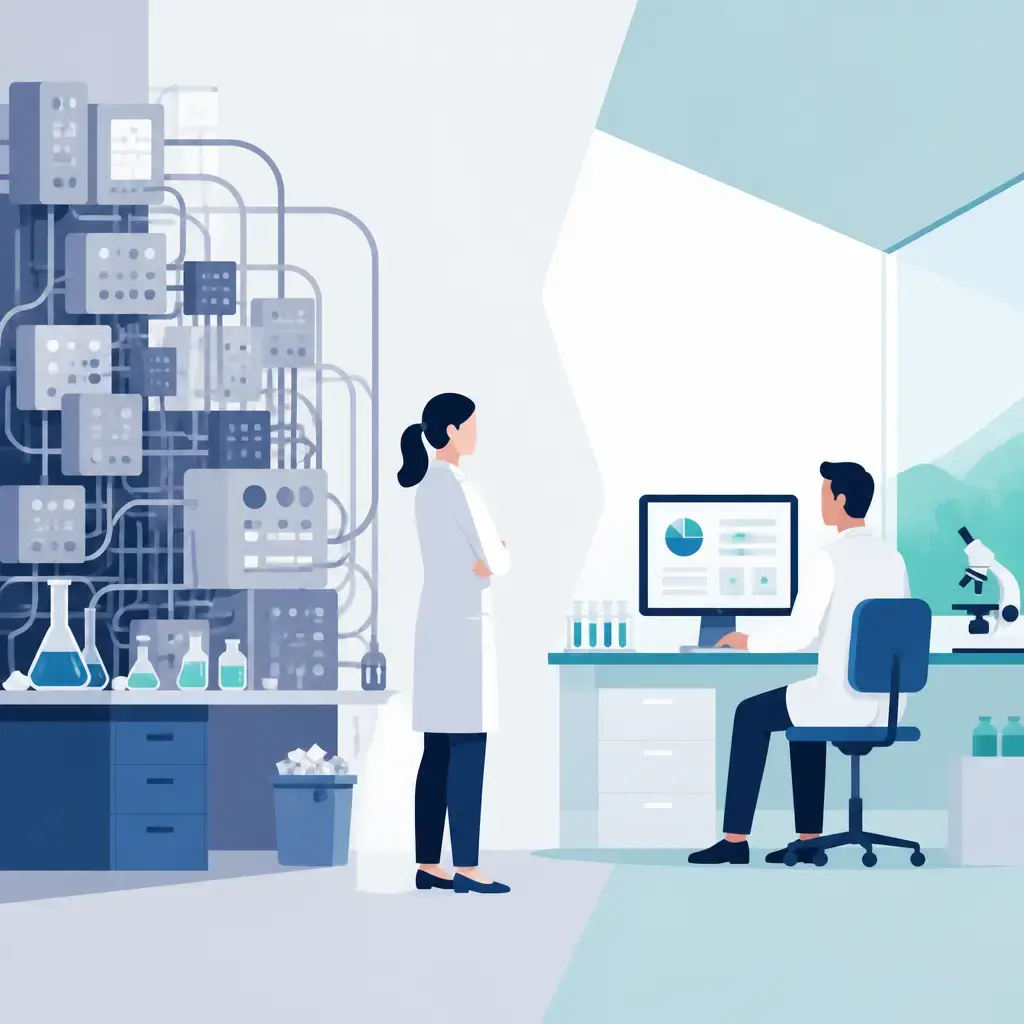
Off the shelf laboratory information management systems promise to do everything. In practice, many labs end up with a bloated platform full of modules they've never opened, a support contract they can't easily exit, and workflows that have been bent to fit the software rather than the other way round. Custom laboratory software takes a different approach: build exactly what the lab needs, nothing more, nothing less.
Key Takeaways
- Off-the-shelf LIMS platforms are often heavily over-specified, leaving labs paying for features they don't use.
- Custom laboratory software is built around your actual workflows, so there's no unnecessary complexity to work around.
- Bespoke systems integrate cleanly with the instruments, ERP platforms and reporting tools you already use.
- Custom builds give you full ownership: no per-seat licensing, no vendor lock-in, no forced upgrades.
- The right custom solution is typically faster to adopt, easier to train staff on, and simpler to adapt as the lab grows.
The Problem With Standard LIMS Platforms
A LIMS is, at its core, a piece of software designed to manage laboratory data: samples, test results, instrument readings, compliance records, client reports. That's a well-defined problem, and the basic concept is sound. The issue is that the major commercial platforms have been built to serve every type of laboratory in every regulated industry. Pharmaceutical, environmental, food and beverage, clinical, forensic, the same platform tries to cover all of them.
The result is software that is extraordinarily broad but rarely a perfect fit for any single lab. Features get added release after release. Menus multiply. Configuration screens nest several layers deep. Before long, the system your team logs into each morning contains hundreds of functions that have no bearing on what your lab actually does.
This bloat has real costs. Training takes longer because staff have to navigate a system that's far more complicated than their actual job requires. IT teams spend time managing and updating modules that are switched off. When something needs changing, a new test type, a revised reporting template, a connection to a new instrument, the answer from the vendor is often a consultancy engagement, a new module licence, or waiting for the next major release.
What Custom Laboratory Software Actually Looks Like
A bespoke laboratory system isn't a stripped-down LIMS. It's a purpose-built web application designed from the ground up around your lab's specific processes. That means it only contains what you need, structured the way your team already thinks about the work.
In practice, a custom system for a testing laboratory might include:
- Sample tracking, from intake through analysis to sign-off, with status visible at a glance
- Results capture, pulling data directly from instruments where possible, or structured manual entry forms where not
- Compliance records, audit trails, method versions, user authentication, all built into the workflow rather than bolted on
- Client reporting, automated report generation in the format your clients expect, delivered through a secure portal
- Inventory management, reagents, consumables, calibration due dates, flagged automatically
None of these features require a massive platform. They require clear thinking about what the lab actually does, and a development team that knows how to translate that into clean, reliable software.
Integration: Where Custom Software Has a Genuine Edge
One of the most commonly cited benefits of a full LIMS is its integration capability, connecting instruments, ERP systems, ELNs, CRM platforms and regulatory databases into a single ecosystem. That's a legitimate goal. Fragmented systems, where data lives in separate silos and staff re-enter the same numbers multiple times, genuinely do cause errors, slow things down, and create compliance headaches.
But here's the thing: integration is not unique to LIMS platforms. A well-built custom system can connect to exactly the same instruments and business systems. Modern APIs make it straightforward to link a bespoke lab application to an ERP system like SAP or Microsoft Dynamics, to pull readings from analytical instruments, or to push reports into a client portal. The difference is that with a custom build, you're only building the integrations you actually need, not configuring (or paying for) a sprawling integration framework designed to accommodate every lab on the planet.
For many laboratories, the critical integrations are actually quite specific: a handful of instruments, one ERP system, perhaps a billing platform. A bespoke system can connect those precisely, without the overhead of a generalised integration layer that needs constant maintenance.
Compliance Without the Complexity
Regulated laboratories, particularly those working under ISO 17025, GLP, or FDA 21 CFR Part 11 requirements, need software that supports audit trails, data integrity, user access controls, and full traceability. Standard LIMS platforms lean on these compliance requirements heavily in their marketing, implying that only a big, validated platform can meet them.
In reality, compliance requirements describe what a system must do, not which system must do it. A custom application can be built to maintain complete audit trails on every action. User roles and permissions can be designed specifically around your team structure. Data validation rules can be written to match your exact methods and reporting standards. Because the system is built for your lab rather than every lab, it's often easier to demonstrate compliance to an auditor, there's no need to explain why certain features are present but disabled, or to maintain validation documentation for modules you don't use.
That said, compliance validation for custom software does require careful documentation during development. This is something to discuss explicitly with any development partner before work begins, and it's one area where having an experienced team matters.
Real Time Visibility Without the Overhead
One genuine strength of modern LIMS platforms is their dashboarding and reporting capability. Managers want visibility across the lab: workload, turnaround times, quality trends, instrument utilisation. That's a reasonable ask.
A custom system can deliver exactly the same visibility, scoped to the metrics that actually matter to your operation. Instead of configuring a generic reporting engine to approximate what you want, the dashboard is built to show the numbers your managers look at every day. When those needs change, a new KPI, a different way of grouping samples, a report for a new client type, the system can be updated without waiting for a vendor's development roadmap.
The Ownership Argument
With a commercial LIMS, you're licensing software. The vendor controls the roadmap, the pricing, the upgrade schedule, and ultimately whether the product continues to exist. Consolidation in the laboratory software market means that platforms get acquired, rebranded, sunset, or folded into larger suites with new pricing structures. Labs that have built their entire operation around a particular platform can find themselves in a difficult position.
With custom software, you own the codebase. There are no per-seat licences that scale uncomfortably as you hire. There's no vendor deciding to discontinue the version you're running. If your development partner builds the software on well-documented, open standards, which any reputable agency should, you're not locked in to a single supplier for future work either.
The upfront investment in a custom build is real, and it's worth being honest about that. But when you factor in annual licence fees, consultancy charges for customisation, training costs driven by unnecessary complexity, and the cost of working around a system that doesn't quite fit, the economics often look different over a three to five year horizon.
When Does Custom Make the Most Sense?
Custom laboratory software isn't the right answer for every situation. If you're a very small lab just starting out, a simpler off-the-shelf tool might get you moving quickly. But custom development tends to be the stronger choice when:
- Your existing LIMS has significant functionality you pay for but never use
- Your team spends time working around the software rather than with it
- You've accumulated workarounds, spreadsheets or parallel processes to fill gaps the LIMS doesn't handle well
- Vendor customisation quotes are expensive and slow to deliver
- You want to own and control your own data infrastructure long-term
These are exactly the situations we see regularly at IceBoxDesigns when talking to laboratories. A system that started as the right tool can become a constraint as the lab grows or as its work evolves.
What a Custom Build Project Actually Involves
The starting point is always a detailed conversation about how the lab operates today: what data is captured, where it goes, who needs to see it, and where the current system creates friction. From that, a development team can map out the features that genuinely need building and the integrations that matter.
A phased approach usually works well for laboratories. Start with the core sample management and results workflow, get that stable and adopted, then add integrations, reporting and client-facing features incrementally. This keeps the project manageable and means staff aren't handed a completely unfamiliar system all at once.
Throughout development, validation documentation, covering what the system does, how it was tested, and how changes are managed, should be produced as a matter of course, not retrofitted at the end.
If you're working with a lab that's outgrown its current platform, or you're evaluating options for a new operation and want to understand what a bespoke system would look like, our custom software development team works with organisations across a range of sectors to build exactly this kind of focused, purpose-built tooling.
The Practical Bottom Line
Laboratories don't need software that can serve every possible use case. They need software that handles their use case well, integrates with the systems they actually use, and can be adapted as requirements change, without an expensive engagement with a vendor every time.
Custom laboratory software delivers that. It removes the bloat, reduces training overhead, makes compliance straightforward, and puts the lab in control of its own infrastructure. For many laboratories that have been living with a feature-heavy platform they only partially use, the switch to a bespoke system is one of the more significant operational improvements they make.
If your lab is carrying software that's doing more work than it needs to, or not quite enough of the right work, get in touch with IceBoxDesigns and let's talk through what a purpose-built solution would look like for you.
Frequently asked questions
Is custom laboratory software suitable for regulated labs that need to meet ISO 17025 or GLP requirements?
Yes. Compliance requirements define what a system must do, audit trails, data integrity, access controls, traceability, not which platform must do it. A custom system can be built to meet these requirements, provided the development process includes proper validation documentation. Discuss compliance needs with your development partner before the project begins.
How long does it take to build a custom laboratory system?
It depends on the scope, but a phased approach is common: a core sample tracking and results workflow can typically be delivered and adopted before adding integrations and reporting features. This keeps the project manageable and avoids handing staff a completely unfamiliar system all at once.
Can custom lab software integrate with existing instruments and ERP systems?
Yes. Modern APIs make it straightforward to connect a bespoke system to analytical instruments, ERP platforms (such as SAP or Microsoft Dynamics), billing systems and client portals. With a custom build, you only develop the integrations you actually need rather than maintaining a broad integration framework.
Is custom software more expensive than a commercial LIMS?
The upfront investment is real, but commercial LIMS platforms carry ongoing licence fees, consultancy charges for customisation, and training costs driven by unnecessary complexity. Over a three to five year horizon, a custom build often compares favourably, particularly once you factor in the cost of working around software that doesn't quite fit your operation.
Related articles
- Software Development
eCoCs Explained: What the UK's Electronic Certificate of Conformity Means for Vehicle Manufacturers
10 September 2026 - Software Development

MVP to Scalable Product: How to Scope It Right and Know When to Scale
20 August 2026 - Software Development
Why ERP Integration, Not AI Tools, Is the Real Starting Point for Manufacturers
6 July 2026
Related services
Need a hand with this? Here's how IceBoxDesigns can help.