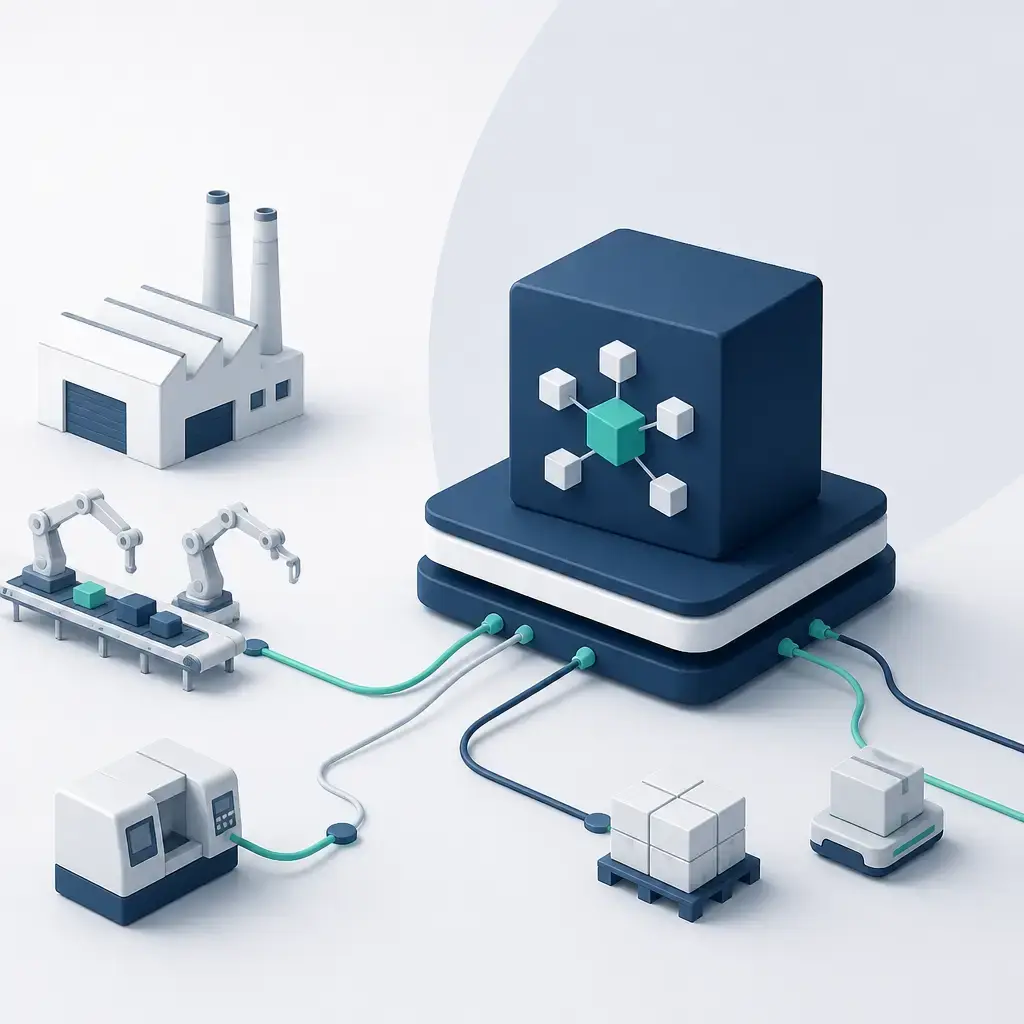
If you run a manufacturing business and you're feeling the pressure to "do something with AI", here's the uncomfortable truth: the tool isn't your problem. Your data is. New research from the 2025 Supply Chain Agility Index found that 40.9% of manufacturers say integration is their single biggest AI challenge. Not budget. Not the technology itself. The fact that their core systems don't talk to each other.
That sounds like bad news. It isn't, really. It means the thing holding most manufacturers back is fixable, and it's the same thing that gives you a head start over competitors still chasing shiny algorithms. Whatever ERP you're running, sorting out your integration is the highest-leverage move you can make before you spend a penny on AI.
Key takeaways
- 40.9% of manufacturers name integration, not budget or technology, as their biggest barrier to AI (2025 Supply Chain Agility Index).
- AI is only as good as the data feeding it. Disconnected systems mean conflicting answers, and conflicting answers mean bad decisions.
- Connecting your ERP to your CRM, EDI, warehouse and BI tools creates one reliable source of truth.
- Buying an AI tool before you've fixed your data usually just creates another silo and wastes the investment.
- A typical integration project runs roughly 8 to 16 weeks depending on how many systems you're connecting.
Why integration is the foundation AI actually needs
ERP integration is simple to describe and harder to do well. It's the work of connecting your ERP to every other piece of business-critical software you run, so they share one clean, current picture of your operations.
Here's why that matters for AI. Machine learning models are only as good as the data they learn from. Feed them a clean, real-time stream and they can spot patterns a human team would miss. Feed them stale spreadsheets and contradictory exports, and you get confident-sounding nonsense. Any AI project built on disconnected data is built on sand.
Most manufacturers don't run one system. They run a tangle of them. Your ERP sits at the centre, but around it you've got a CRM, EDI platforms for trading with partners, and warehouse management software keeping track of stock. When each of those holds its own version of the truth, asking a question about inventory or sales gets you five different answers. A proper ERP API integration means you get one answer, and you can trust it.
That single-source-of-truth idea isn't just about back-office systems either. The same logic applies to anything customer-facing. Connect your ERP to your website and buyers see live stock and accurate pricing instead of placing orders you can't fulfil.
What disconnected data is actually costing you
The cost of leaving systems disconnected doesn't show up as a single line on a balance sheet. It hides in the day-to-day grind, and it adds up fast. These are the problems we see again and again with manufacturing data silos.
Manual exports and spreadsheets. Your team burns hundreds of hours pulling CSVs out of one system and stitching them together in fragile spreadsheets that are out of date the moment they're saved. The effort is real and the output is unreliable.
Duplicate data entry. When systems don't talk, people become the integration layer. You pay staff to re-key orders, customer details and stock figures from one screen into another. Every keystroke is a chance to introduce an error, and those errors get expensive when they reach a shipping label or an invoice.
Delayed decisions. Leadership ends up steering the business on last week's or last month's numbers. By the time a report lands, the moment to act on it has often passed. You miss opportunities and you don't spot risks until they've already cost you.
An inability to scale. This is the quiet killer. With disconnected systems, every new order, supplier or product line adds more manual work, not less. The complexity grows faster than the business does, and eventually it caps your growth. You hit a ceiling that has nothing to do with demand and everything to do with admin.
If any of that sounds familiar, you're not alone, and you're not stuck. The pattern is the same one that pushes a lot of growing businesses to move beyond fragile spreadsheets and into proper connected systems. We've written more on that shift in our piece on custom software for small businesses when spreadsheets start holding you back.
Disconnected vs integrated: the real difference
The gap between disconnected operations and a fully integrated ERP ecosystem isn't a small tweak. It changes how the whole business runs, from reactive firefighting to genuine forward planning. Here's how the two stack up.
| Metric | Disconnected operations (the old way) | Integrated ERP ecosystem (the new way) |
|---|---|---|
| Decision speed | Days or weeks, based on manual reports | Real-time, based on live dashboards |
| Data accuracy | Low, prone to human error | High, automated single source of truth |
| Inventory costs | High, overstocking from poor forecasting | Optimised, reduced carrying costs |
| AI readiness | Non-existent, no reliable data foundation | High, clean structured data for AI/ML |
Look at that bottom row. AI readiness goes from non-existent to high purely on the back of integration. You don't buy your way there with a clever tool. You build it by getting your data in order first.
Real time visibility, and what it lets you do
When your ERP data is live and trustworthy, your teams stop guessing. Better supply chain visibility means you can act with certainty instead of hedging. In practice that looks like:
- Forecasting demand far more accurately, because you're working from current numbers rather than a stale snapshot.
- Responding instantly to tariff changes or supplier disruptions, instead of finding out weeks later when a shipment doesn't arrive.
- Modelling supply chain interruptions before they hit, so you can find the best path forward rather than scrambling.
- Cutting excess inventory carrying costs, because you're not overstocking to cover for poor visibility.
For UK manufacturers in particular, that ability to react quickly to supply and trade disruption isn't a nice-to-have. Costs of holding too much stock, and the risk of running out at the wrong moment, both bite hard. Real-time visibility is what lets you walk that line without padding your warehouse just in case.
What an AI ready platform actually involves
The manufacturers genuinely leading on AI aren't the ones with the biggest software budgets. They're the ones who invested in the data infrastructure that makes AI work in the first place.
A proper manufacturing ERP integration connects your ERP to the systems around it: your CRM, EDI, vendor portals and BI platforms. Once those are wired together with clean, structured, two-way data flow, AI has something solid to stand on. The 2025 Supply Chain Agility Index backs this up, which is the same research that flagged integration as the number one AI barrier.
The order of operations matters here. Data infrastructure first, AI second. Get that backwards and you'll spend money on tools that can't deliver because they've got nothing reliable to learn from.
How a proper integration project should run
Good integration work follows a clear, staged process. It isn't a single bulk job where you flip a switch and hope. A solid four-step approach looks like this.
- Strategic discovery. Map the entire operational workflow first, from sales and inventory through to shipping and finance. The point is to find the highest-impact places to connect, not to wire everything together for the sake of it.
- Custom API development. Build robust, scalable API integrations that link the ERP to whatever you actually use, whether that's a mainstream CRM or a custom-built portal.
- Data synchronisation and validation. Set up reliable two-way data flow and put rigorous validation rules in place, so data integrity holds across the whole ecosystem rather than drifting out of sync over time.
- Go-live and support. Manage the deployment so there's no operational disruption, then provide ongoing support to keep the integrated system running well.
That same rigour applies to e-commerce platforms too, where an ERP needs to feed live stock and pricing into the storefront. The principle is identical: connect carefully, validate properly, then keep it healthy.
This is squarely the kind of work we do at IceBoxDesigns. Bespoke integrations, APIs and connecting systems that were never designed to talk to each other sit right at the heart of our custom software development. The technology under the bonnet differs from one business to the next, but the discipline of mapping the workflow first and validating the data before go-live doesn't change.
The mistake that sinks most manufacturing AI projects
A lot of manufacturers chase the promise of AI without building the foundation underneath it. It almost always ends the same way: a failed project, wasted budget and a sour taste that puts the business off trying again. Real AI readiness starts with data, not algorithms. Here are the three mistakes that cause it.
Mistake one: focusing on the algorithm, not the data. A sophisticated AI forecasting tool is useless if you feed it inaccurate, delayed data from disconnected spreadsheets. The cleverest model in the world can't fix bad inputs.
Mistake two: underestimating the cost of bad data. AI models trained on flawed data produce flawed outputs. Those outputs drive strategic decisions, and poor strategic decisions in manufacturing can cost millions. The data quality problem isn't an IT footnote. It's a business risk.
Mistake three: creating more silos. Bolting on a standalone AI platform without integrating it into your core ERP just creates another disconnected system. Now you've got the original problem plus a new one. You've made the mess worse and called it progress.
The common thread is obvious once you see it. Every one of these failures comes from skipping the integration step and jumping straight to the tool. Don't.
Where to start if your systems don't talk to each other
If you recognise your own business in any of this, the first move isn't to shortlist AI vendors. It's to take an honest look at how your data flows today. Which systems hold which information? Where are people re-keying things by hand? Where do you wait days for a report that should be instant?
Those questions point straight at the integration points worth fixing first. You don't have to connect everything on day one. You start with the connections that remove the most manual work and unlock the most reliable data, then build out from there. Integration is best treated as an ongoing strategy rather than a one-off project, because as your business adopts new tools, the layer connecting them needs to evolve too.
For manufacturers especially, the payoff isn't abstract. It's fewer wasted hours, fewer costly errors, faster decisions and, eventually, a data foundation clean enough that AI can actually do something useful with it. That's the order that works. Sort the plumbing, then turn on the cleverness.
If you'd like help mapping where your systems are leaking time and connecting your ERP to the rest of your stack, that's exactly the kind of integration work our custom software development team handles. Get the data backbone right first, and everything you want to do with AI afterwards gets a great deal easier.
Frequently asked questions
What's the typical timeline for an ERP integration project?
A typical project ranges from roughly 8 to 16 weeks, depending on how complex the work is and how many systems you're connecting. You should expect a detailed project plan with clear milestones after the initial discovery phase, rather than a vague open-ended commitment.
How does ERP integration improve supply chain visibility?
By connecting your ERP with supplier portals, EDI systems and logistics software, you get a single real-time view of your whole supply chain. That lets you track materials, anticipate delays and respond to disruptions as they happen rather than weeks later.
Can you integrate an ERP with custom-built software?
Yes. Custom API development can build secure, reliable connections between your ERP and any proprietary or bespoke software your business relies on, including front-end websites that need to show live stock or pricing.
Is ERP integration a one-time project or an ongoing process?
The initial build is a defined project, but the most successful companies treat integration as an ongoing strategy. As you adopt new tools and processes, the layer connecting your systems needs to evolve, so it's worth having support in place to manage that growth.
Related articles
- Software Development
eCoCs Explained: What the UK's Electronic Certificate of Conformity Means for Vehicle Manufacturers
10 September 2026 - Software Development
MVP to Scalable Product: How to Scope It Right and Know When to Scale
20 August 2026 - Performance

Why Your Web App Is Slow on Mobile (and How to Fix It)
2 July 2026
Related services
Need a hand with this? Here's how IceBoxDesigns can help.