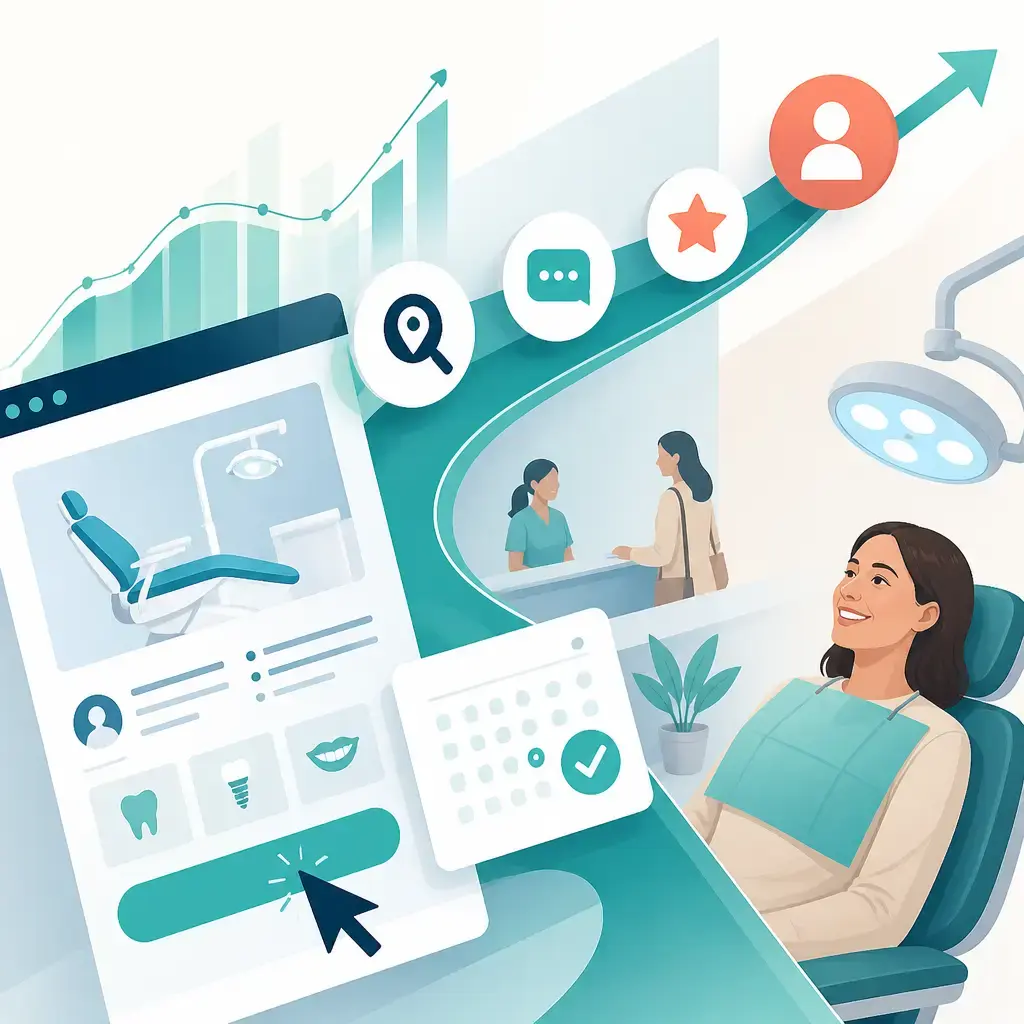
Most dental practices don't have a traffic problem. They have a conversion problem. People are finding the website, reading a bit, then drifting off without booking. If you want to increase dental patients without doubling your ad spend, the fastest wins usually sit in two places: making it stupidly easy to book, and following up with the people who almost booked but didn't.
This guide pulls together what actually moves the needle for a dental practice, with a bias towards the practical and the slightly unusual. Some of it is about your website. Some of it is about what happens in the 30 seconds after someone calls and gets your voicemail. All of it is designed to fill chairs.
Key takeaways
- Dental websites typically convert between 2% and 5% of visitors, so small improvements to your booking flow can hand you 20 to 50 inquiries from the same 1,000 visitors a month.
- A well-optimised dental website can lift your conversion rate by 30% or more, and websites built for conversion increase bookings by 29%.
- Following up with leads automatically can raise conversion rates by 47%, and an automated missed-call text matters because 85% of texts are read within 5 minutes.
- Over 60% of patients search for a dentist on a mobile, so a fast, tap-friendly site that loads in under 3 seconds is non-negotiable.
- The top three Google Map Pack positions take 70% of clicks, so local search is where the ready-to-book patients are.
Start with the maths, because it's on your side
Here's the bit most practices skip. You don't need more visitors to grow. You need a bigger slice of the visitors you already have.
Conversion rate for dental websites usually sits between 2% and 5%. The top-performing practices do better, but let's use that range. If 1,000 people visit your site every month at 2%, you get 20 new patient inquiries. Push that to 5% and you get 50 inquiries from exactly the same traffic. Same ad budget. Same SEO. Same everything. Two and a half times the inquiries.
That's why conversion work is the cheapest growth lever you have. When your conversion rate improves, your marketing spend works harder, your cost per new patient drops, and the whole thing starts to compound. More bookings lead to more reviews, more reviews lead to more trust, more trust leads to more bookings. You're not buying growth, you're earning it from traffic you've already paid for.
If you take one idea from this whole article, make it this: before you spend another penny driving people to your site, fix what happens when they arrive.
The booking flow is where money leaks out
The single most important thing on your website is the appointment booking system. If a patient finds it awkward, they'll go to the practice down the road. That's not laziness, it's friction, and friction kills bookings.
Keep the form short and honest
Long forms scare people off. Limit your booking form to 5 to 7 essential fields: name, contact details, preferred date and time, and reason for visit. That's it. You can gather the rest at the practice.
A few details that genuinely help:
- Show a clear privacy line so people know where their data goes.
- Let patients pick from real available time slots rather than "we'll call you back".
- Confirm the booking by both text and email straight away.
And put the booking option on every page. Not just the contact page. Someone reading your implants page should be able to book from that page, in that moment, without hunting for a menu.
One last thing that sounds obvious but trips up loads of practices: test your form regularly. Nothing burns a new patient faster than filling in their details, hitting submit, and getting an error. If the form's broken, you're paying to send people to a dead end.
Treat mobile as the main event, not the afterthought
Over 60% of patients look for a healthcare provider on their phone. So your site isn't really a desktop site with a mobile version. It's a mobile site that also works on desktop.
A quick checklist worth holding your website against:
- Responsive design that adapts to every screen size.
- Touch-friendly buttons, at least 44x44 pixels, so people aren't fat-fingering tiny links.
- Forms that auto-fill from phone data where they can.
- Click-to-call, so a tap on your number dials it.
- Loading speeds under 3 seconds.
That last point matters more than people think. A slow site on a patchy mobile connection loses visitors before they've even seen your offer. If your pages are sluggish, that's worth fixing properly, and an ongoing website maintenance plan keeps speed, security and uptime sorted so the site that's bringing you patients doesn't quietly fall over.
Write calls to action like a human, not a button factory
Every page needs at least one obvious call to action, and "Submit" or "Click Here" isn't it. Use language that speaks to what the patient actually wants:
- "Book Your Cleaning Today"
- "Get Relief From Tooth Pain"
- "Schedule Your Free Consultation"
- "Book Your Same-Day Emergency Visit"
Give the button a colour that stands out from the rest of the page, and put it where people are already deciding: the top of the page, and the end of each service description. Some practices find that pairing a small incentive with the CTA, like "Book Now for 15% Off First Visit", lifts conversions noticeably. Worth testing.
Speaking of testing: don't guess your way through this. Try different wording and placements and watch what books more appointments. If you want a deeper look at the whole approach, our piece on conversion rate optimisation breaks it down without the jargon.
Trust is the thing standing between a visitor and a booking
People don't book a dentist they don't trust. They've never met you, they're nervous about cost and pain, and they're handing you their face. Your job online is to dissolve that hesitation before they reach the booking form.
Reviews do more heavy lifting than any clever copy
More than 86% of patients read online reviews before choosing a dentist. So reviews aren't a nice-to-have, they're the proof that makes everything else believable.
Don't just dump them on a testimonials page (though have one of those too). Scatter genuine reviews across the site, especially next to the points where people make decisions: service pages, pricing, the booking form itself. A five-star quote sitting right above the "Book Now" button does real work.
A mix of formats helps different people:
- Short video testimonials, 30 to 60 seconds, feel the most authentic.
- Written quotes with a patient photo and a real procedure mentioned.
- Star ratings for different parts of the experience.
- Third-party verification badges from review platforms.
There's also a credibility threshold worth aiming for. Getting past the 100+ review mark signals to a wary patient that lots of people have already trusted you and lived to smile about it. Automating your review requests, where a patient gets a gentle text after their visit asking for a review, is the only realistic way most practices hit that number consistently without nagging by hand.
The slightly counter intuitive bit about replying to reviews
Responding to every review, good and bad, builds trust with the people reading them later. Here's the surprising part: evidence shows patients actually prefer AI-generated review responses over human ones by 58%, because they tend to be more structured and informative.
That doesn't mean fire your front desk and let a bot run your reputation. It means a well-set-up automation can keep every review answered promptly and professionally, which is more than most busy practices manage on their own. If automating the repetitive admin around reviews and follow-ups appeals, that's exactly the kind of thing AI business automation is built for, freeing your team to focus on the patients in front of them.
The leads you're losing right now, today
This is where most practices are quietly bleeding patients, and it's the most fixable problem of the lot.
Rescue the missed call
When someone rings your practice and hits voicemail, or hangs up before leaving a message, you've usually lost them. They ring the next dentist on the list.
An automated missed-call-to-text fixes this. The moment a call goes unanswered, a text fires off: thanks for calling, here's a link to book straight away. The numbers explain why it works. 85% of texts are read within 5 minutes, and 78% of patients prefer text over leaving a voicemail. You're meeting people where they already are, in the few minutes when they still want to book.
Think about how many calls your front desk genuinely can't get to during a busy clinic. Lunchtime. The school-run rush. Evenings after you've closed. Each one is a patient who was ready to book. Catching even half of them is found money.
Follow up with the people who didn't book first time
Plenty of prospective patients interact with your practice or your content and then don't book on the spot. That's normal. They get distracted, they want to think about it, life happens.
A structured nurture campaign brings them back. When someone fails to book, they go into an automated sequence of texts spaced out over time, keeping you top of mind and pointing them back to the booking page. Offices that follow up with leads automatically increase conversion rates by 47%. Nearly half as many again, just from not letting warm leads go cold.
Fix the phone call itself
The first phone call with a prospective patient is make-or-break. A patient who calls is already further down the path than a website visitor, and how that call is handled decides whether they book.
AI-powered call grading analyses these calls to spot patterns and weak points, and AI-driven call coaching helps your front desk team improve. Research shows AI-driven call coaching boosts conversion rates by over 52%. The point isn't to replace your team, it's to show them, with real data, what a winning new-patient call sounds like so they can do more of it.
Getting found by the patients who are ready to book
All the conversion work in the world does nothing if nobody arrives. So you still need to show up where patients are searching, and the patients searching "dentist near me" at 9pm with toothache are the ones most likely to book today.
Win local search
Local search is where ready-to-book patients live. Practices ranking in the top three Google Map Pack positions get 70% of all clicks, and the number one organic result captures 33% of clicks. If you're not up there, you're invisible to a big chunk of your local demand.
The groundwork: keep your Google Business Profile accurate and active, with correct hours, contact details and services, and build up those local listings. If you've not set this up properly yet, our guide to your Google Business Profile walks through why it matters for a local practice and how to get it right.
Use paid search for the high intent stuff
Organic rankings take time to build. PPC gets you to the top of the results immediately for high-intent searches like "emergency dentist near me". 65% of high-intent searches result in an ad click, so running tight campaigns on your highest-value services, dental implants, emergency care, cosmetic work, puts you in front of patients who are ready to act.
Start small. Test a couple of platforms, watch your return, and pour budget into what's working rather than spraying it everywhere. If you want this done properly rather than burning money on broad keywords, Google and Meta ad management is about getting the right patients, not just clicks. We've also written specifically about Google Ads for dentists and how to win the right patients without torching your budget.
Make social ads actually convert
Social media isn't just posting and hoping. Boosted posts and website-traffic ads let you amplify reach and target the right local audience. Social ads paired with website-traffic campaigns produce a 3X increase in conversion rates compared to organic effort alone. The key is sending that traffic to a page built to convert, which loops right back to the booking flow we started with.
The out the box plays worth trying
Most practices do the obvious stuff. Here are a few that genuinely set you apart.
Direct mail, still. It sounds old-fashioned, but Every Door Direct Mail campaigns are still effective, particularly in higher-income neighbourhoods. Pick your mail routes carefully, send a new-patient special, and you're reaching households your competitors have written off as a dead channel. It works best when the offer points somewhere frictionless, like a simple online booking page.
Same-day and extended hours. Leaving room for same-day and emergency appointments makes you the obvious choice for anyone in pain right now. And adding a few evening or weekend slots picks up the patients who simply can't make it during office hours. Both are small operational tweaks that signal you respect people's time, which builds loyalty as well as bookings.
Live chat that answers fast. Real-time communication tools let a hesitating visitor get an instant answer to the question holding them back, whether you take their insurance, what an implant costs, whether you do nervous patients. Answer it in the moment and they book. Leave it unanswered and they go looking elsewhere.
Target the patients worth targeting. Not every new patient is equal. If you're focused on cosmetic work, aim your marketing at adults in higher-income areas. If you're family or paediatric-focused, speak to parents. Tailoring the message to the right people attracts patients who are more likely to stay and accept treatment, rather than filling the diary with one-off cleanings.
A simple order to tackle this in
Don't try to do all of it at once. Here's a sensible sequence:
- Fix the booking form and mobile experience first. This is the leak. Short form, on every page, fast on mobile, working confirmations.
- Sharpen your calls to action and add proof. Action-led CTAs, reviews near decision points, a credible testimonials page.
- Plug the lead leaks. Missed-call-to-text and an automated nurture sequence so warm leads stop slipping away.
- Tighten local search. Get your Google Business Profile and listings spot on so you climb the Map Pack.
- Layer in paid search and social for the high-intent, high-value patients once the foundations convert.
- Measure everything. Track where new patients come from, your conversion rate, and which channels pay off, then double down on the winners. You can't improve what you don't measure.
Where IceBoxDesigns fits in
The pattern across all of this is the same. You're sitting on traffic and leads that aren't converting, and the fixes are mostly about removing friction and following up properly. A faster, mobile-first site with a clean booking flow handles the first part. Smart automation around missed calls, reviews and follow-ups handles the second.
If your dental website is getting visitors but not enough bookings, that's a fixable problem, and usually a quicker one than you'd expect. Get in touch about paid advertising and conversion-led growth and we'll help you turn the patients you're already attracting into patients in the chair.
Frequently asked questions
What is a good conversion rate for a dental website?
Dental websites typically convert between 2% and 5% of visitors into actions like booking an appointment, calling, or filling out a form. Top-performing practices do better. The simple maths: at 2%, 1,000 monthly visitors gives you 20 inquiries; at 5%, the same traffic gives you 50.
What's the single biggest thing I can change to get more bookings?
Your booking flow. Keep the form to 5 to 7 essential fields, put it on every page, make sure it loads fast on mobile (under 3 seconds), and confirm bookings by text and email. A well-optimised dental website can lift conversions by 30% or more, and conversion-built websites increase bookings by 29%.
How do I stop losing patients who call when the phone isn't answered?
Set up an automated missed-call-to-text. When a call goes to voicemail or gets abandoned, an instant text thanks them and links them straight to your booking page. It works because 85% of texts are read within 5 minutes and 78% of patients prefer text over voicemail.
Is it worth replying to online reviews, and can that be automated?
Yes. More than 86% of patients read reviews before choosing a dentist, and replying to them builds trust with future readers. Interestingly, patients prefer AI-generated review responses over human ones by 58%, because they tend to be more structured. Automating review requests and responses is the realistic way to keep on top of it.
Related articles

Related services
Need a hand with this? Here's how IceBoxDesigns can help.