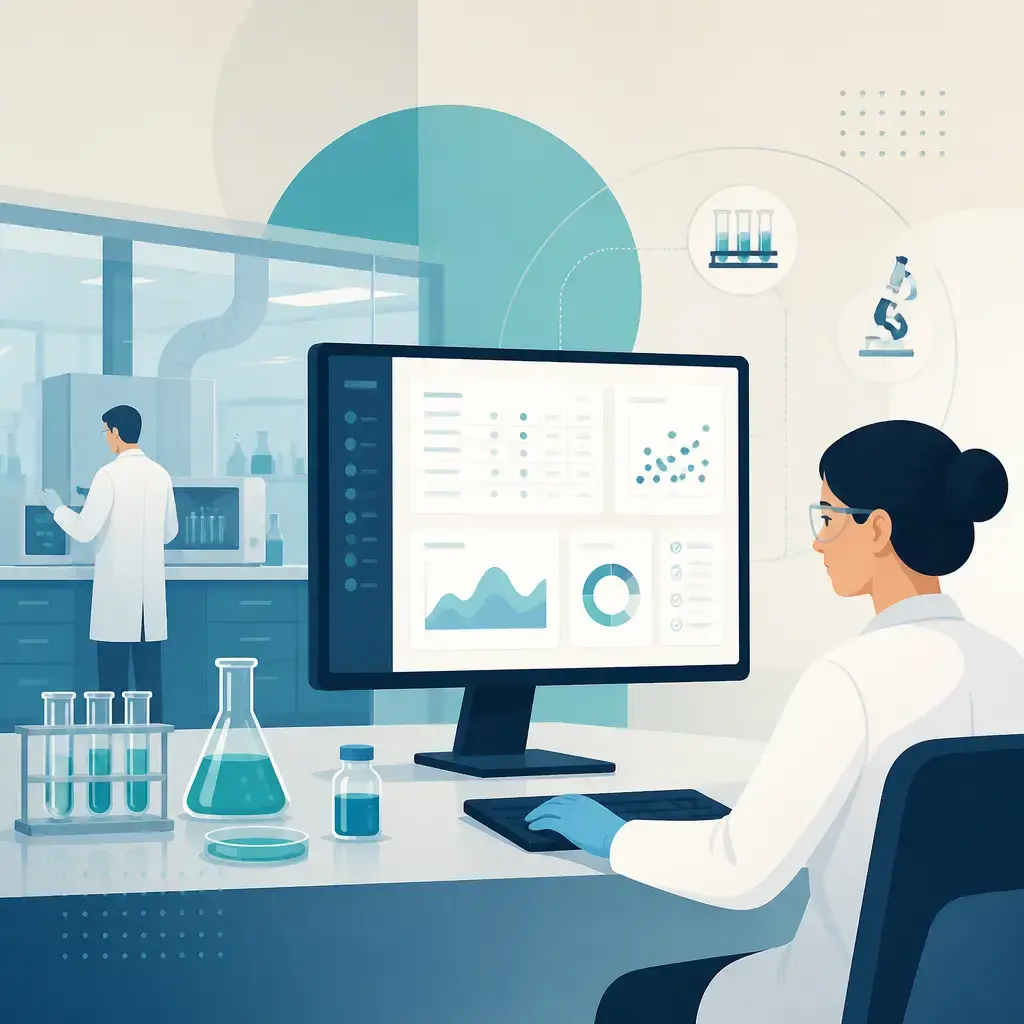
Off the shelf LIMS platforms promise quick deployment, but many labs outgrow them fast. If you run a laboratory with specialised workflows, complex compliance requirements, or multiple systems that need to talk to each other, custom LIMS software is probably worth a serious look. This guide breaks down what a custom Laboratory Information Management System actually does, when it makes sense to build one, and what decisions shape whether the project succeeds or fails.
Key Takeaways
- A LIMS is mission critical infrastructure, not a convenience tool, downtime can delay results, halt operations, and trigger regulatory non compliance.
- Workflow mapping must come before any technology decisions. Projects that start with tech choices instead of process documentation tend to fail.
- Data integrity, accuracy, completeness, consistency, and traceability, is the core design constraint around which everything else is built.
- Custom development makes most sense when workflows are highly specialised, multiple system integrations are required, or vendor lock-in is a real concern.
- Stakeholder buy-in from lab staff, QA teams, and IT from the very start is as important as the technical architecture.
What Custom LIMS Software Actually Is
A Laboratory Information Management System is the digital backbone of laboratory operations. It manages samples, tests, instruments, users, data, and compliance reporting, either within a single lab or across multiple sites.
What separates a LIMS from generic software is the environment it operates in. It has to adapt to laboratory-specific workflows, strict scientific data integrity requirements, regulated compliance standards, instrument integrations, and full audit and traceability needs. A custom LIMS is built around how a lab actually works, not how a vendor assumes it should.
That distinction matters more than it might sound. A clinical diagnostic laboratory has very different compliance and reporting obligations compared to a research lab or a food and beverage quality testing facility. One configuration cannot serve all of them well.
Why Labs Move Away From Off the Shelf Systems
Commercial LIMS platforms can work well initially, particularly for smaller labs with fairly standard processes. But the limitations surface quickly as a lab grows or its regulatory environment gets more demanding.
The most common reasons labs move to custom LIMS include:
- Rigid workflows that don't match how the lab actually operates
- Expensive licensing and user limits that make scaling costly
- Poor integration with instruments, ERP systems, or other internal platforms
- Limited customisation for compliance reporting or data formats
- Scalability problems when expanding across departments or multiple sites
Custom LIMS software, when designed correctly, gives laboratories long-term control, flexibility, and cost efficiency that packaged products simply can't match.
Understanding the Laboratory Ecosystem
A LIMS doesn't operate in isolation. It sits inside a complex ecosystem of people, processes, instruments, and external systems. Getting this picture right before you write a single line of code is what separates successful projects from expensive rework.
The Stakeholders Involved
Every key group interacts with a LIMS differently, and ignoring any one of them leads to either low adoption or operational bottlenecks down the line. The main stakeholders are:
- Lab technicians and scientists (the primary day-to-day users)
- Quality assurance teams
- Lab managers overseeing workflows and resource allocation
- Compliance and regulatory officers
- IT and data teams responsible for infrastructure and integrations
Requirements gathering has to involve all of these groups early. A system that works beautifully for scientists but creates headaches for compliance officers, or vice versa, won't get used properly.
Types of Laboratories That Use LIMS
LIMS requirements vary significantly by lab type. Common categories include clinical and diagnostic laboratories, pharmaceutical and biotech labs, research and academic environments, environmental testing labs, food and beverage quality facilities, and forensic laboratories. Each has its own regulatory landscape, data structures, and workflow patterns.
Compliance Is a Design Constraint, Not an Afterthought
Compliance is one of the most critical drivers of LIMS design, and it has to be treated as a first-class concern from day one, not bolted on at the end.
Depending on the lab type and geography, a LIMS may need to support laboratory accreditation standards, data integrity principles, audit trails and electronic signatures, sample chain of custody tracking, and data retention and archiving rules.
These requirements shape the architecture, the data model, and the workflows. If you don't account for them early, you'll be rebuilding large parts of the system later.
Data Integrity Is Non-Negotiable
In a laboratory context, data integrity isn't a nice-to-have feature, it's the whole point. A LIMS must ensure data accuracy, completeness, consistency, and full traceability of any changes made to records.
If test data can't be trusted or audited, the entire laboratory operation is at risk. Regulators won't accept results from a system that can't prove its data hasn't been altered inappropriately. Scientists can't rely on results they can't reproduce. The consequences of getting this wrong run from invalidated test results through to damaged institutional credibility.
Mapping Workflows Before Choosing Technology
This is where many LIMS projects go wrong. Teams get excited about technology choices, cloud vs on-premise, which framework to use, which database engine, before they've properly understood the workflows the system needs to support.
Effective custom LIMS projects start by documenting current lab processes in detail, identifying pain points and bottlenecks, defining where compliance checkpoints need to sit, and mapping out the optimised future workflows the system should enable. Technology should follow workflow, not the other way around.
Typical Laboratory Workflows a LIMS Must Handle
While every lab is different, most LIMS implementations need to cover the following sequence:
- Sample registration and labelling, unique identification, barcode or QR code generation, sample type classification
- Test assignment and execution, linking samples to test methods, scheduling, method versioning
- Instrument data capture, automated or manual entry of results from lab instruments
- Result validation and approval, review workflows, re-test handling, authorisation steps
- Reporting and release, generating compliant reports, releasing results to relevant parties
- Archiving and audit, long-term retention, full audit trail access
Each step can vary between labs and even between departments within the same lab. That's precisely why customisation is necessary.
Core Functional Modules of a Custom LIMS
A well-built custom LIMS is typically structured as a modular system, where each module maps directly to a real laboratory process. Poor modularisation creates brittle systems that are hard to scale or audit.
Sample Management and Lifecycle Tracking
Sample management is the heart of any LIMS. A robust sample module needs to support sample registration and unique identification, barcode or QR code labelling, sample type classification, chain of custody tracking, and status changes across the full lifecycle. Every action on a sample must be timestamped and linked to the user who performed it. Losing traceability invalidates test results.
Test and Analysis Management
Once samples are registered, they're assigned to tests or assays. The test management module handles test definition and versioning, method assignment, test scheduling, result capture, and re-tests. Test methods change over time, so version control is essential for audits and result reproducibility.
Instrument and Equipment Integration
Modern labs rely heavily on instruments. A custom LIMS needs to handle instrument inventory, calibration and maintenance logs, and automated data capture from instruments where possible. This integration layer is often where off-the-shelf products fall short, proprietary instruments may not connect cleanly to commercial platforms, but a custom system can be built specifically around the instruments the lab actually uses.
When Custom LIMS Makes Sense (and When It Doesn't)
Custom LIMS development isn't always the right answer. For a small lab with standard workflows, an off-the-shelf system may be perfectly adequate initially.
Custom development makes sense when:
| Scenario | Why Custom Wins |
|---|---|
| Highly specialised lab workflows | Off-the-shelf systems force compromises that break real processes |
| Multiple system integrations required | Custom code can be built around your actual instrument and software stack |
| Long-term scalability across sites | You control the architecture and can scale it your way |
| Complex regulatory reporting | Compliance logic can be built precisely to your requirements |
| Vendor lock-in is a concern | You own the codebase and aren't dependent on a vendor's roadmap |
The build-vs-buy decision deserves honest scrutiny. Custom development requires real investment, and costs depend on workflow complexity, the number of integrations, compliance requirements, and the number of user roles and access controls needed. Underestimating scope is the most common cause of delays and budget overruns.
Getting Stakeholder Buy-In Right
A LIMS affects the daily work of everyone in the lab. Even a technically excellent system will fail if the people using it weren't involved in shaping it.
Successful projects involve lab staff in the requirements gathering process, bring QA and compliance teams in early, and include IT teams from the start for infrastructure and integration planning. Without genuine buy-in, adoption suffers regardless of how well the system is built.
Why Development Experience Matters Here
LIMS development sits at the intersection of laboratory science, data management, compliance and audit requirements, and enterprise software engineering. That's an unusual combination. Inexperienced development teams often misinterpret lab workflows, underestimate what compliance actually demands in practice, and build inflexible data models that become expensive to change later.
This is why partnering with a development team that understands both the technical and the regulatory landscape matters so much for a project like this. Our bespoke software development work at IceBoxDesigns follows exactly this kind of structured, requirements-first approach, understanding the operational context deeply before designing the system architecture.
The Practical Reality of Building Custom LIMS Software
Building custom LIMS software is genuinely complex. It's not the same as building a typical business application. The data is sensitive, the workflows are regulated, the users are specialists with high expectations, and the consequences of errors extend well beyond the software itself.
The labs that succeed with custom LIMS projects are the ones that treat it as a strategic investment rather than a tech project. They start with thorough workflow mapping, get stakeholders involved early, set realistic cost and timeline expectations, and choose development partners who understand the domain.
Done well, a custom LIMS gives a laboratory exactly what no packaged product can: a system built around how that lab actually operates, with the compliance architecture, integrations, and scalability it specifically needs.
Ready to Build a Custom System for Your Laboratory?
If your lab is outgrowing an off-the-shelf LIMS, or you're starting from scratch and need something built around your specific workflows and compliance requirements, we can help. Take a look at our custom software development service to see how we approach complex, domain-specific builds, or get in touch to talk through what your project needs.
Frequently asked questions
What is custom LIMS software?
Custom LIMS (Laboratory Information Management System) software is a tailored digital system built specifically around a laboratory's own workflows, compliance requirements, instruments, and data management needs. Unlike off-the-shelf platforms, it isn't built around a vendor's assumptions about how labs should work.
When does building a custom LIMS make more sense than buying an off-the-shelf system?
Custom development makes sense when lab workflows are highly specialised, multiple instrument or system integrations are required, long-term scalability across departments or sites is needed, regulatory reporting is complex, or vendor lock-in is a concern. For small labs with standard workflows, off-the-shelf systems may be sufficient initially.
What are the most important things to get right before building a LIMS?
Workflow mapping comes first, before any technology decisions. You also need to involve all key stakeholders (lab staff, QA, compliance, and IT) early in requirements gathering, and you must treat compliance and data integrity as core design constraints from day one, not additions to be addressed later.
Why do many custom LIMS projects run over budget or timeline?
The most common cause is underestimating scope. Costs and timelines depend on workflow complexity, the number of integrations, compliance requirements, and user roles and access controls. Projects that start with technology choices rather than thorough workflow documentation are especially prone to costly rework.
Related articles
- Software Development
eCoCs Explained: What the UK's Electronic Certificate of Conformity Means for Vehicle Manufacturers
10 September 2026 - Software Development

MVP to Scalable Product: How to Scope It Right and Know When to Scale
20 August 2026 - Software Development
Why ERP Integration, Not AI Tools, Is the Real Starting Point for Manufacturers
6 July 2026
Related services
Need a hand with this? Here's how IceBoxDesigns can help.