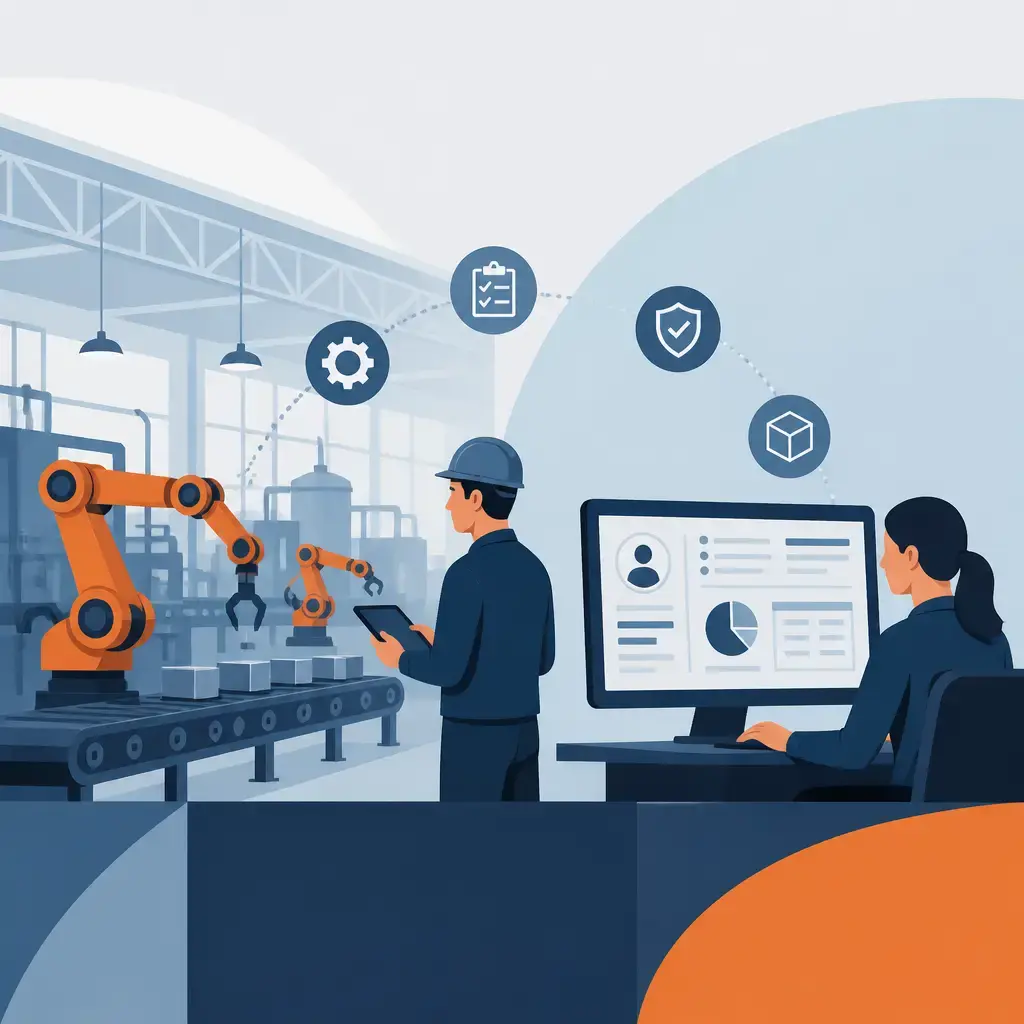
Generic CRM tools are built for generic businesses. Manufacturing factories have complex sales processes, intricate supply chains and strict compliance obligations that off-the-shelf software simply wasn't designed to handle. Custom CRM software, built around the way your factory actually works, is quickly becoming a competitive necessity rather than a nice-to-have.
Key Takeaways
- Off-the-shelf CRM tools often can't accommodate the complex sales processes and specialist requirements common in manufacturing.
- Custom CRM software can automate order processing and inventory management, cutting errors and saving staff time.
- A centralised customer data system helps sales teams personalise communication and strengthen long-term relationships.
- Supply chain tracking, quality control monitoring and compliance reporting can all live inside a single bespoke platform.
- Custom systems scale with your factory as it grows, rather than forcing you to work around someone else's product roadmap.
The Problem with Off the Shelf CRM in a Factory Setting
Most mainstream CRM platforms, the big subscription-based names you'll recognise, were designed for software companies, agencies and sales teams that sell relatively straightforward products to individual buyers. They're good at what they do. But drop one into a manufacturing environment and cracks appear fast.
Manufacturing sales cycles are often long and involve multiple stakeholders: purchasing managers, engineers, quality teams and finance. Products may be configured to order. Pricing can depend on volume, materials cost or customer-specific agreements. Lead times are tied directly to production capacity and raw material availability. None of that maps neatly onto a standard sales pipeline built around "lead, opportunity, closed won".
When a factory tries to squeeze its processes into an off-the-shelf CRM, one of two things tends to happen. Either the team abandons half the features and uses it as an expensive contacts book, or they spend months trying to configure workarounds that still don't quite work. Either way, the promise of better efficiency goes unrealised.
Streamlining Day to Day Operations
One of the clearest wins from custom CRM software in manufacturing is operational efficiency. A system built to match your actual workflows can automate repetitive tasks that currently eat up staff time, order processing, inventory checks, quote generation, delivery scheduling. Automation here doesn't just save time; it removes the human error that creeps in when someone is manually re-entering the same data across three different systems.
Think about order processing specifically. In many factories, a confirmed order triggers a chain of actions: updating stock levels, flagging production scheduling, notifying despatch, generating an invoice. Done manually, or across disconnected tools, each handoff is a point of failure. A custom CRM can link all of those steps together so the right information reaches the right people automatically, without anyone having to chase it.
The same logic applies to inventory management. When your CRM knows what's been ordered, it can flag when stock of a component is running low before it becomes a production problem. That kind of proactive visibility is very hard to achieve with a generic tool that wasn't built to talk to your inventory system.
Better Customer Relationships, Backed by Real Data
Manufacturing businesses often underestimate how much customer relationship management actually matters to their growth. Repeat business, long-term contracts and referrals are the lifeblood of most factories, yet the data needed to nurture those relationships, order history, preferences, complaints, conversations, contract terms, is frequently scattered across emails, spreadsheets and people's memories.
A custom CRM brings all of that into one place. Sales teams get a complete picture of each customer: what they've ordered, when, at what price, any quality issues that were raised, upcoming renewal dates. With that context, conversations become more informed and more useful. You're not asking a customer to repeat information they've already given you. You're spotting that their order volumes have dropped and reaching out before they go elsewhere.
For manufacturers with large customer bases or complex account structures, where one client might have multiple sites, divisions or buying contacts, custom software can model those relationships accurately in a way that generic CRMs rarely handle well.
Supply Chain Visibility in One Platform
Manufacturing supply chains are genuinely complex. You might be managing dozens of suppliers, tracking inbound shipments of raw materials, monitoring lead times that fluctuate with global conditions, and trying to ensure that production doesn't stall because a single component is stuck at a port somewhere.
Custom CRM software can act as a single platform for all of that. Supplier records, outstanding purchase orders, expected delivery dates and shipment tracking can sit alongside your customer and sales data, giving everyone in the business a joined-up view. When a supplier delay threatens a customer delivery, the team can see it immediately and respond, whether that's finding an alternative supplier, adjusting the production schedule or proactively contacting the customer to reset expectations.
This kind of integrated visibility is almost impossible to achieve by bolting together several off-the-shelf tools. Data lives in different places, doesn't update in real time and requires manual effort to reconcile. A purpose-built system removes those barriers.
Quality Control You Can Actually Track
Quality control is non-negotiable in manufacturing. A defect that makes it to a customer doesn't just cost money to fix, it damages the relationship, potentially loses the contract and, in regulated industries, can have far more serious consequences.
Custom CRM software can embed quality tracking directly into the workflow. When products are inspected, results are logged against the relevant order and customer record. Patterns become visible: if a particular product line or supplier is generating a higher rate of defects, the data surfaces that early rather than after a costly complaint. Corrective actions can be tracked through to resolution and linked to the relevant order history.
For manufacturers who supply into industries with strict quality standards, automotive, aerospace, food production, medical devices, this kind of traceable, auditable record is not just useful, it's often required. A custom system can be designed from the ground up to capture the specific data points your quality process demands, rather than trying to repurpose fields that were built for something else entirely.
Compliance Without the Headache
Manufacturing factories operate under a significant weight of regulation. Depending on your sector, you might be dealing with environmental reporting obligations, health and safety records, product certification requirements or industry-specific standards. Keeping on top of all of it is time-consuming, and the consequences of falling short range from fines to lost certifications to reputational damage.
Custom CRM software can help by building compliance tracking directly into your systems. Key metrics, environmental impact data, worker safety records, certification expiry dates, audit schedules, can be monitored and reported on from within the platform. Automated alerts can flag upcoming deadlines before they become urgent. Reports that used to take days to compile manually can be generated in minutes.
This isn't about replacing your compliance team or your legal obligations. It's about giving them the tools to stay on top of requirements without spending half their time hunting for data across disconnected systems.
Reporting and Analytics That Actually Reflect Your Business
Every CRM comes with dashboards and reports. The question is whether the metrics they show are the ones that matter to you. Generic reporting tools are built around generic KPIs, pipeline value, win rates, average deal size. Those are useful, but they don't tell a factory manager whether production capacity is aligned with forecast demand, or whether a particular product category is becoming less profitable as material costs rise.
Custom CRM software can be built to surface the specific metrics your management team actually uses to make decisions. That might be order fulfilment times broken down by product type, customer satisfaction scores linked to specific production runs, or a rolling view of margin by account. When the data your system collects matches the decisions you need to make, you stop guessing and start acting on evidence.
Over time, that analytical capability compounds. You build a historical record that lets you spot seasonal patterns, anticipate demand shifts and make better decisions about capacity, pricing and investment.
Flexibility to Grow With Your Factory
One of the most practical arguments for custom CRM software is longevity. Off-the-shelf platforms update on their own schedule, deprecate features you rely on and raise prices when they choose. Your business ends up adapting to their product roadmap rather than the other way around.
A custom system belongs to you. When your factory adds a new product line, opens a second site, acquires a business or changes its sales structure, the software can be updated to reflect that. There's no waiting for a vendor to prioritise your feature request, and no paying for a higher pricing tier just to unlock something you actually need.
That flexibility is particularly valuable for growing manufacturers. The system that works well for a 50-person factory can be scaled and extended to serve a 200-person operation without forcing a painful migration to an entirely new platform.
Is Custom CRM Software Right for Your Factory?
Custom doesn't mean overengineered. A well-scoped bespoke CRM can be built to solve specific, clearly-defined problems, and phased in over time as your confidence and requirements grow. The starting point is usually a clear audit of where your current tools are letting you down: where data gets lost, where processes rely on manual effort, where your team is working around the system rather than with it.
If those pain points are real and recurring, the investment in a custom solution typically pays back faster than people expect, not because bespoke software is magic, but because a system that fits your actual process gets used properly, and used consistently.
Our custom software development team works with businesses across manufacturing and other sectors to design and build CRM and operational tools that match the way they work. If you'd like to talk through what that might look like for your factory, get in touch.
Frequently asked questions
Can't we just use Salesforce or HubSpot for our manufacturing business?
You can, but off-the-shelf CRMs are built for simpler, more linear sales processes. Manufacturing factories typically have complex order structures, multi-stakeholder accounts, production-linked lead times and compliance requirements that generic platforms handle poorly. You often end up with expensive workarounds or simply stop using features that don't fit.
What's the difference between custom CRM software and a standard CRM with customisation?
Standard CRMs can be configured to a degree, but you're still constrained by what the platform supports. Custom CRM software is built from scratch around your specific workflows, supply chain, quality control, compliance and all, so there are no artificial limits, and you own the system outright.
How long does it take to build a custom CRM for a manufacturing factory?
It depends on complexity and scope. A focused system tackling specific pain points can be delivered in a matter of months. Larger, more integrated platforms covering sales, supply chain and compliance take longer. A good development partner will phase the build so you get usable value early rather than waiting for everything to be finished.
Is custom CRM software affordable for a small or medium-sized manufacturer?
The upfront cost is higher than a monthly SaaS subscription, but the total cost of ownership over several years is often lower, particularly when you factor in what you're currently spending on multiple tools, manual workarounds and staff time lost to poor processes. A phased build can also spread the investment over time.
Related articles
- Software Development
eCoCs Explained: What the UK's Electronic Certificate of Conformity Means for Vehicle Manufacturers
10 September 2026 - Software Development
MVP to Scalable Product: How to Scope It Right and Know When to Scale
20 August 2026 - Software Development
Why ERP Integration, Not AI Tools, Is the Real Starting Point for Manufacturers
6 July 2026
Related services
Need a hand with this? Here's how IceBoxDesigns can help.