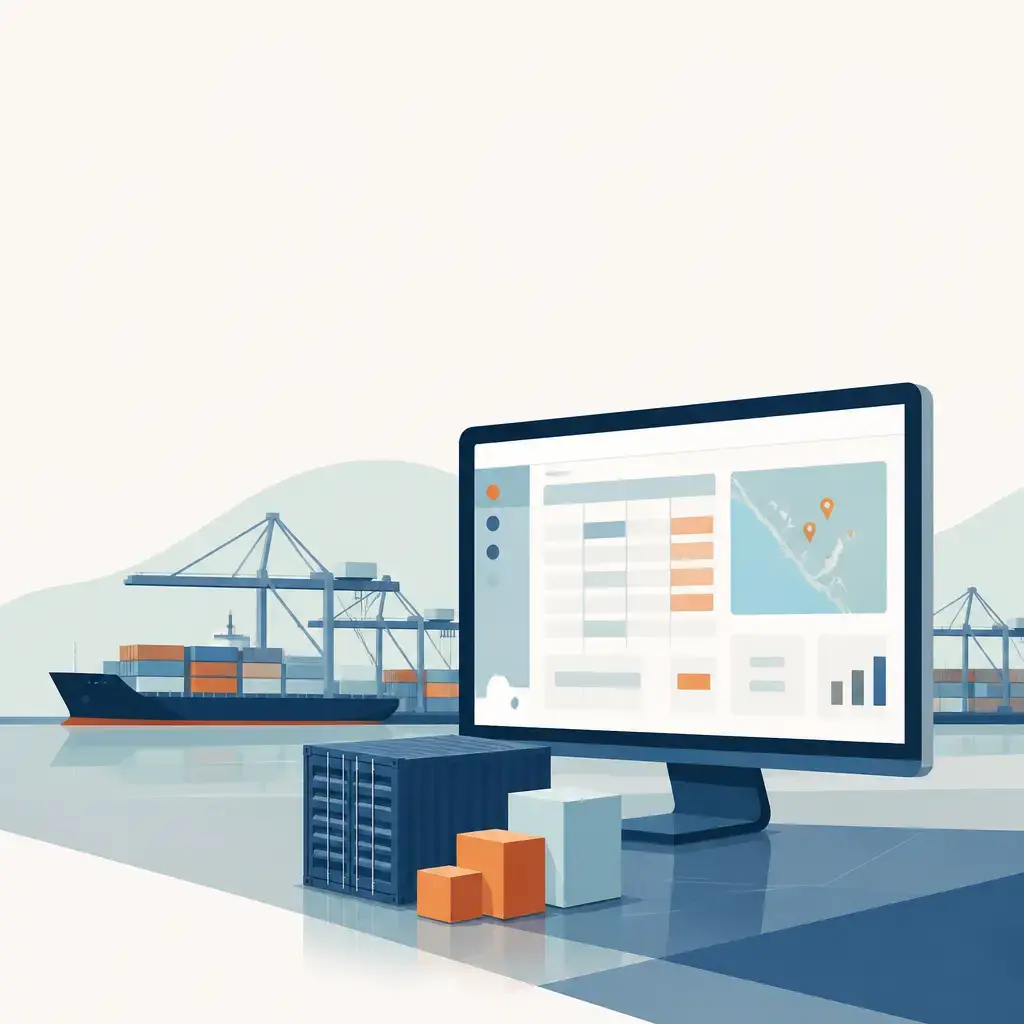
Spreadsheets were never meant to run a logistics operation. They work fine for a handful of bookings or a small fleet, but once your volumes grow, your team expands, or your compliance requirements stack up, they start to crack. The same is true of generic off-the-shelf software that was built for a completely different industry and then bolted onto yours with a few workarounds.
The good news: custom software built around how your operation actually works is more achievable than most business owners think, and the return on getting it right is significant.
Key Takeaways
- Spreadsheets and outdated systems create bottlenecks, errors and compliance risk in logistics environments.
- Custom software can be built modularly, so you only pay for and activate the functions you actually need.
- Cloud-based, mobile-accessible systems mean your team can work from anywhere across a site or operation.
- Automating repetitive tasks (queue management, bookings, equipment tracking) frees staff for higher-value work.
- The investment in a bespoke system typically pays back through time saved and mistakes avoided.
What's Actually Going Wrong With the Current Setup?
Most logistics businesses, port operators and freight terminals don't realise how much their current tools are costing them until they properly audit the situation. Common problems include:
Manual data entry across multiple systems. Someone enters a booking into a spreadsheet, someone else copies it into an email, a third person updates a whiteboard. Every handoff is a chance for an error, and errors in logistics mean delayed vehicles, missed slots and unhappy clients.
No real-time visibility. With spreadsheets or basic software, you can't see what's happening across your operation as it happens. You're always working from data that's already slightly out of date.
Compliance headaches. Port and terminal operations carry real regulatory obligations, things like weight verification requirements under international shipping protocols. Tracking this manually is slow, error-prone, and creates audit risk.
Software that doesn't talk to anything else. A lot of businesses are running three or four disconnected tools because none of them integrate properly. Staff end up being the integration layer, copying data between systems by hand.
No room to scale. A spreadsheet that works for 50 movements a week falls apart at 500. If your growth is outpacing your systems, it's not a process problem, it's a software problem.
What Purpose Built Software Actually Does Differently
The clearest illustration of what's possible comes from looking at how specialist logistics software is designed. Systems built specifically for container terminals and port operations are modular and personalised, you activate the modules relevant to your operation rather than paying for (and navigating) features you'll never use.
They handle queue management and bookings automatically, so vehicles move through efficiently and staff aren't manually coordinating every arrival. They speed up loading and unloading and manage the transit of vehicles across the site. They interface directly with terminal operating systems (TOS) and manage equipment automatically, removing the need for manual status updates.
Compliance is built in rather than bolted on. Properly designed logistics software traces and communicates information in line with the key sector protocols and directives, so your reporting is happening as a by-product of normal operations rather than requiring a separate manual process.
And critically, good modern systems are cloud-based and accessible from mobile devices. That matters enormously in an environment where your team is spread across a large site and needs to update or check information on the move rather than walking back to a fixed terminal.
Why Generic Software Usually Disappoints
There's always a temptation to buy an off-the-shelf system because it feels lower risk. You can see it, there's a demo, there's a support team, and the upfront cost looks manageable. But off-the-shelf software is built to work for the widest possible range of businesses, which means it's optimised for none of them in particular.
You end up adapting your processes to fit the software, rather than the other way around. Staff develop workarounds. You pay for modules you don't need. Updates break things. And when your operation has a specific requirement, a particular integration, a compliance field, a reporting format, you're at the mercy of the vendor's roadmap.
For a large enough operation, the annual licence cost of off-the-shelf software often rivals (or exceeds) the cost of building something tailored. Once you factor in the time spent on workarounds, re-keying data and managing the gaps between systems, the calculation tilts further still.
The Modular Approach: You Don't Have to Build Everything at Once
One thing that stops businesses from moving towards custom software is the assumption that it means a massive, expensive project that takes over a year and touches everything. That's rarely how it needs to work.
A sensible approach is modular: identify the single biggest bottleneck in your current operation, the process that costs the most time, creates the most errors, or carries the most compliance risk, and build a focused solution for that first. Get it working well, measure the impact, then expand.
For a logistics or freight business, that first module might be bookings and slot management. Or it might be automated compliance reporting. Or a mobile-accessible dashboard that gives your shift managers real-time visibility across the yard. Each of those is a discrete, manageable piece of work. Once one module is running, integrating the next one is straightforward because the foundations are already there.
This approach also means you can build a business case internally. It's much easier to get sign-off on a focused piece of work with a clear measurable outcome than it is to pitch a full system replacement from day one.
What Automation Actually Looks Like in Practice
Automation in this context doesn't mean robots or AI in the science-fiction sense. It means removing the manual steps from processes that currently require a human to copy, update or relay information.
Some concrete examples relevant to logistics and port-adjacent businesses:
- A vehicle arrives and checks in via a mobile interface. The system automatically logs the arrival time, updates the queue, and notifies the relevant team. No phone call, no clipboard, no manual update.
- A booking is made. The system checks slot availability, confirms it, and sends a confirmation automatically. Any changes propagate across the system in real time.
- A measurement is taken (weight, for example). The system records it, checks it against the relevant threshold, flags any issues, and logs it for compliance reporting, without anyone needing to transcribe it.
- End-of-day reports are generated automatically from operational data rather than assembled by hand from multiple sources.
None of those are exotic. They're just the logical outcome of having a system designed around your actual workflows rather than a generic template.
The People Angle
It's worth addressing the concern that comes up in almost every conversation about automation: what happens to the staff?
In practice, the businesses that implement this kind of software don't usually reduce headcount. What they find is that the people they have can handle significantly more volume, and spend their time on things that actually require judgement rather than data entry. Supervisors supervise instead of updating spreadsheets. Coordinators handle exceptions instead of chasing status updates. That's a better use of people and, frankly, a better job for them.
There's also a training and onboarding benefit. When your processes live inside a well-designed system rather than in people's heads and personal spreadsheets, onboarding a new team member is faster and more consistent.
Is This Only Relevant to Ports and Large Terminals?
Not at all. The problems described here, disconnected systems, manual data entry, compliance tracking done by hand, no real-time visibility, apply across logistics at every scale. Hauliers, freight forwarders, warehouse operators, distribution centres: they all face the same structural issues.
The principles of purpose-built, modular, cloud-based software apply just as well to a 20-person freight business as they do to a large container terminal. The scope and complexity differ, but the underlying logic is the same: software should be built around how your operation works, not the other way around.
If your business is currently held together by spreadsheets, shared inboxes and systems that don't talk to each other, that's not a small operational quirk. It's a significant drag on efficiency and a real risk to accuracy and compliance, and it tends to compound as you grow.
Ready to Move Beyond Spreadsheets?
At IceBoxDesigns, we build bespoke web applications, internal tools and operational systems for businesses that have outgrown generic software. Whether you need a booking and slot management system, a compliance tracking tool, a mobile-accessible operations dashboard, or a full operational platform, we can scope and build it around your actual workflows.
Get in touch for a straightforward conversation about what a custom solution could look like for your operation, no jargon, no hard sell.
Frequently asked questions
How do I know if my logistics business actually needs custom software, or just a better process?
If the same information is being entered into more than one system by hand, if staff regularly work around your current tools, or if your software can't produce the reports you need without manual assembly, those are strong signals that the software is the problem. Better processes help, but only up to the point where the tools themselves are the bottleneck.
How long does it take to build a custom logistics system?
A focused first module, say, a booking and slot management tool or a compliance tracking system, can typically be scoped, built and deployed within a few months. A full operational platform takes longer, but most businesses build incrementally rather than all at once, which keeps each phase manageable and lets you prove value quickly.
Is custom software more expensive than off-the-shelf?
Upfront it can be, though not always. Over time, when you factor in annual licence costs, the time spent on workarounds, and the cost of errors caused by manual processes, bespoke software often works out comparable or cheaper. It also scales with your business rather than requiring you to upgrade to a higher licence tier.
Can a custom system integrate with our existing tools?
Yes, in most cases. Modern custom software is built with APIs and integrations in mind, so it can connect to existing tools, accounting software, CRM, compliance platforms, rather than replacing everything at once. The scope of integration depends on what you're currently running.
Related articles
- Software Development
eCoCs Explained: What the UK's Electronic Certificate of Conformity Means for Vehicle Manufacturers
10 September 2026 - Software Development
MVP to Scalable Product: How to Scope It Right and Know When to Scale
20 August 2026 - Software Development
Why ERP Integration, Not AI Tools, Is the Real Starting Point for Manufacturers
6 July 2026
Related services
Need a hand with this? Here's how IceBoxDesigns can help.