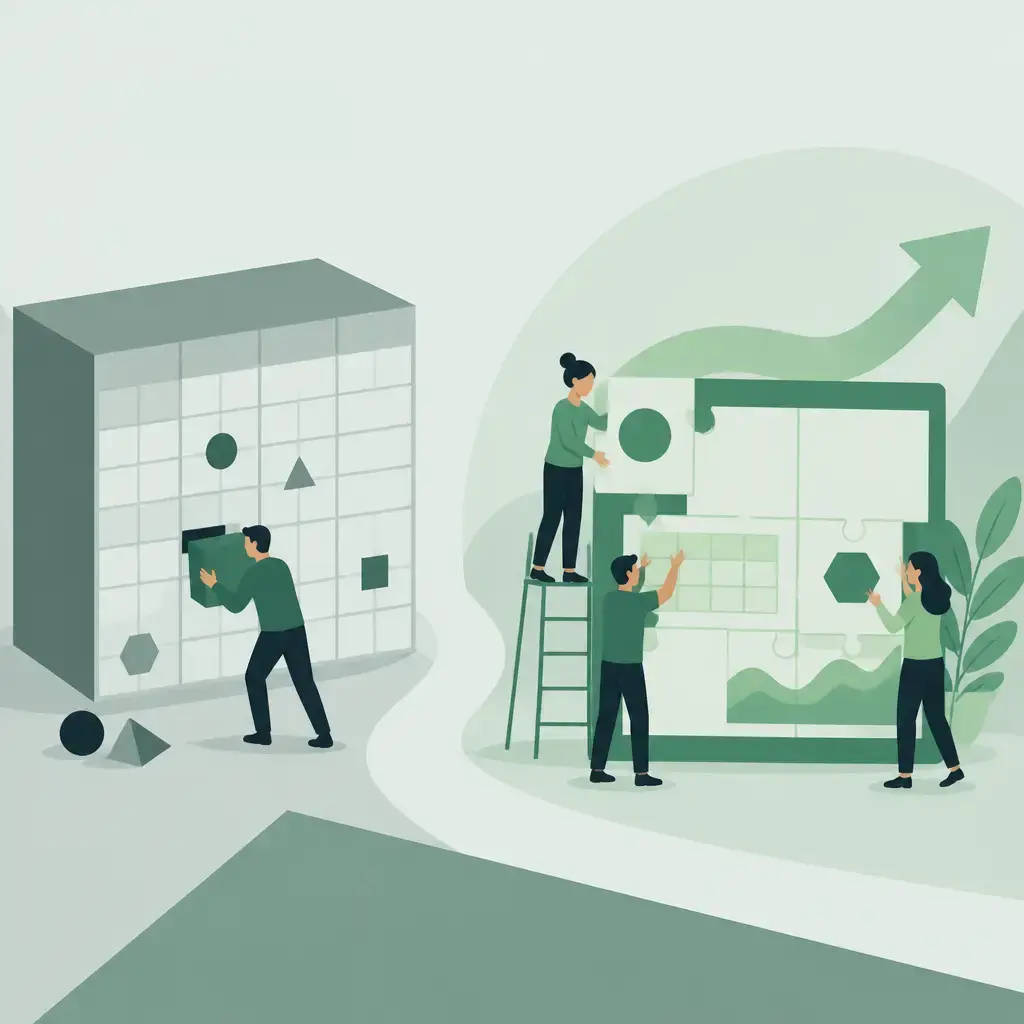
Generic software asks your business to fit its mould. Custom software development does the opposite, it's built around how you actually work, what your team needs, and where you want to go. For small and medium businesses in particular, that difference can be the gap between growing confidently and spending your days wrestling with tools that weren't designed for you.
Key Takeaways
- Off-the-shelf software is built for the broadest possible market, which means significant compromises for businesses with specific needs.
- Custom software is designed around your processes, not the other way around, eliminating friction rather than creating it.
- The higher upfront investment in custom development typically pays back through reduced inefficiencies, lower long-term maintenance costs, and less reliance on multiple platforms.
- Legacy tools like Microsoft Access databases and Excel spreadsheets are common pain points that custom software can replace or extend effectively.
- A proper custom build becomes a strategic asset that grows with your business, not a constraint that holds it back.
Why Off the Shelf Software Lets Businesses Down
Pre-packaged software is built with the widest possible audience in mind. That's its commercial logic, but it's also its core weakness. To serve everyone, it serves no one especially well.
A manufacturing firm might find itself contorting well-established workflows to fit a generic enterprise resource planning (ERP) system. A creative agency might struggle with project management tools that don't reflect the nuanced way they track client work and creative processes. These aren't minor annoyances, they're fundamental misalignments that drain productivity, increase operational stress, and ultimately hurt the bottom line.
The assumption baked into most off-the-shelf products is that businesses can be reduced to a simplified set of standardised processes. In reality, every organisation has its own practices, its own quirks, and its own way of doing things. A retail company's inventory management needs are completely different from a healthcare provider's patient tracking system, yet traditional software packages often apply a one-size approach regardless.
The Real Cost of Making Do
Businesses often underestimate what it actually costs to work around software limitations. There's the obvious stuff, staff spending extra time on manual steps because the tool doesn't automate the right things, or data being exported from one system and re-entered into another. But there's also the subtler cost: teams building elaborate workarounds in Excel, keeping critical business data in Access databases that haven't been properly maintained in years, or running half a dozen different subscriptions because no single tool does the whole job.
None of this shows up on a single invoice, but across a year it adds up considerably in lost hours, avoidable errors, and the mental load of managing complexity that shouldn't exist.
The Microsoft Access Problem
Microsoft Access is still quietly running a surprising number of UK businesses. It was a genuinely useful tool when it launched, and for simple data management tasks in its day it did the job. But Access databases have a habit of growing far beyond what they were ever designed for. What started as a straightforward contacts list or stock tracker becomes a sprawling, fragile system that only one person in the office fully understands, and everyone is quietly terrified of breaking.
Common problems we see with Access databases include:
- Single-user or limited multi-user access. Access wasn't built for teams working simultaneously, and performance degrades quickly when multiple people try to use it at once.
- No proper web or mobile access. Staff working remotely or on-site can't easily reach an Access database without specific setup, which becomes a real problem for businesses operating across locations.
- Fragile file structure. Access databases stored on shared drives get corrupted. It's not a question of if, it's when. Without proper backups and maintenance, the risk is significant.
- Reporting limitations. Pulling meaningful reports out of Access often requires someone who knows the tool well. Non-technical staff frequently can't get the insight they need without help.
- No integration with modern tools. Getting your Access data to talk to your CRM, your accounting package, or your e-commerce platform usually requires custom scripting or manual exports.
The right move for most businesses still running on Access isn't to patch it further, it's to replace it with a proper web-based application that stores data securely, allows the right people to access it from anywhere, and integrates with the other tools in your stack. That's exactly the kind of thing custom software development is built for.
Fixing Excel Problems With Custom Software
Excel is a brilliant tool. It's also one of the most widely misused tools in business. The problem isn't Excel itself, it's that businesses use it to manage things it was never designed for: live operational data, multi-user workflows, customer records, stock management, project tracking.
Some of the most common Excel pain points we hear about:
- Version control chaos. When a spreadsheet is emailed back and forth or saved on a shared drive, you end up with five versions and nobody is sure which one is current.
- Human error. Manual data entry into spreadsheets introduces mistakes. A misplaced decimal or an overwritten formula can have real consequences, and it's often not caught immediately.
- Scaling issues. A spreadsheet that works fine for 200 rows starts to creak at 2,000 and becomes unusable at 20,000. Excel isn't a database, and using it as one has limits.
- No audit trail. Who changed what, and when? Excel doesn't give you this out of the box, which is a problem in any regulated industry or when something goes wrong.
- Broken formulas. Complex spreadsheets maintained by multiple people over several years become genuinely difficult to audit. One broken formula in a key cell can produce wrong figures that nobody notices for weeks.
A custom built application can take everything your team currently does in Excel and turn it into a proper system: structured data entry forms that reduce errors, real-time visibility for the whole team, automated calculations that don't rely on fragile formulas, and reporting that anyone can run without needing to know how VLOOKUP works.
This isn't about replacing Excel entirely, it's about using the right tool for the right job. Excel remains excellent for ad hoc analysis and financial modelling. It's just not a substitute for a database-driven application when your business data has grown beyond a certain point.
What Custom Software Development Actually Looks Like
The process of building custom software should start long before any code is written. A proper engagement begins with understanding your business at its core, not just what you do, but how you do it, where the friction is, and what you're trying to achieve. That means conversations with the people who actually use the systems day to day, not just management.
From there, the design phase should produce something that feels like a natural extension of your organisation, not an external product you've been handed. Agile development, where you see working software in stages and give feedback throughout, means the end result reflects reality rather than assumptions made at the start of the project.
Ongoing support matters too. Technology is never truly finished. Your business changes, your team grows, regulations shift, and your software needs to keep up. A good development partner treats the relationship as ongoing, not transactional.
The Advantages Custom Software Delivers
Flexibility. A custom solution is designed around your existing processes. It can automate complex workflows and integrate with the legacy systems you're not ready to replace, rather than forcing you to change how you work to accommodate it.
Efficiency. By stripping out unnecessary features and focusing on exactly what your team needs, custom software reduces operational friction. Staff aren't hunting through menus built for a different type of business, they're working in a system designed for their job.
Competitive advantage. Technology can be a genuine differentiator. When your competitors are all using the same off-the-shelf platforms, a system built around your specific capabilities and processes gives you an edge they can't easily replicate.
Data management. Generic software offers standardised reporting that often misses the specific insights your business actually needs. Custom platforms can be built with analytics capabilities that capture granular, contextualised data, generate real-time actionable insights, and support data-driven decision-making that's genuinely relevant to your operation.
Is the Investment Worth It?
Custom software does require a higher upfront investment than buying a subscription to an off-the-shelf product. That's a fair point, and it's worth being honest about. But the long-term value calculation tends to look different once you account for the full picture.
Consider what your business currently spends on:
- Multiple software subscriptions that each solve part of the problem
- Staff time spent on manual workarounds and data re-entry
- Productivity lost to tools that don't fit the workflow
- The risk of data loss or errors from fragile Access databases and spreadsheets
- Future licensing costs that grow as your team grows
A custom solution consolidates that cost, reduces ongoing inefficiencies, and becomes a strategic asset that belongs to your business. You own it. It grows with you. And it doesn't hold you back because a software vendor decided to sunset a feature or change their pricing model.
How IceBoxDesigns Approaches This
At IceBoxDesigns, we build bespoke web applications, internal tools, customer portals, dashboards and integrations for businesses that have outgrown what off-the-shelf software can do. Whether that's replacing a creaking Access database with a proper web-based system, turning an unwieldy collection of spreadsheets into a clean internal tool, or building something entirely new around a process your business owns, the approach is the same: start with understanding your business, build what you actually need, and support it properly over time.
If you're making do with tools that don't quite fit, it's worth having a conversation about what a purpose-built solution could look like. Our custom software development service is designed for exactly that.
Ready to Stop Working Around Your Software?
If your team is losing hours to manual workarounds, your Access database is one bad day away from corruption, or your spreadsheets have grown into something nobody fully trusts anymore, it's time to look at a better approach. Get in touch with IceBoxDesigns and let's talk about what custom software could do for your business.
Frequently asked questions
What are the main disadvantages of off-the-shelf software for small businesses?
Off-the-shelf software is designed for the broadest possible market, which means it often forces businesses to compromise on functionality and adapt their processes to fit the tool. Common problems include unnecessary features, missing capabilities specific to your industry, poor integration with your other systems, and limited reporting that doesn't capture the insights your business actually needs.
When should a business replace its Microsoft Access database with custom software?
If your Access database is being used by multiple people simultaneously, accessed remotely, handling large volumes of data, or struggling to integrate with modern tools, it's worth considering a replacement. Other warning signs include reliance on a single person who understands the system, recurring corruption issues, and reporting that requires manual exports or specialist knowledge.
Can custom software replace spreadsheets like Excel for business operations?
For operational tasks, managing customer records, tracking stock, running workflows, yes, a custom-built application is far more reliable than spreadsheets. Excel is excellent for analysis and modelling, but using it as a database or multi-user operational tool introduces version control problems, human error risks, and scaling limits that a proper application avoids.
Is custom software development only for large companies with big budgets?
Not at all. Many small and medium businesses benefit from custom software, particularly when they're running inefficient workarounds in Excel or Access, or paying for multiple subscriptions that each solve only part of the problem. The upfront investment is higher than an off-the-shelf subscription, but the long-term savings in staff time, reduced errors, and lower ongoing costs often make it the better value option.
Related articles
- Software Development
eCoCs Explained: What the UK's Electronic Certificate of Conformity Means for Vehicle Manufacturers
10 September 2026 - Software Development
MVP to Scalable Product: How to Scope It Right and Know When to Scale
20 August 2026 - Software Development
Why ERP Integration, Not AI Tools, Is the Real Starting Point for Manufacturers
6 July 2026
Related services
Need a hand with this? Here's how IceBoxDesigns can help.