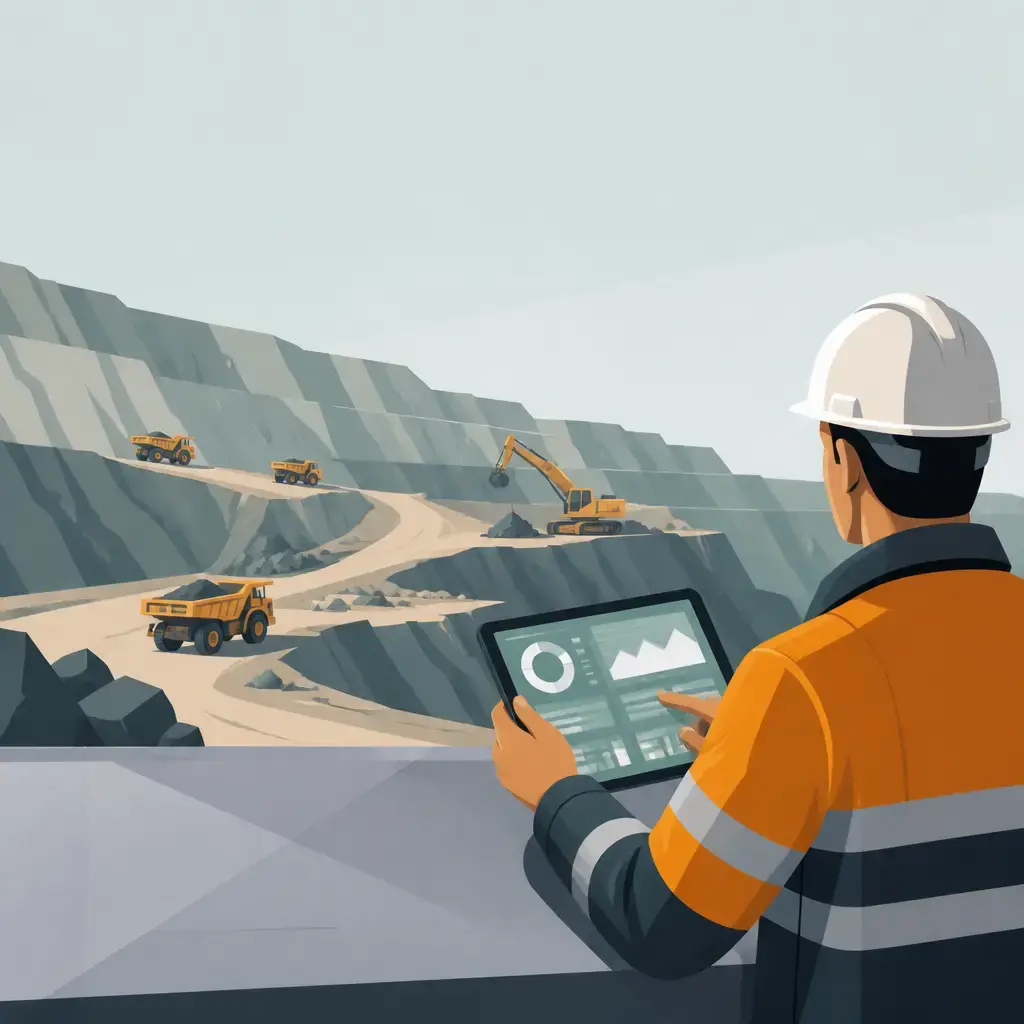
Spreadsheets have run quarry and mining operations for a very long time. They're familiar, cheap and flexible enough to handle almost anything, until the operation grows, the regulatory pressure mounts, or a simple formula error sends the wrong lorry to the wrong loading bay. That's the point where a growing number of quarry operators, mining companies and aggregate producers are making the move to purpose-built custom software.
This isn't just a tech trend. It's a practical response to the real demands of extractive industry: vehicle throughput, safety compliance, machinery integration and the ability to manage it all without being physically on site.
Key Takeaways
- Spreadsheet-based management creates bottlenecks, compliance risks and limited visibility at busy quarry and mining sites.
- Custom software can automate queue management, vehicle bookings, site entry and exit, and integration with crushing plant machinery.
- A modular approach means operators only pay for and activate the features they actually need.
- Cloud-based, mobile-accessible systems let managers monitor and control operations from anywhere.
- Safety and regulatory compliance improve when automation reduces the need for personnel to move around active extraction areas.
Why Spreadsheets Eventually Let You Down
There's nothing wrong with a well-built spreadsheet. For a small operation running a handful of vehicles a day, it can do the job. But extractive sites aren't static. Quarries scale up. Regulatory requirements around safety and environmental reporting tighten. The number of contractors, vehicles and machinery integrations multiplies.
At that point, spreadsheets start to buckle. They don't talk to your weighbridge. They can't flag a vehicle queue building at the gate. They can't tell a crusher operator that a delivery is running twenty minutes late. And they certainly can't give you a live view of what's happening on site when you're in a meeting or working remotely.
More critically, manual data entry creates error risk. In a high-hazard environment like a quarry or mine, an error isn't just an inconvenience, it can mean a compliance failure, a safety incident, or a vehicle in the wrong place at the wrong time.
What Custom Software Actually Does Differently
The shift to purpose-built software for quarries and mining operations isn't about replacing humans with machines. It's about giving the people running the site far better information and control, with less friction.
Here's what that looks like in practice across the areas that matter most.
Queue and Booking Management at Site Entry and Exit
One of the most immediate pain points at any busy quarry is the gate. Vehicles pile up, drivers wait, and the whole operation loses time. Custom software can manage bookings and queues at both entry and exit points, so arrivals are staggered, vehicle transit is faster, and the site isn't overwhelmed at peak times.
This isn't just an efficiency gain. Fewer vehicles idling at the gate means less congestion in areas where heavy plant is moving, which directly reduces safety risk.
Integration With Site Machinery
A quarry doesn't operate in isolation. Crushing plants, weighbridges, conveyor systems and other machinery are all generating data constantly. The problem is that data usually lives in silos, the weighbridge software doesn't talk to the dispatch system, which doesn't talk to the booking platform.
Custom software built for extractive operations can interface with existing site machinery and connected devices, including material crushing plants, pulling data from all of them into a single system. That means a site manager gets one coherent picture rather than five separate ones they have to reconcile manually.
Real Time Monitoring and Mobile Access
One of the clearest advantages of a cloud-based system over a spreadsheet is accessibility. A spreadsheet lives on someone's laptop. A cloud platform is available from any device, which, on a quarry site, typically means a mobile phone or tablet.
Manager needs to check vehicle throughput from the site office? Fine. Needs to approve a booking from a vehicle on another part of the site? Also fine. The control doesn't disappear the moment you step away from a desk.
Automatic monitoring of operations means fewer things fall through the cracks. The system is watching the processes so the people running the site can focus on the decisions that actually need human judgement.
Safety and Regulatory Compliance
Extractive industries operate under serious health and safety obligations. In the UK, quarry operators are subject to the Quarries Regulations 1999 alongside broader health and safety legislation, and the paperwork and record-keeping requirements that come with them are substantial.
Automation helps here in two ways. First, it reduces the need for personnel to physically move around active areas of the site to collect information or manage processes. Less movement in hazardous zones means fewer opportunities for incidents. Second, a well-built system creates automatic records of operations, which makes compliance reporting significantly more straightforward than trying to reconstruct it from spreadsheets after the fact.
The Modular Approach: Pay for What You Need
One concern operators often raise about custom software is cost and complexity. If the system is built from scratch for your operation, doesn't that mean you're paying for a vast amount of capability you'll never use?
The answer, increasingly, is no, because well-designed systems for this sector are modular. You activate the modules relevant to your site, your processes and your scale. A smaller quarry might start with queue management and vehicle tracking, then add machinery integration later as the operation grows. A large mining operation might need the full stack from day one.
This modularity also means the software can scale with the business rather than becoming obsolete when the business changes. That's a meaningful difference from either a spreadsheet or an off-the-shelf system that was never built with extractive industry in mind.
The Rare Earth and Mining Picture
Beyond aggregate quarries, the same logic applies across the broader extractive sector, from rare earth mineral operations to open-cast coal sites to offshore aggregate dredging. These are all environments where:
- Operational data is complex and high-volume.
- Regulatory scrutiny is intense.
- Safety is non-negotiable.
- The cost of inefficiency compounds quickly.
Rare earth extraction in particular has come under increasing attention globally as demand for battery minerals and electronics components grows. These are operations that often run in remote or challenging locations, where manual processes and paper records are especially ill-suited. The case for software that automates data capture, integrates with remote monitoring equipment and provides cloud-based visibility is arguably even stronger in these environments than in a standard aggregate quarry.
Making the Business Case
For a business owner or operations manager weighing up the move from spreadsheets to custom software, the case usually comes down to a few straightforward questions.
What is the current system costing you? Not just in software licence fees, but in staff time spent on manual data entry, errors that need investigating, compliance reporting that takes days to pull together, and vehicle downtime at the gate.
What are the regulatory stakes? In extractive industries, a compliance failure isn't just a fine, it can mean a site closure. If your current system makes compliance harder to demonstrate, that's a real risk on the balance sheet.
How much visibility do you actually have? If the honest answer is "not much, unless someone tells me", then the upside from real-time monitoring and mobile access is substantial.
Can you grow on your current system? If you're already managing complexity with workarounds and workarounds of workarounds, the answer is probably no.
Custom software doesn't solve every problem. It needs proper scoping, good implementation and buy-in from the people using it day to day. But for extractive operations that have outgrown their spreadsheets, it's the logical next step.
What to Look for in a Custom Software Partner
If you're exploring bespoke software for a quarry, mining or extraction operation, a few things are worth checking before you commit.
First, look for experience with industrial or operational environments, not just web applications. A system that needs to interface with weighbridges and crushing plant machinery has different requirements to a booking system for a hotel.
Second, ask about integration capability. Your site already has devices and systems. The software needs to work with them, not replace them wholesale.
Third, check how the system handles offline or low-connectivity situations. Quarry sites and remote mining locations don't always have reliable internet. A system that becomes useless when the signal drops is a liability.
Fourth, understand the support and maintenance model. Custom software needs ongoing attention, updates, security patches, adjustments as your processes change. Make sure that's covered.
At IceBoxDesigns, we build bespoke software for operational and industrial businesses, the kind of systems that integrate with existing infrastructure, give management real-time visibility, and actually fit the way the business runs rather than forcing the business to adapt to the software. If you're weighing up what a move away from spreadsheets would look like for your operation, we're happy to talk through the options.
Frequently asked questions
What can custom software do for a quarry that a spreadsheet can't?
Custom software can automate queue and booking management at site entry and exit, integrate in real time with on-site machinery like crushing plants and weighbridges, monitor operations automatically, and give managers mobile access from anywhere. Spreadsheets require manual data entry, don't talk to other systems and offer no real-time visibility.
Is custom software for quarries only relevant to large operations?
No. A modular system lets you activate only the features you need, so a smaller quarry can start with the basics, queue management, vehicle tracking, and add more capability as the operation grows. You're not forced to take on a system built for a much larger site.
How does automation improve safety on a quarry site?
By reducing the need for personnel to physically move around active extraction areas to collect data or manage processes, automation cuts down the number of people in high-hazard zones. It also creates automatic records of operations, which makes demonstrating compliance with health and safety regulations significantly easier.
Can bespoke software integrate with machinery already on our site?
Yes, provided it's built with integration in mind. Well-designed custom software for extractive operations can interface with existing on-site devices and machinery, including crushing plants, so you get a single unified picture rather than data trapped in separate systems.
Related articles
- Software Development
eCoCs Explained: What the UK's Electronic Certificate of Conformity Means for Vehicle Manufacturers
10 September 2026 - Software Development

MVP to Scalable Product: How to Scope It Right and Know When to Scale
20 August 2026 - Software Development
Why ERP Integration, Not AI Tools, Is the Real Starting Point for Manufacturers
6 July 2026
Related services
Need a hand with this? Here's how IceBoxDesigns can help.