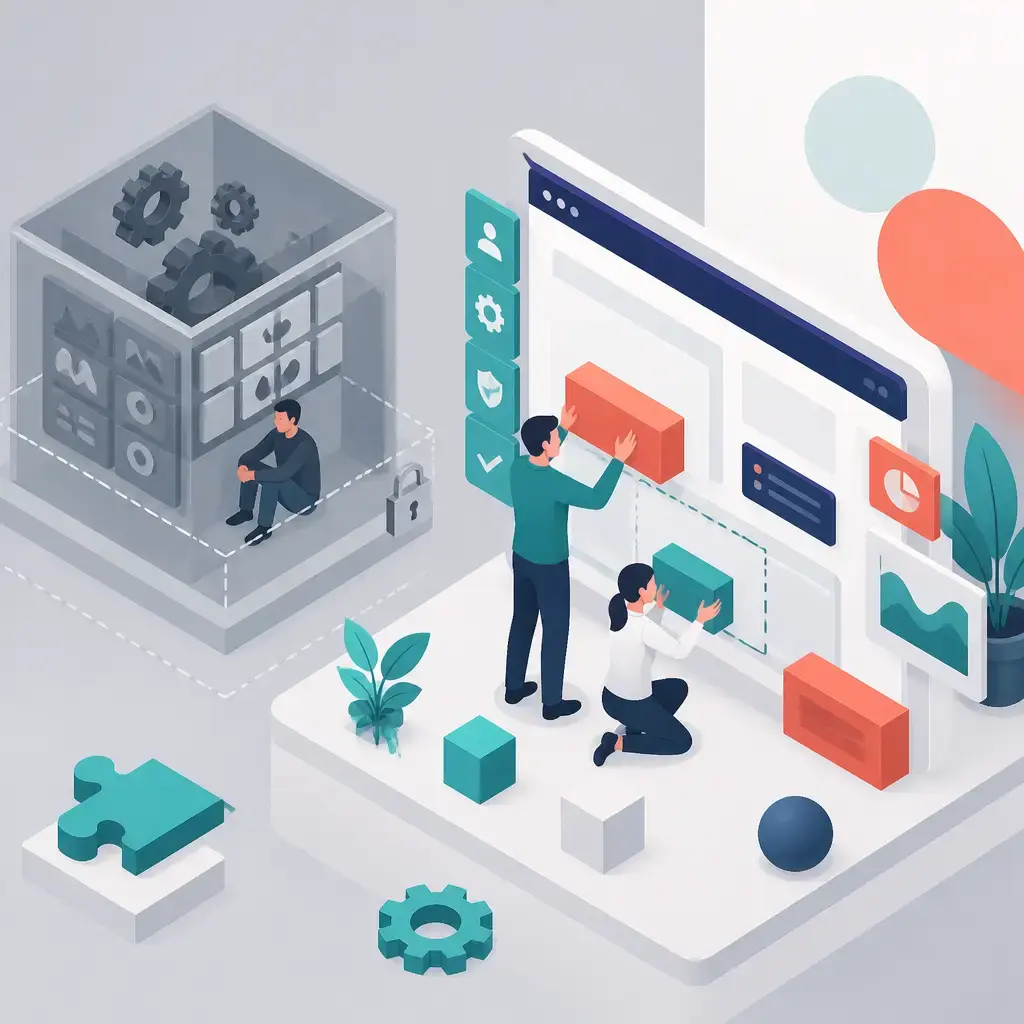
Off the shelf software makes you fit around it. Custom software development does the opposite, it's built around how your business actually works. That might sound like a luxury, but for growing businesses with specific processes, compliance requirements, or integration needs, a generic tool can quietly cost more than a bespoke one ever would.
According to Grand View Research, the custom software development market is expected to grow at a rate of 22.6% CAGR from 2025 to 2030. That's not a niche trend, it reflects how many businesses across industries are realising that generic tools have a ceiling.
Key Takeaways
- Custom software is designed and built from scratch to meet your exact business needs, workflows, and industry regulations, not the other way around.
- Off-the-shelf software often looks cheaper upfront but brings recurring licensing fees, limited flexibility, and forced process changes.
- Custom solutions offer complete data control, planned updates on your timeline, and security built in from the ground up.
- Compliance requirements, GDPR, HIPAA, PCI DSS, can be woven directly into a custom build, reducing legal and operational risk.
- The market is expanding fast, with low-code platforms making custom development more accessible and cost-effective than ever before.
What Custom Software Development Actually Means
Custom software development is the process of designing, building, and deploying software specifically for the needs of one business or individual. That's different from buying a licence for a product that thousands of other businesses also use.
The practical implication is significant. A bespoke system can plug directly into your existing tools, mirror your actual workflows, and grow with you as your needs change. You're not waiting for a vendor to add a feature to their roadmap, your development team builds what you need, when you need it.
It's also worth knowing that the barriers to custom development have come down considerably. Low-code platforms, which let developers build fully customised applications with far less manual coding, have made bespoke builds faster and more affordable. This is particularly relevant for small and medium businesses that previously felt priced out of the custom route.
Custom Software vs. Off-the-Shelf: What's the Real Difference?
The choice often comes down to short-term cost versus long-term fit. Here's how the two approaches compare across the factors that matter most:
| Factor | Custom Software | Off-the-Shelf Software |
|---|---|---|
| Upfront cost | Higher | Lower |
| Long-term cost | Lower (no recurring licence fees) | Higher (ongoing licensing, add-ons) |
| Flexibility | Built around your workflows | You adapt to the software |
| Scalability | Scales to your exact requirements | Limited by the vendor's roadmap |
| Security | Built to your specifications | Shared, standardised security model |
| Compliance | Designed in from the start | May require costly workarounds |
| Updates | On your timeline | Vendor-controlled, often disruptive |
| Integration | Tailored to your existing systems | May require middleware or compromise |
The table makes the trade-offs clear. Off-the-shelf software isn't a bad choice for every situation, if a standard tool genuinely does what you need, there's no reason to build from scratch. But when your processes are specific, your data is sensitive, or your compliance obligations are real, forcing a generic product to fit is often the more expensive path in the long run.
The Benefits Worth Knowing About
You Own Your Data, Completely
With a custom system, you decide where your data lives, how it's stored, and who can access it. That means private cloud storage, your choice of hosting provider, encryption protocols that match your risk profile, and cybersecurity measures suited to your industry. With off-the-shelf software, you're working within whatever data management approach the vendor has chosen, and that's rarely optimised for your specific situation.
For any UK business handling personal data, this matters enormously. GDPR compliance isn't just a tick-box exercise, and having full control over your data architecture makes it far easier to demonstrate compliance and respond quickly if something goes wrong.
Updates Happen When You're Ready
One of the most underrated frustrations with off-the-shelf software is the forced update. The vendor decides when a new version goes live, and sometimes that means unexpected downtime, changed interfaces, or features disappearing without warning. With custom software, updates are planned around your schedule. You test before you deploy, and your team isn't blindsided by changes they didn't ask for.
Compliance Is Built In, Not Bolted On
If your business operates in healthcare, finance, e-commerce, or any other regulated space, compliance isn't optional. Custom software lets you build GDPR, HIPAA, PCI DSS, or any other relevant regulation directly into the system architecture from day one. That's a fundamentally different approach from buying off-the-shelf software and then trying to configure it to meet regulations it wasn't designed for. The latter tends to be expensive, imperfect, and prone to gaps.
Dedicated Support That Knows Your System
With a bespoke system, the team that built it understands it completely. When something breaks or needs changing, you're not raising a ticket into a generic support queue, you're working with people who know every part of your software. That means bugs get fixed faster, security vulnerabilities get patched quickly, and changes can be made without unexpected side effects elsewhere in the system.
Automation That Actually Fits Your Processes
Custom software can automate the specific repetitive tasks your business actually faces, not a generic set of workflows that sort-of match what you do. Whether that's data entry, inventory updates, customer notifications, reporting, or something entirely specific to your industry, a bespoke build automates what you need automated, integrated with the other tools and systems you already use.
This is an area where the gap between custom and off-the-shelf can be enormous. Generic automation tools give you pre-built workflows that you adapt your processes to fit. Custom automation is built around the process you already run, or the improved version of it you want to run.
Long Term Cost Efficiency
The upfront investment in custom software is real. But so are the ongoing costs of off-the-shelf tools: licensing fees, per-user charges, premium tiers to unlock features you actually need, and the hidden cost of staff working around limitations every day. A custom build eliminates unnecessary features you're paying for but don't use, removes recurring licence fees, and gives you full ownership of the software itself. Over three to five years, many businesses find the custom route considerably cheaper.
When Does Custom Software Make Most Sense?
Not every business needs a fully bespoke system, and it's worth being honest about that. Custom development makes the strongest case when:
- Your processes are genuinely unique and no off-the-shelf tool covers them well
- You operate in a regulated industry where compliance needs to be built into the system architecture
- You're dealing with sensitive data that requires specific security and hosting arrangements
- You need deep integration with other internal systems or third-party tools
- You've outgrown your current software and keep hitting its limits
- You want full ownership and control, with no dependency on a vendor's decisions
For businesses in growth mode especially, the scalability question is critical. Custom software is built to scale with you, not to a ceiling the vendor set when they built their product.
Low-Code Platforms: Custom Development Without the Complexity
One of the most significant shifts in the custom software space is the rise of low-code development platforms. These tools allow developers to build fully customised applications using visual interfaces, drag-and-drop components, and pre-built logic, without writing every line of code from scratch.
Platforms like Visual LANSA, for instance, provide a drag-and-drop interface and visual development tools designed to make it easier to implement automated processes and connect to backend systems with minimal coding effort. Visual LANSA's centralised, active repository approach is also designed to reduce application maintenance costs by as much as 80%, with cross-referencing capabilities that help developers quickly find where specific components are used and generate impact lists for efficient, targeted updates.
The upshot for businesses is that custom development no longer necessarily requires a large team of specialist developers working for months. Low-code platforms can bring down both the cost and the timeline considerably, making bespoke builds more accessible to smaller organisations than they've ever been.
Practical Considerations Before You Start
If you're seriously thinking about commissioning custom software, a few things are worth getting clear before any development starts:
Define the problem first, not the solution. The most successful custom software projects start with a very clear articulation of the problem to be solved, not a list of features. Features can be built in many ways, the problem is fixed.
Map your current workflows honestly. A bespoke system is only as good as the processes it reflects. If your current workflows are messy or inconsistent, those problems will be built into the software. It's worth spending time tidying the process before the build starts.
Think about integration early. What other systems does this software need to talk to? Your CRM, accounting software, e-commerce platform, or third-party APIs? Integration requirements significantly affect architecture decisions, so they need to be on the table from the beginning.
Plan for maintenance. Custom software needs ongoing care, security updates, bug fixes, and new features as your business evolves. Factor in a maintenance arrangement from the start, so the system doesn't stagnate once it's launched.
Get the data ownership terms in writing. If you're working with a development agency or partner, make sure the contract is clear about who owns the codebase and the data. With genuine custom software, you should own both outright.
Why 'Tailored' Isn't Just a Buzzword
The word 'tailored' gets thrown around a lot in software marketing, but in the context of custom development it means something specific and concrete. A tailored solution doesn't just have your logo on the login screen, it reflects your actual data model, your team's actual workflows, your actual compliance obligations, and your actual integration requirements.
That specificity is what drives the real advantages: higher user adoption because the software matches how people actually work, fewer workarounds and manual fixes, cleaner data because the system captures exactly what you need, and faster processes because nothing is designed for someone else's business.
For businesses with genuinely unique challenges, whether that's a complex operational model, a niche industry, a specific regulatory environment, or an ambitious growth plan, off-the-shelf tools will always be a compromise. Custom software development is how you stop compromising.
If you're exploring a bespoke build for your business, IceBoxDesigns custom software development service covers everything from initial scoping through to build, integration, and long-term support. Whether you need an internal tool, a customer portal, an API integration, or a full operational platform, we build around what you actually need, not what's easiest to package.
Frequently asked questions
How much does custom software development cost compared to off-the-shelf software?
Custom software has a higher upfront cost, but off-the-shelf products typically carry ongoing licensing fees, per-user charges, and premium tier costs that add up over time. Custom software also eliminates the hidden cost of staff working around tool limitations every day. Over several years, many businesses find the bespoke route cheaper overall.
How long does it take to build custom software?
It depends heavily on the scope and complexity of the project. Simple internal tools can take weeks; complex platforms with multiple integrations can take many months. Low-code development platforms have reduced timelines significantly for many types of projects, making bespoke development faster and more accessible than it used to be.
Is custom software development suitable for small businesses?
Yes, particularly where a small business has specific workflows, compliance requirements, or integration needs that generic tools don't cover well. Low-code platforms have also brought the cost and complexity of custom builds down considerably, making them realistic for smaller organisations.
What's the difference between custom software and a customised off-the-shelf product?
A customised off-the-shelf product is a generic tool with configuration options applied, you're still working within the vendor's framework. Custom software is built from scratch to your exact requirements, meaning your processes, data model, integrations, and compliance needs are reflected in the architecture from day one.
Related articles
- Software Development
eCoCs Explained: What the UK's Electronic Certificate of Conformity Means for Vehicle Manufacturers
10 September 2026 - Software Development
MVP to Scalable Product: How to Scope It Right and Know When to Scale
20 August 2026 - Software Development
Why ERP Integration, Not AI Tools, Is the Real Starting Point for Manufacturers
6 July 2026
Related services
Need a hand with this? Here's how IceBoxDesigns can help.