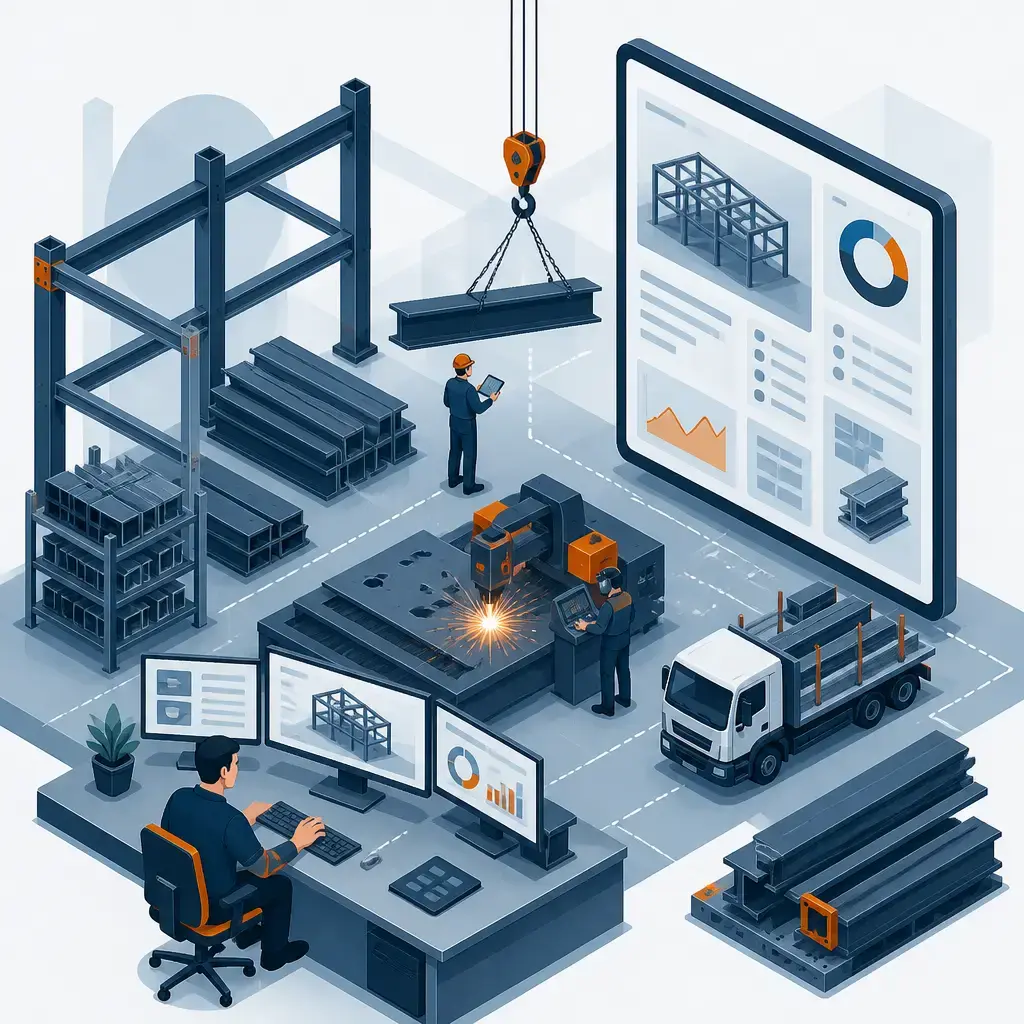
Metal fabrication and structural steel businesses are not short of operational complexity. You're tracking raw materials across multiple jobs, managing supplier deliveries, keeping stock levels balanced, and producing documentation that has to be right first time. Most businesses in this sector are still running a patchwork of spreadsheets, legacy tools and manual processes to hold it all together. That works, until it doesn't.
Bespoke software for metal fabrication is not a new idea, but it is becoming a much more accessible one. And for businesses working in steel, aluminium and other structural materials, the case for getting off generic tools and onto something purpose-built is stronger than ever.
Key Takeaways
- Metal fabrication businesses face specific software challenges that off-the-shelf tools rarely address well, particularly around material tracking, stock optimisation and document exchange.
- Custom software can give you real-time visibility across inventory, orders and production workflows in a single system.
- Automated material tracking and forecasting directly reduces waste, scrap and overstocking, which hits the bottom line.
- Integration with industry-standard tools (accounting packages, barcode scanners, ERP systems) means a bespoke solution does not have to exist in isolation.
- A well-built system pays for itself through time savings, fewer errors and better production efficiency.
Why Generic Software Falls Short for Fabricators
The problem most fabricators run into is that generic business software is not built around the way a metal or steel business actually works. A standard inventory system designed for retail or wholesale does not understand Bills of Material, material traceability, cutting schedules or the relationship between raw stock and finished structural components.
You end up bending the software to fit your processes, or more likely, your team invents workarounds. Someone maintains a separate spreadsheet for material offcuts. Someone else keeps a manual log of what went to which job. The result is data spread across multiple places, no single source of truth, and errors that only surface when something goes wrong on the shop floor or a delivery is wrong.
For structural steel fabricators in particular, where a single shipment error can hold up an entire construction project, that is a serious operational risk.
What a Purpose Built Software Solution Actually Does
The core value of a bespoke or purpose-built system is that it is designed around your specific workflows, not around a generic business model. Here is what that looks like across the main operational areas:
Real Time Material Tracking
Good fabrication software tracks raw materials and finished products throughout the entire fabrication process, in real time. That means you always know where a piece of stock is, what job it has been allocated to, how much has been consumed and what remains. It eliminates guesswork and prevents the two most common and costly problems: overstocking (tying up cash in materials you do not need right now) and shortages (stopping production because something critical has run out).
For steel fabricators, where material costs are a significant proportion of job costs, accurate tracking directly protects your margins.
Automated Stock Optimisation
Beyond tracking what you have, a well-designed system forecasts what you will need. Automated forecasting tools look at your order pipeline, historical usage and lead times from suppliers to keep stock levels at the right point. Not too high, not too low. This reduces storage costs, frees up working capital and means you're not turning down work because materials are not available.
Streamlined Document Exchange
Fabrication businesses generate a lot of paperwork: purchase orders, delivery notes, invoices, shipment records, quality certificates. Managing this manually is slow and error-prone. Automated document exchange, sometimes handled through Electronic Data Interchange (EDI) systems, automates the flow of these documents between your business and your suppliers or customers. Orders get processed faster, invoices match deliveries, and communication does not get lost in email inboxes.
For businesses supplying into construction or manufacturing supply chains where customers have strict EDI requirements, this capability moves from a nice-to-have to a commercial necessity.
Full Supply Chain Visibility
Knowing what is happening inside your business is one thing. Knowing what is happening across your supply chain is another. A purpose-built system gives you visibility into inbound material shipments, supplier lead times and delivery schedules, so you can plan production around what is actually going to arrive and when. If a delivery is going to be late, you know early enough to adjust rather than having your team standing idle.
Waste and Scrap Reduction
Material waste is a direct cost in fabrication. With accurate real-time usage data, software can highlight where excess consumption is occurring, flag inefficiencies in cutting or processing, and help your team make better decisions about material allocation. Even a modest reduction in scrap across a year's production can be significant in value.
The Integration Question
One concern fabricators often raise about custom software is whether it will work alongside the tools they already use. The short answer is yes, if it is built properly.
A well-designed bespoke system can integrate with accounting packages like QuickBooks, barcode scanning hardware from manufacturers such as Zebra and similar industrial-grade devices, and industry-specific platforms. For structural steel fabricators, integration with tools like Tekla PowerFab is particularly valuable, as it bridges the gap between design and detailing on one side and production and inventory management on the other. Businesses using software that integrates tightly with Tekla have reported errors in shipping and inventory control being completely eliminated.
The key is that integration needs to be designed in from the start, not bolted on afterwards. That is one of the strongest arguments for a custom build over trying to force two off-the-shelf systems to talk to each other.
What This Looks Like for Small and Mid-Sized Fabricators
There is sometimes an assumption that sophisticated software is only for large operations. That is not the case. Purpose-built solutions can be built or configured for small to mid-sized fabricators, with features scaled to what you actually need rather than a full enterprise deployment you'll use 20% of.
For a smaller fabricator, the most impactful areas are usually inventory tracking, job costing and document management. These are the areas where manual processes create the most friction and where automation delivers the fastest return. A well-scoped custom build does not need to cover everything on day one. It can start with your biggest pain point and grow from there.
For a larger or more complex operation, the scope expands: multi-level Bills of Material, quality management, financial reporting, traceability across the full production chain, and integration with customer systems. xTuple ERP, for example, is designed with small to mid-sized fabricators in mind and includes tools for managing quotes and special pricing, multi-level Bills of Material, financial reporting, traceability and quality management, showing the kind of functionality that genuinely belongs in a fabrication-specific system.
The Business Case in Plain Numbers
It is worth being concrete about where the value comes from, even without attributing specific numbers to your business, because the categories of saving are consistent across fabricators:
| Area | How Software Helps | Type of Saving |
|---|---|---|
| Material tracking | Eliminates manual stock checks and allocation errors | Time and materials |
| Stock optimisation | Reduces overstocking and prevents shortages | Working capital and production uptime |
| Document automation | Removes manual data entry from purchase orders and invoices | Admin time and error costs |
| Waste reduction | Real-time usage data flags excess consumption | Direct material cost |
| Supply chain visibility | Earlier warning of delivery issues | Production continuity |
| Integration | Single source of truth across systems | Fewer mistakes, less duplication |
One well-documented example: xTuple helped Creamer Metal Products cut 50% of unnecessary expenses. That figure came from a real implementation, not a theoretical model, and it illustrates how much inefficiency can be buried in manual processes that people have simply stopped questioning.
Building vs Buying: What Is Right for Your Business?
For many fabricators, the starting point is a decision between buying an off-the-shelf product designed for the sector and commissioning something built specifically for how your business operates.
Off-the-shelf products designed for fabrication are significantly better than generic business software. If your processes are fairly standard and you are willing to adapt to the software's way of working, they can be a good choice, especially for smaller operations that need to get up and running quickly.
A fully bespoke system makes more sense when your processes are genuinely different from the norm, when you have existing systems that need to integrate in specific ways, or when you want the software to work around your team rather than requiring your team to work around the software. It also makes sense when you are building something you want to own outright and adapt over time without being dependent on a vendor's roadmap.
The honest answer is that many fabricators end up in a middle ground: a core platform that handles standard functionality, extended or modified by custom development to fit their specific needs. That hybrid approach often delivers the best balance of speed to value and long-term flexibility.
How IceBoxDesigns Can Help
At IceBoxDesigns, we build bespoke software and custom web applications for businesses with complex operational needs, and metal fabrication and structural steel businesses are a good fit for what we do. Whether you need a standalone inventory tool, a job management system, a customer portal that connects to your production data, or a full operational platform with API integrations to your existing software, we build it around your processes, not around a generic template.
We are not selling you a product off a shelf. We sit down with you, understand how your business actually works, and build something that fits it. If you are running a fabrication or steel business and your current software is letting you down, it is worth having a conversation about what a purpose-built solution could do for you.
Get in touch with IceBoxDesigns to talk through what your business needs.
Frequently asked questions
Do I need a large business to justify custom fabrication software?
No. Purpose-built solutions can be scoped for small and mid-sized fabricators. You start with your biggest pain point, whether that is inventory tracking, job costing or document management, and scale from there. The savings in time and materials tend to justify the investment well before you reach enterprise scale.
Can bespoke software integrate with the tools we already use, like QuickBooks or Tekla?
Yes, provided integration is designed in from the start. A well-built custom system can connect to accounting packages, barcode scanning hardware and industry-specific platforms like Tekla PowerFab. Businesses using software that integrates tightly with Tekla have reported shipping and inventory control errors being completely eliminated.
What is the difference between off-the-shelf fabrication software and a bespoke build?
Off-the-shelf products designed for fabrication are a solid choice if your processes are fairly standard and you are happy to adapt to the software. A bespoke build makes more sense when your workflows are non-standard, you need specific integrations, or you want to own and adapt the system over time without depending on a vendor's roadmap.
How does software reduce waste and scrap in a metal fabrication business?
By giving you real-time usage data, the software can flag where excess material consumption is occurring, help your team allocate stock more precisely to each job, and highlight inefficiencies in cutting or processing. Even a modest reduction in scrap, sustained across a full year's production, has a meaningful impact on profitability.
Related articles
- Software Development
eCoCs Explained: What the UK's Electronic Certificate of Conformity Means for Vehicle Manufacturers
10 September 2026 - Software Development

MVP to Scalable Product: How to Scope It Right and Know When to Scale
20 August 2026 - Software Development
Why ERP Integration, Not AI Tools, Is the Real Starting Point for Manufacturers
6 July 2026
Related services
Need a hand with this? Here's how IceBoxDesigns can help.