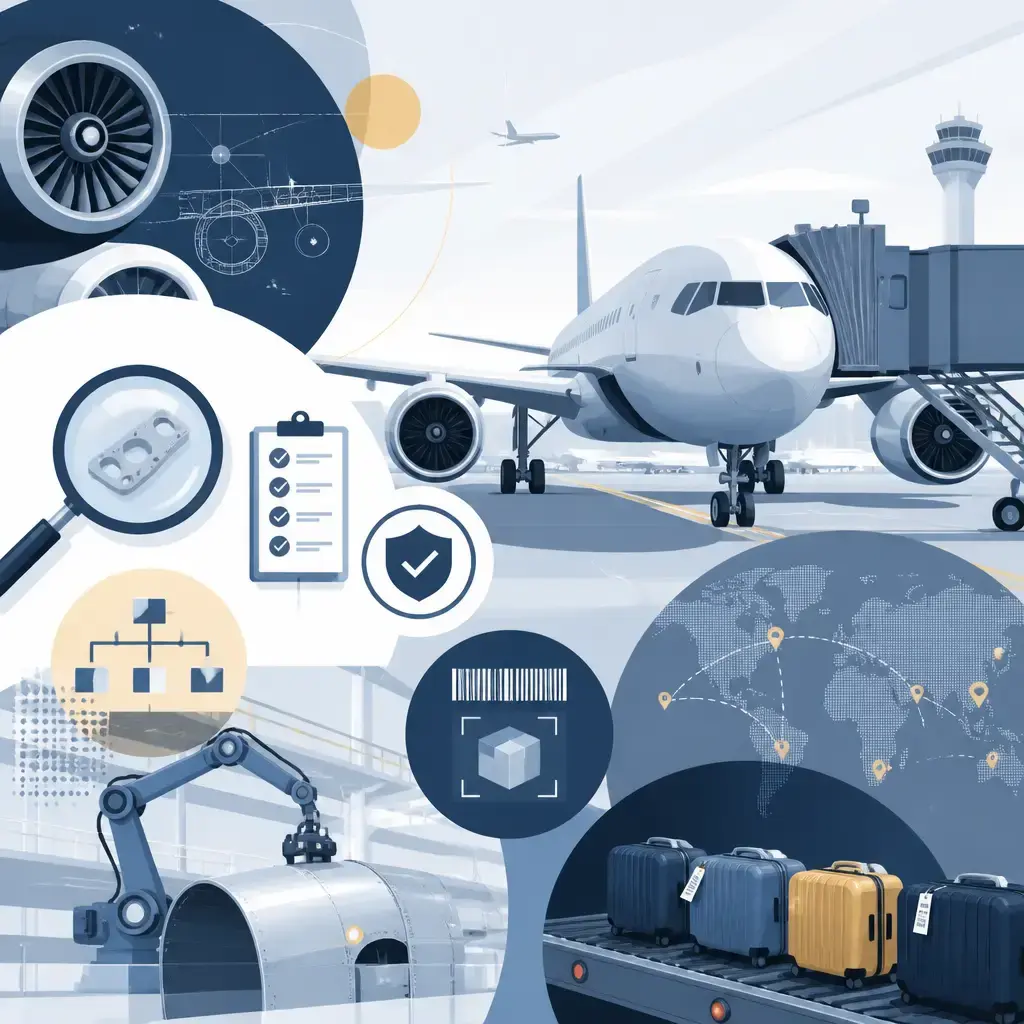
Aerospace ERP is manufacturing software built for one of the most heavily regulated industries on earth. Where a generic ERP platform tracks stock and orders, an aerospace focused one tracks every serial number, every batch, every engineering change and every inspection checkpoint, because standards like AS9100, FAA, EASA and MOD requirements demand exactly that level of documentation. This article looks at what aerospace ERP actually does, where generic platforms fall short, and then a cautionary tale from the airline side of the same industry: what happened to baggage handling when staff disappeared and the data stopped flowing between systems. The lesson at the end applies well beyond aviation.
Key takeaways
- Aerospace manufacturers deal with deep multi-level Bills of Materials, strict standards (AS9100, FAA, EASA, MOD), end-to-end traceability requirements and frequent engineering changes. Generic ERP rarely handles any of that well.
- Industry-focused ERP pulls production, MRO, supply chain, engineering and compliance into one platform, with serial and batch tracking, CAPA workflows and complete audit trails built in.
- The airline side of aviation shows what disconnected data costs. SITA's figures put mishandled baggage at nearly 0.8% of all passenger bags in 2022, and bags mishandled during transfers cost the industry $2.2 billion that year alone.
- Whether it's a factory floor or an airport apron, the fix is the same: shared, real-time data flowing between every system and stakeholder, not records trapped in silos.
Why aerospace manufacturing breaks ordinary software
Most manufacturing software assumes a fairly simple world. You buy materials, you make things, you ship them, you invoice. Aerospace doesn't work like that, and the gap between what generic tools assume and what the sector actually demands is where problems start.
Here's what aerospace manufacturers are actually up against:
- Complex multi-level Bills of Materials. Aircraft components sit inside deep hierarchical structures with long production cycles. A single assembly can involve thousands of individual components, each with its own revision history and supply chain.
- Strict regulatory compliance. Standards such as AS9100, FAA, EASA, MOD and other defence requirements mandate strict documentation and quality processes. These aren't guidelines you can interpret loosely. Fail an audit and contracts are at risk.
- End-to-end traceability. Every part, batch and material must be traceable throughout the lifecycle of the aircraft or component. If a part fails in service, you need to know where it came from, what it went into and where everything from the same batch ended up. Quickly.
- Rigorous quality expectations. Non-conformance leads to costly rework, delays or contract penalties. There's very little tolerance for "close enough".
- Extended global supply chains. Manufacturers rely on multiple tiers of suppliers, each needing real-time visibility and strict approvals. Your traceability obligations don't stop at your own factory gate.
- High-frequency engineering changes. Designs, materials and processes change often, and every change needs proper configuration and revision control so the shop floor never builds to a superseded drawing.
Any one of these would stretch a generic system. All six together, every day, on every order, is why the sector has moved towards software built specifically for it.
What aerospace ERP gives you that generic platforms don't
Generic ERP can handle basic manufacturing workflows. What it rarely offers is the depth needed for aerospace-specific requirements: stringent traceability, engineering change control and compliance documentation. Aerospace ERP closes those gaps by bringing production, MRO, supply chain, engineering and compliance workflows together in one unified platform, rather than leaving each department with its own disconnected tool.
In practice, that means:
- Specialised modules for quality, document control, production and MRO, instead of bolted-on workarounds.
- Real-time data visibility, so decisions across departments are made on current information rather than last week's export.
- Integrated workflows that cut out duplication and manual rekeying between systems.
- Configurable processes that can be shaped to sector-specific and customer-specific requirements.
- Greater control over compliance, keeping day-to-day operations aligned with the standards the business is audited against.
The payoff is precision, better operational efficiency and audit readiness across the whole organisation, rather than a scramble every time a customer or regulator asks to see the paperwork.
Full traceability and serial/batch control
Traceability is the foundation everything else sits on. Safety, quality and compliance all depend on knowing exactly where each part came from and how it was used. Aerospace ERP handles this at the level the sector requires:
- Serial and batch tracking for every part, component and material.
- Complete audit trails documenting inspections, tests and certifications.
- Rapid data retrieval to support customer audits, investigations or recalls.
- Provenance tracking from raw materials right through to final assembly and beyond.
That last point matters more than it might sound. When a customer audit lands or a recall question comes in, the difference between pulling a full provenance record in minutes and spending days reconstructing it from paper and spreadsheets is enormous. One is a demonstration of control. The other is a red flag to an auditor.
Quality assurance and compliance management
In aerospace, quality isn't a department that checks things at the end. It's embedded in every step, and the ERP system is what makes that practical rather than aspirational. Dedicated quality modules give manufacturers:
- Integrated quality management tools aligned with AS9100 and other industry standards.
- Document and revision control for procedures, work instructions and certifications.
- Non-conformance and CAPA (Corrective and Preventive Action) workflows, so problems are logged, investigated and closed out properly instead of dealt with informally.
- Inspection checkpoints built directly into production processes, so a job physically can't move forward past a missed inspection.
The effect is that issues get spotted early, while they're still cheap to fix, and every action taken is documented and traceable. When the auditor asks "how do you know this was inspected?", the answer is in the system, timestamped, not in someone's memory.
Managing multi-level assemblies and engineering change
Aerospace products often involve thousands of components arranged in deep BOM structures, and those structures don't stand still. Designs evolve constantly. Aerospace ERP keeps this under control with:
- Multi-level BOM management for genuinely complex structures.
- Configuration and revision tracking, so engineering and production are always working from the same, current version.
- Engineering change control workflows with approvals, impact assessments and audit trails.
- Real-time visibility of component availability and assembly progress.
The impact assessment part is worth dwelling on. When a material spec changes, you need to know immediately which assemblies, which open orders and which stock holdings are affected. Strong configuration control means fewer errors, better communication between engineering and the shop floor, and the ability to keep evolving designs without chaos.
Production planning and scheduling
Planning in aerospace is hard for structural reasons: long lead times, specialised materials and a lot of resources to coordinate. ERP gives planners tools that match the problem:
- Capacity planning to get the most from machines, labour and other resources.
- MRP (Material Requirements Planning) that syncs demand forecasts with stock levels, so long-lead-time materials are ordered when they need to be, not when someone notices the shelf is empty.
- Scheduling that aligns production with customer deadlines and material availability.
- Scenario modelling, so you can assess the impact of a supply chain disruption or a design change before it hits the schedule, not after.
Together these help manufacturers keep on-time delivery rates up and make the operation more predictable, which in a sector with contract penalties for delay is a commercial issue as much as an operational one.
MRO: maintenance, repair and overhaul
MRO isn't a sideline in aerospace. It's a critical revenue and service function in its own right, and it comes with its own record-keeping and compliance demands. Integrated MRO functionality covers:
- Full asset history and maintenance tracking across each serviced asset's life.
- Contract management and service-level monitoring.
- Field service tools that let engineers log inspections, repairs and part usage on the spot.
- Lifecycle management from initial manufacture through ongoing servicing.
Because MRO sits inside the same platform as production and traceability data, the service history of an asset connects directly back to its build record. That's what makes long-term asset performance genuinely manageable rather than a paper chase.
Supply chain management and supplier collaboration
Aerospace supply chains run across multiple tiers of suppliers, and every tier has to meet the same quality expectations. ERP strengthens this with:
- Approved supplier lists and compliance checks, so purchasing can only go to suppliers who've passed the bar.
- Real-time performance metrics, including delivery accuracy and quality scores.
- Automated purchasing and stock replenishment workflows.
- Visibility across multi-tier supply chains, not just your direct suppliers.
Better transparency here means fewer delays and fewer nasty surprises when materials arrive that don't meet spec.
Defence and high security environments
Defence work raises the bar again. Organisations in this space need heightened levels of security, documentation and control, and the ERP system has to make sure sensitive data and processes are managed properly. If you hold or are bidding for defence contracts, how your systems handle controlled information should be part of the software conversation from day one, not an afterthought.
Generic ERP vs aerospace focused ERP at a glance
| Requirement | Generic ERP | Aerospace-focused ERP |
|---|---|---|
| Traceability | Basic batch tracking at best | Serial and batch tracking for every part, with full provenance from raw material to final assembly |
| Compliance | Generic quality fields | Tools aligned with AS9100, FAA, EASA and MOD requirements, with document and revision control |
| BOMs | Flat or shallow structures | Deep multi-level BOMs with configuration and revision tracking |
| Engineering change | Manual, outside the system | Built-in change workflows with approvals, impact assessments and audit trails |
| MRO | Not covered | Full asset history, contract management and field service tools |
| Suppliers | Purchase orders and invoices | Approved supplier lists, compliance checks and multi-tier visibility |
What baggage handling teaches us about disconnected systems
Here's where it gets interesting. The same industry that demands serial-level traceability on the factory floor has, on the airline side, a long-running case study in what happens when data doesn't flow between stakeholders: baggage.
The current process is more fragile than most passengers realise. When an aircraft arrives, bags are unloaded and immediately sorted into local and transfer baggage. Some network carriers pre-sort and containerise bags in Unit Load Devices (ULDs) based on whether they're local or connecting. Local bags head to reclaim. Transfer bags either go through a sorting facility or, when time is tight, get a direct "tail-to-tail" transfer to the connecting aircraft, which is notably labour-intensive because each bag has to be delivered to a specific aircraft stand. The whole system involves multiple stakeholders and depends on tight timing at every step, which makes it increasingly vulnerable when passenger volumes climb.
The numbers got worse, fast
The industry had been improving for years. The mishandled baggage rate fell to 0.6% of all passenger bags between 2016 and 2019, then dropped to 0.35% during 2020, largely because pandemic travel restrictions slashed passenger numbers. Then travel came back faster than expected and the trend reversed. According to SITA's Baggage IT Insights report, the mishandled rate climbed from under 0.5% of all passenger bags pre-pandemic to nearly 0.8% in 2022.
Breaking that down, 80% of mishandled bags were merely delayed, while the remaining 20% were lost or damaged. Transfer bags made up the majority of mishandled bags in 2022, and the mishandling rate on international flights was eight times higher than on domestic flights. Mishandling during transfers typically happens when handling systems simply don't have enough time to move bags between flights, which is why trips with multiple stops are especially exposed.
The cost is staggering. Airport Industry News reported that mishandled baggage, particularly the over 4 million bags mishandled during transfers, cost the industry $2.2 billion in 2022 alone.
Why it happened
The biggest single cause was the labour shortage at airports. The pandemic downturn led to thousands of dismissals, and when travel resumed the industry couldn't rehire fast enough, especially in ground operations. A 2023 IATA survey found 60% of ground handling supervisors felt they didn't have enough qualified staff to keep operations running smoothly. With fewer people, fewer tail-to-tail transfers happened, so more bags missed their connecting flights. Resurgent international travel and airport congestion made it worse.
But there's a second cause that should sound familiar after everything above about ERP: the absence of comprehensive, real-time data sharing among airlines, airports and ground handling teams. As Aviation Pros have pointed out, that gap in interconnected data flow and real-time tracking is itself a driver of misplaced luggage and delays. It's the baggage version of a factory where engineering, production and quality each keep their own records. Data providers like OAG have positioned themselves around exactly this problem, simplifying complex data and integrating it into the various systems involved so all the stakeholders work from one consistent source of information.
The response: shared systems and real-time visibility
Passengers got tired of waiting and took matters into their own hands. Personal trackers like Apple's AirTags have boomed, with online searches for "luggage tracking" up 220% over the past year and Google searches relating to luggage and "AirTag" more than quadrupling since early 2022. When an industry's customers start building their own tracking layer because they don't trust the official one, that's a message.
The industry is responding. The Airport Business 2023 Baggage Handling System survey found 75% of North American airports plan to upgrade their baggage handling systems within the next five years. SITA's research shows 57% of airlines have already given staff mobile access to real-time baggage information, a figure expected to reach 84% by 2025, and 67% of airlines plan to extend that real-time visibility to passengers themselves, up from 25% today.
There's also long-standing shared infrastructure here worth knowing about. WorldTracer is a SITA and IATA service for tracking lost or delayed baggage. It has been in operation for many years and is used by all airlines that are IATA members, and most of the European low-cost carriers, such as Norwegian Air Shuttle and Wizz Air, use it too. That's the model in miniature: when a problem spans many organisations, the answer isn't every airline building its own isolated lost-bag database. It's a shared, industry-standard system that everyone integrates with. The integration is the value.
The lesson if you're not Airbus or British Airways
You probably don't run an aircraft factory or a ground handling operation. But the pattern in both halves of this story applies to almost any growing business.
The aerospace manufacturers' problem and the airlines' baggage problem are the same problem at different scales: critical information living in disconnected places, moved between them by hand, by people who are stretched. The factory version is engineering changes that don't reach the shop floor in time. The airport version is a transfer bag that misses its flight because no system flagged it early enough. The fix in both cases is connected systems with real-time visibility, and the cost of not fixing it compounds quietly until something expensive happens.
In our experience, the smaller-business version of this looks like a workshop where the quotes live in one spreadsheet, the job tracking in another, the certs in a shared drive, and the only "integration" is someone retyping numbers on a Friday afternoon. It works until volume picks up or a customer audit lands, which is exactly the failure mode the baggage figures show: a manual system that coped at low volume falling over when demand returned. We've written before about the point where spreadsheets start holding a business back, and the warning signs are remarkably consistent across sectors.
There's also a build-versus-buy lesson in WorldTracer. Where a mature, industry-standard platform exists, the smart move is usually to integrate with it rather than reinvent it. The bespoke work that pays off is the connective tissue: the integrations, dashboards and workflow tools that join your industry's standard systems to the way your specific business operates. That's true whether you're a tier-three aerospace supplier needing traceability records your ERP doesn't quite produce, or a logistics firm wanting live visibility your off-the-shelf tools don't give you. If your operation has outgrown manual processes, turning the spreadsheets and gaps into proper custom software is usually a far smaller project than people fear, and considerably cheaper than the rework, penalties and lost customers that disconnected data eventually causes. For businesses still running core processes in Excel, there's even a well-trodden path from spreadsheet to web application that keeps what works and replaces what doesn't.
One more practical point for UK suppliers specifically: if you're in an aerospace or defence supply chain, your customers' compliance obligations flow down to you. Being able to show controlled, traceable, auditable processes isn't only about passing your own audits. It's increasingly a condition of winning and keeping contracts. Software that produces that evidence as a by-product of doing the work, rather than as a separate documentation exercise, is what makes compliance sustainable.
Ready to connect your systems?
If your business runs on systems that don't talk to each other, or on spreadsheets doing a job they were never meant for, we can help. IceBoxDesigns builds bespoke software, integrations and dashboards that give you the kind of visibility this article is about, scaled to your business rather than to an aircraft programme. Talk to us about custom software development and we'll tell you honestly whether you need something built, something integrated, or neither.
Frequently asked questions
What is aerospace ERP?
Aerospace ERP is enterprise resource planning software tailored to aerospace and defence manufacturing. It unifies production, MRO, supply chain, engineering and compliance workflows in one platform, with serial and batch traceability, engineering change control and quality tools aligned with standards such as AS9100, FAA, EASA and MOD requirements.
Why isn't generic ERP enough for aerospace manufacturers?
Generic ERP can handle basic manufacturing workflows but rarely offers the depth aerospace demands: deep multi-level BOM management, serial-level traceability from raw material to final assembly, engineering change workflows with approvals and audit trails, and compliance documentation that stands up to customer and regulatory audits.
What is WorldTracer?
WorldTracer is a SITA and IATA service for tracking lost or delayed baggage. It has been in operation for many years and is used by all IATA member airlines, and most European low-cost carriers such as Norwegian Air Shuttle and Wizz Air use it too.
How big is the mishandled baggage problem?
According to SITA's Baggage IT Insights report, the mishandled baggage rate rose from under 0.5% of all passenger bags pre-pandemic to nearly 0.8% in 2022. Of those bags, 80% were delayed and 20% lost or damaged. Airport Industry News reported that mishandled baggage, including over 4 million bags mishandled during transfers, cost the industry $2.2 billion in 2022.
Related articles
- Software Development
eCoCs Explained: What the UK's Electronic Certificate of Conformity Means for Vehicle Manufacturers
10 September 2026 - Software Development

MVP to Scalable Product: How to Scope It Right and Know When to Scale
20 August 2026 - Software Development
Why ERP Integration, Not AI Tools, Is the Real Starting Point for Manufacturers
6 July 2026
Related services
Need a hand with this? Here's how IceBoxDesigns can help.