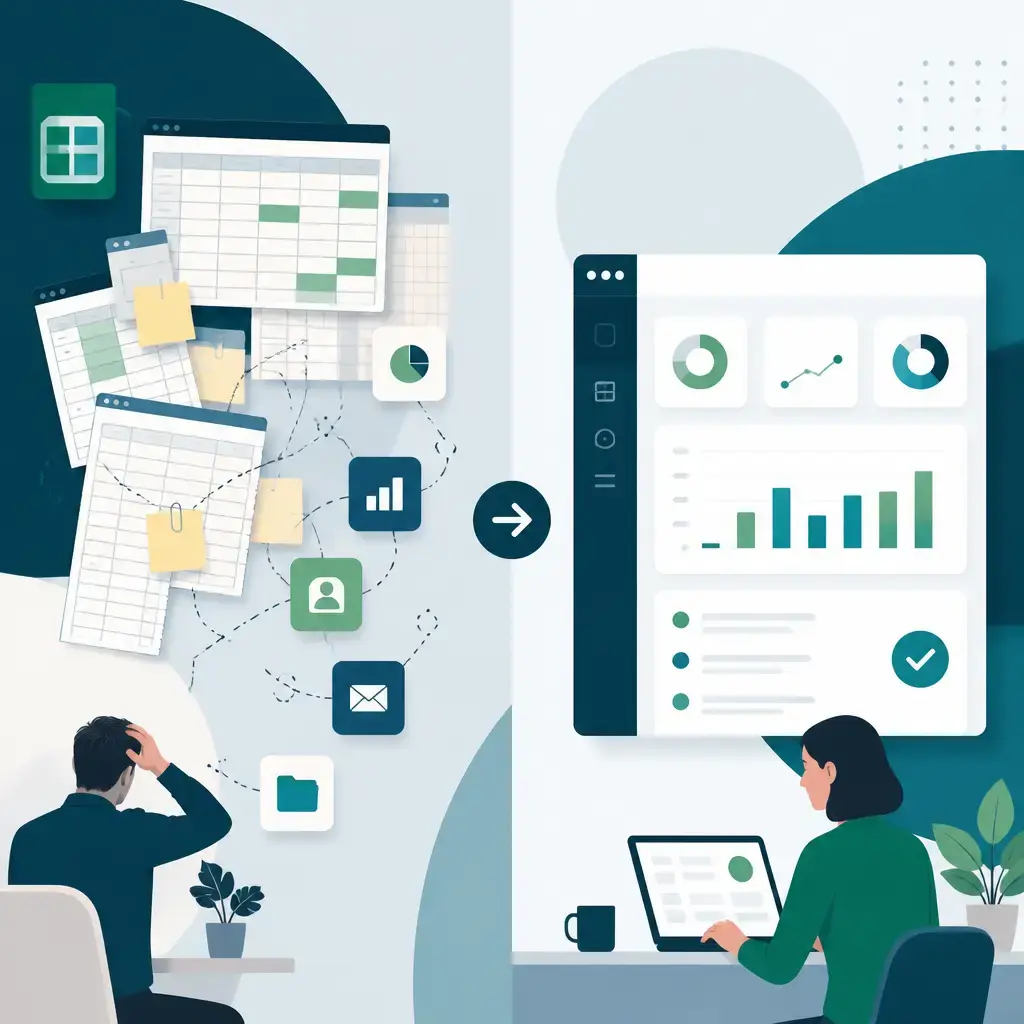
If your business is held together by a master spreadsheet that only one person really understands, you already know the problem. Custom software for small businesses isn't a luxury reserved for big firms with big budgets anymore. It's how smaller operations fix the specific, awkward problems that off-the-shelf tools can't touch. And the market backs that up: custom software development is set to jump from 44.52B in 2024 to 54.26 billion by 2025, growing at a 21.9% CAGR. Tailored software has gone mainstream.
The short version: when generic apps make you work around them instead of for you, and when the gaps are costing you real hours every week, building something that fits your actual process usually pays off. This is especially true for manufacturers across the north of England still running their whole operation out of Excel, where the spreadsheet has quietly become the most fragile and most important system in the business.
Key takeaways
- Custom software is built around your specific operations, so it solves problems that off-the-shelf products often miss entirely.
- The custom software development market is growing fast, from 44.52B in 2024 to 54.26 billion by 2025 at a 21.9% CAGR, and it's no longer just for large enterprises.
- It's worth considering when your workflows are niche, generic apps create inefficiencies, you need to scale, or you want a customer experience competitors can't copy.
- Many small manufacturers, especially in the north of England, still run production, stock and orders on spreadsheets, which works until it badly doesn't.
- Choosing the right partner matters as much as the build itself: look for a team that challenges your assumptions, shows relevant work, gives you clear ownership rights, and offers ongoing support.
What custom software actually means for a small business
Custom software development means building a solution exclusively for how your business runs. Not a template you bend to fit. A tool shaped around your processes and your project requirements from the start.
That's the real difference. Off-the-shelf products are built for the average of thousands of businesses, which means they're a decent fit for none of them in particular. Custom software solves the problems shelf software ignores, and it does it while keeping your operations efficient rather than forcing you to add manual steps to plug the gaps.
Picture the everyday version of this. Right now you might have one app for orders, another for stock, a spreadsheet for scheduling, and someone re-typing the same numbers between all three. Replace that lot with one system that automates the handoffs, and you get better delivery times and tidier resource allocation almost immediately. The waste wasn't in the work. It was in the joins between your tools.
How the process tends to work
A good custom software development agency doesn't start with code. It starts with your business goals. The team needs to understand what you're actually trying to achieve before anyone designs a screen.
From there, an experienced group of developers create, test and launch the solution. Done properly, the result isn't just a working tool. It's a strategic edge that makes it easier to scale and stay agile when your market shifts. That's the part small business owners tend to underestimate: the right system doesn't just save time today, it removes the ceiling on what you can do next year.
If you want a deeper look at what to expect from a build partner, we've written more on custom software development in Manchester and what to look for in a development partner.
The northern manufacturing problem: when the spreadsheet becomes the system
There's a pattern we see constantly with small and mid-sized manufacturers across the north of England. The whole business runs on Excel. Production planning, stock levels, job costing, supplier orders, despatch, even payroll workarounds. It started as one tidy sheet years ago, and it grew.
Now it's a forty-tab workbook with colour-coded cells, macros nobody dares touch, and a column that someone added in 2019 that everyone's scared to delete. It works, mostly, because one or two long-serving people know exactly how to feed it. That's the danger. The business depends on a tool that depends on a person.
For a lot of these firms the spreadsheet was the right call at the time. It was free, flexible, and everyone could use it. The trouble is the things that make Excel brilliant for a small operation are the same things that make it risky as you grow.
Why spreadsheets quietly cost manufacturers money
Here's where it bites. A spreadsheet has no real concept of who changed what, when, or why. One wrong figure typed into a costing sheet and a job goes out underpriced, and you might not notice for months. Stock counts drift out of sync with reality because two people are editing different copies. The same purchase order gets raised twice because nobody can see the other person's tab in real time.
Then there's the simple friction of re-keying. On a factory floor, the same number often gets entered three or four times: once on a paper job sheet, again into the production sheet, again into the stock sheet, again into the accounts. Every one of those is a chance to fat-finger a digit. Multiply that across a week and you're losing hours to data entry and quietly carrying errors you can't see.
Scaling makes all of this worse, not better. Win a big new contract and your trusty workbook starts to creak. It gets slower, more prone to crashing, and harder for new staff to learn. The very moment your business is growing is the moment the spreadsheet becomes the thing holding it back.
What a custom system does instead
The fix isn't "buy a giant ERP that costs more than your van fleet." For most small manufacturers, the right answer is a custom tool that mirrors how they already work, just without the fragility.
That means one place where a job is entered once and flows through to production, stock and despatch automatically. Stock that updates as materials get used, so you can predict reorders instead of running out. Clear job costing that shows true margin per order rather than a best guess. And proper permissions, so people only see and change what they should, with a record of who did what.
We've gone into the spreadsheet-to-software shift in detail before, including how to turn an Excel spreadsheet into a web app and why it's worth it. The headline for a northern manufacturer is this: you keep the logic you've built up over years, you lose the brittleness, and you stop the business living or dying by one person's workbook.
Real examples of custom software for small businesses
The abstract case for custom software never lands as well as a concrete one. Here are a few, straight from the kinds of small businesses that benefit most.
Inventory
A bakery using automated inventory management could track ingredients in real time, predict when to reorder, and sync directly with suppliers. The result is no more stock-outs and a genuine lift in operational efficiency. Swap the bakery for a small engineering firm tracking raw steel and components and the logic is identical.
CRM
A local HVAC company (heating, ventilation and air conditioning) can manage customer service histories properly with a CRM built around its work. The system could schedule maintenance appointments and send personalised reminders, which lifts loyalty and customer satisfaction. Service businesses live and die on whether they remember to follow up. A tool that does it automatically pays for itself.
Booking
A fitness studio that wants a high-quality way for clients to book classes and pay easily can have all of it in one user-friendly, branded platform. No third-party logo, no clunky redirect, no clients dropping out at the payment step. Just a booking experience that matches what people expect.
Management
A marketing agency could use a project management tool to automate its client workflows. Tracking deadlines and generating detailed reports automatically could save the team several hours each week. Those hours go back into billable work instead of admin.
Notice the common thread. In each case the business isn't doing anything exotic. It's just doing its ordinary work without the manual glue that generic software leaves you to apply yourself.
When is custom software actually the right call?
Not every business needs bespoke software, and a good partner will tell you so. But there are clear signals it's worth the investment.
| Signal | What it looks like | Why custom helps |
|---|---|---|
| Niche workflows | Specialised inventory tracking for a craft brewery, or job costing for a fabrication shop | Generic apps don't model your process, so you end up forcing your work to fit their assumptions |
| Off-the-shelf inefficiency | Manual data entry between disjointed systems | A custom system removes the re-keying and the errors that come with it |
| Scalability is critical | Planning to expand without hitting tech limits | Software built for you grows with you instead of capping your growth |
| Competitive differentiation | Offering a customer experience rivals can't replicate | A tailored tool becomes part of why customers choose you |
If you recognise two or more of those, the conversation is worth having.
You don't need to be an enterprise to benefit
There's a myth that custom software belongs to banking, healthcare and retail giants. Enterprise software does dominate those industries, holding 61.1% of the US market. But that's not the whole picture.
Custom tools let smaller businesses compete without the complexity or cost of enterprise-grade systems. A small clinic might use a custom patient portal to rival much larger providers. A local retailer could tie a loyalty programme directly to inventory data and use it to lift sales. The point of custom software isn't scale for its own sake. It's relevant when generic tools hold you back, or when your industry's standards demand something better than the default.
For manufacturers specifically, this matters more than ever. A small fabrication shop that can give a customer an accurate lead time, a clear order status, and an instant quote is competing on the same footing as far bigger rivals, without needing their budget.
Choosing a custom software development company
The build matters. The partner you build with matters just as much. Get this wrong and even good software becomes a liability.
Think of a custom software development partner as a guide. A dedicated team should help you navigate the risks with real technical expertise, and balance innovation with practicality when shaping your solution. For a small business, this relationship is everything. The right company doesn't just hand over a finished tool, it becomes a trusted ally in your growth. So treat the choice as picking a partnership, not just buying a product.
The DOs
- Partnership. Make sure your partner genuinely understands your goals and can translate your vision into tools that actually work for you, not a clever demo that misses the point.
- Prioritise. A good agency steers you toward solutions that solve your real needs, often starting with a Minimum Viable Product so you can test the idea before scaling it.
- Experience. Find a team that has built similar tools before, so they can anticipate the awkward bits like inventory syncing or seasonal demand spikes before they trip you up.
- Support. The best development services offer ongoing maintenance to fix issues and help the software grow with you. Software is never "finished," and the relationship shouldn't end at launch. Keeping a system patched, backed up and running well is exactly the kind of work an ongoing website maintenance plan is built for.
The DON'Ts
- The yes-man hire. If an agency promises every feature without ever pushing back, walk away. Good partners challenge your assumptions and advise on what's genuinely best for the project.
- Hype over substance. A company that reaches for trendy tech but is indifferent to your actual needs is a red flag. The technology should solve your problem, not show off theirs.
- The contract trap. Some firms lock you into proprietary systems or bury hidden fees for updates. Always read the contract and check your ownership rights before signing anything.
- No relevant portfolio. If a company can't show real-world examples of work with businesses like yours, it probably doesn't understand your objectives well enough to deliver.
Where IceBoxDesigns fits
We build bespoke web applications, internal tools, dashboards and integrations for exactly the kind of small and mid-sized businesses described above. A lot of our most rewarding work starts with a manufacturer in the north of England who's outgrown a spreadsheet and finally wants a system that won't fall over when someone's on holiday.
The approach is the one this article argues for. We start with your goals, not a feature list. We'll push back where it helps. We build something you own, and we stick around to maintain and grow it. If you've read this far nodding along about your master spreadsheet, that's usually the sign it's time.
The honest cost of waiting
The easy decision is to do nothing. The spreadsheet still opens, the orders still go out, and changing systems feels like a hassle you can put off.
But the cost of waiting is real, it's just hidden. It's the hours lost to re-keying. The orders mispriced because a formula broke. The new starter who takes three months to learn a workbook only one person fully understands. The contract you couldn't take on because the back office couldn't cope. None of those show up as a single scary invoice, which is exactly why they get ignored.
Custom software development unlocks growth for small businesses by solving the unique challenges that ready-made tools quietly ignore. If generic apps are getting in your way, or your spreadsheet has become the most important and most fragile thing in your business, it's worth a proper conversation. Have a look at our custom software development service and tell us what your master spreadsheet is currently holding together. We'll tell you honestly whether it's time to replace it.
Frequently asked questions
How much does custom software for a small business cost?
It depends entirely on scope, which is why a good partner scopes it with you rather than quoting a flat figure. Many small businesses start with a Minimum Viable Product, a focused first version that solves the core problem and proves the idea before you spend more scaling it. That keeps the initial cost down and lets you test value early.
We run our manufacturing business on Excel and it mostly works. Why change?
Because "mostly works" usually means the business depends on one person who understands the spreadsheet, and on nobody making a typo. As you grow, that fragility becomes expensive: mispriced jobs, stock that drifts out of sync, slow onboarding, and re-keying the same numbers across tabs. A custom system keeps the logic you've built up and removes the risk.
Will I actually own the software, or am I locked in?
You should own it, and you should confirm that in writing before you start. Some firms lock clients into proprietary systems or charge hidden fees for updates. Always review the contract for ownership rights so you're not trapped, and choose a partner who's upfront about it.
Is custom software only for big companies?
No. Enterprise software dominates sectors like banking, healthcare and retail, holding 61.1% of the US market, but small businesses in those same sectors still benefit from tailored tools. Custom software lets a smaller firm compete without the complexity or cost of enterprise-grade systems, for example a small clinic running a patient portal that rivals far larger providers.
Related articles
- Software Development
eCoCs Explained: What the UK's Electronic Certificate of Conformity Means for Vehicle Manufacturers
10 September 2026 - Software Development
MVP to Scalable Product: How to Scope It Right and Know When to Scale
20 August 2026 - Software Development
Why ERP Integration, Not AI Tools, Is the Real Starting Point for Manufacturers
6 July 2026
Related services
Need a hand with this? Here's how IceBoxDesigns can help.