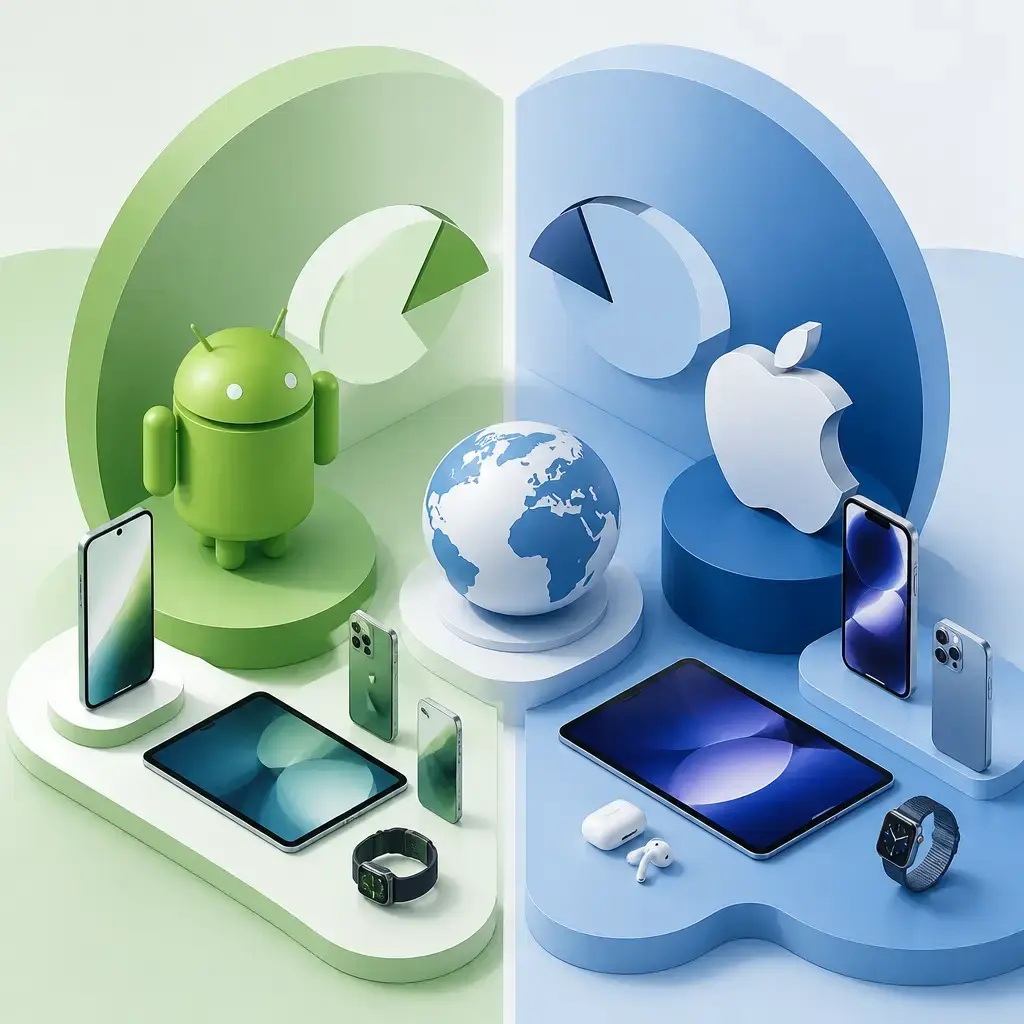
Android owns 72% of the global market. iOS commands 78% of the $1,000-plus segment and 57 to 60% of the US market. In 2026, the iOS vs Android split isn't just about phones anymore, it's about two completely different ecosystems, AI approaches, user behaviours and development trade-offs. If you're a business owner thinking about building a mobile app, this article gives you the numbers and the practical context you need to make the right call.
Key Takeaways
- Android has 72% global OS market share; iOS holds 28% but dominates the US (57 to 60%) and the premium segment (78% of $1,000+ devices).
- Android has roughly 3.9 to 4.5 billion active users worldwide; iOS has 1.56 to 1.8 billion, but iOS is growing faster at 7% year-on-year versus Android's 4%.
- iOS users spend more per app; Android's much larger global user base suits volume-focused strategies, especially in emerging markets.
- iOS development is generally faster and simpler due to a controlled hardware ecosystem; Android requires broader testing across devices and OS versions.
- Your target audience and geography should drive your platform choice, not personal preference.
The 2026 Market at a Glance
Here's how the two platforms compare across the metrics that actually matter for businesses and app builders:
| Category | iOS | Android |
|---|---|---|
| Global OS market share | 28% | 72% |
| US market share | 57 to 60% | 40 to 43% |
| $1,000+ segment share | 78% | 22% |
| Global active users | 1.56 to 1.8 billion | 3.9 to 4.5 billion |
| Annual user growth | 7% year-on-year | 4% year-on-year |
| Average selling price | $850+ | $100, $2,000+ |
| 2026 annual shipments | ~247 million units | 1.1 billion+ units |
| Native AI platform | Apple Intelligence (on-device) | Google Gemini (3 tiers) |
| Total apps available | ~1.8 million | ~2.7 million |
| Security approach | Walled garden | Sandbox 2.0 (Android 16) |
The numbers tell a clear story. Android wins on volume. iOS wins on spend and premium reach.
How AI Has Changed the Comparison in 2026
The biggest shift in 2026 is how deeply AI is baked into both platforms, and they've taken very different routes.
On Android, Google's Gemini is embedded directly into the OS across three tiers. It can manage your schedule, draft emails and anticipate what you need next, all without you opening a single app.
Apple has gone the opposite direction. Apple Intelligence on iOS 26 has repositioned Siri as a privacy-first, predictive assistant that processes as much as possible on the device itself, before anything reaches the cloud. For users and businesses handling sensitive data, that distinction matters.
Neither approach is objectively better. They reflect genuinely different philosophies about where your data should live and how AI should behave.
Understanding Who Uses Each Platform
The demographics here aren't just interesting, they should directly inform your app strategy.
iPhone users, particularly those on recent models, tend to be brand-loyal, premium-oriented and embedded in the wider Apple ecosystem. They treat their phone as part of a connected set of devices rather than a standalone tool. They're more likely to pay for apps, subscribe to premium tiers and spend more per transaction within apps.
Android users skew towards customisation, flexibility and device variety. Many value open-source software and the ability to sideload applications. They tend to prefer control over their experience. They're also far more geographically diverse, Android dominates in India, Southeast Asia, Africa and most of Latin America.
What This Means for App Revenue
iOS users are generally more willing to pay upfront for apps and in-app subscriptions, especially when those apps integrate with the Apple ecosystem. That makes iOS the stronger platform if your revenue model depends on direct purchases or premium subscriptions, particularly in the US and Western Europe.
Android users are more drawn to freemium models, ad-supported platforms and cost-effective tools. The income per user is frequently lower, but the sheer scale of Android's global user base (3.9 to 4.5 billion active users) makes it compelling if you're targeting volume or markets where affordability drives purchasing decisions.
One practical nuance: app stores on both platforms now allow developers to set region-specific pricing. So you could charge more for an app in the US and less in Poland, adjusting to local market conditions. That flexibility matters if you're building for a global audience.
Development Speed and Complexity: iOS vs Android
This is where it gets very practical for business owners planning a build.
Building for iOS
iOS's controlled hardware ecosystem, Apple makes both the chips and the software, means fewer edge cases, simpler quality assurance and faster development cycles. For lean teams or businesses working to a tight timeline, iOS can realistically get you to market three to four weeks ahead of Android. That's a meaningful head start if you're preparing an investor demo or bootstrapping a product launch.
Building for Android
Android is far more fragmented. Dozens of manufacturers run the OS on wildly different hardware, and users are spread across multiple OS versions at any one time. That fragmentation makes testing more complex and QA cycles longer. It increases development costs compared to iOS in most cases.
That said, Android's reach is unmatched. If your target market is in India, Southeast Asia or other high-growth regions, the extra development investment is usually justified.
iPhone 17 vs Google Pixel 10: A Hardware Baseline
Using first-party flagship devices gives the clearest comparison of what each platform can do at its best. The Google Pixel 10 (Android) and the iPhone 17 (iOS) represent each company's own vision for their platform.
Performance
In raw performance terms, the iPhone 17 sets a higher bar. Performance testing shows the iPhone averaging 130.97 FPS versus 80.58 FPS for the Pixel 10 in graphical rendering and system responsiveness. Apple's A19 processor outpaces Google's Tensor G5 chip in processing speed, multitasking fluidity and consistent performance under load.
Long-Term Update Support
Android: Google promises seven years of OS updates, security patches and feature drops for its Pixel 10 series.
iOS: Apple doesn't publish official support timetables, but historical data suggests iPhones receive iOS updates for five to seven years after being discontinued, which in practice often means well over seven years of real-world support from launch.
Both platforms are broadly comparable on longevity now, which removes one of Android's previous weaknesses.
A Word on Comparing Beyond Flagships
The Pixel 10 vs iPhone 17 comparison is useful as a baseline, but the broader Android ecosystem is far more diverse. Many Android devices vary significantly in hardware, software optimisation and how long they receive updates. That diversity is a strength for market reach, but a headache for developers who need to ensure consistent app performance.
Which Platform Should You Build For First?
There's no universal right answer, but here's a practical framework:
Build iOS first if:
- Your primary market is the US, UK, Western Europe, Canada or Australia
- Your revenue model relies on premium pricing, subscriptions or in-app purchases
- You're working to a tight timeline or limited development budget
- You're building for fintech, healthcare or any sector where iOS's 58% North American market share among professionals gives you direct access to decision-makers
Build Android first if:
- Your audience is primarily in India, Southeast Asia, Africa or Latin America
- You're targeting volume over per-user spend
- You need the widest possible reach and can accommodate the additional testing overhead
- You're building an e-commerce or consumer app for markets where Android dominates
For most UK businesses targeting domestic and US customers, iOS tends to be the smarter first move, faster to build, higher revenue per user, and better aligned with the premium segment. Android expansion makes sense in a second phase once the product is validated.
If you're at the stage of deciding what to build and for whom, our custom software development team can help you work through the platform strategy alongside the build itself, whether that's a native app, a cross-platform solution or a web application that sidesteps the question entirely.
The AI Angle for Business Owners
Beyond the phone specs, the AI capabilities baked into both platforms in 2026 have real implications for business apps built on top of them. Google Gemini's deep OS integration means Android apps can tap into predictive, ambient intelligence in ways that weren't possible before. Apple Intelligence's on-device approach opens up use cases where privacy is non-negotiable, financial data, health records, confidential communications.
If you're planning an app that uses AI features, the underlying platform's AI architecture will shape what's possible, how you build it and how your users experience it.
Keeping Your Digital Products Healthy Long-Term
Whichever platform you choose, the work doesn't stop at launch. OS updates on both iOS and Android introduce changes that can affect your app's behaviour, security and compatibility. Staying on top of those updates, alongside performance monitoring and security patching, is part of running a mobile product responsibly. Our website maintenance plans cover ongoing support for digital products, keeping them secure and running properly as platforms evolve underneath them.
The iOS vs Android question in 2026 is sharper than it's ever been. Two mature platforms, two distinct AI philosophies, two different user bases. Getting the choice right from the start saves time, money and rework down the line. If you're planning a build and want a straight conversation about which direction makes sense for your business, get in touch with the IceBoxDesigns team.
Frequently asked questions
What is Android's global market share in 2026?
Android holds 72% of the global OS market share in 2026, compared to iOS at 28%. However, iOS leads in the US with 57 to 60% of the market and controls 78% of the $1,000-plus device segment.
Is it faster to develop an app for iOS or Android?
iOS development is generally faster. Apple's controlled hardware ecosystem means fewer edge cases and simpler testing. For lean teams, this can mean getting to market three to four weeks ahead of an equivalent Android build.
How many active users does each platform have in 2026?
Android has approximately 3.9 to 4.5 billion active users globally. iOS has 1.56 to 1.8 billion active users. iOS is growing faster at 7% year-on-year versus Android's 4%.
Which platform is better for app revenue?
iOS users generally spend more per app and are more willing to pay for premium subscriptions, making iOS stronger for direct revenue models, particularly in the US and Western Europe. Android's larger global user base suits volume-driven, freemium or ad-supported approaches.
Related articles
- Software Development

eCoCs Explained: What the UK's Electronic Certificate of Conformity Means for Vehicle Manufacturers
10 September 2026 - Software Development
MVP to Scalable Product: How to Scope It Right and Know When to Scale
20 August 2026 - Software Development
Why ERP Integration, Not AI Tools, Is the Real Starting Point for Manufacturers
6 July 2026
Related services
Need a hand with this? Here's how IceBoxDesigns can help.