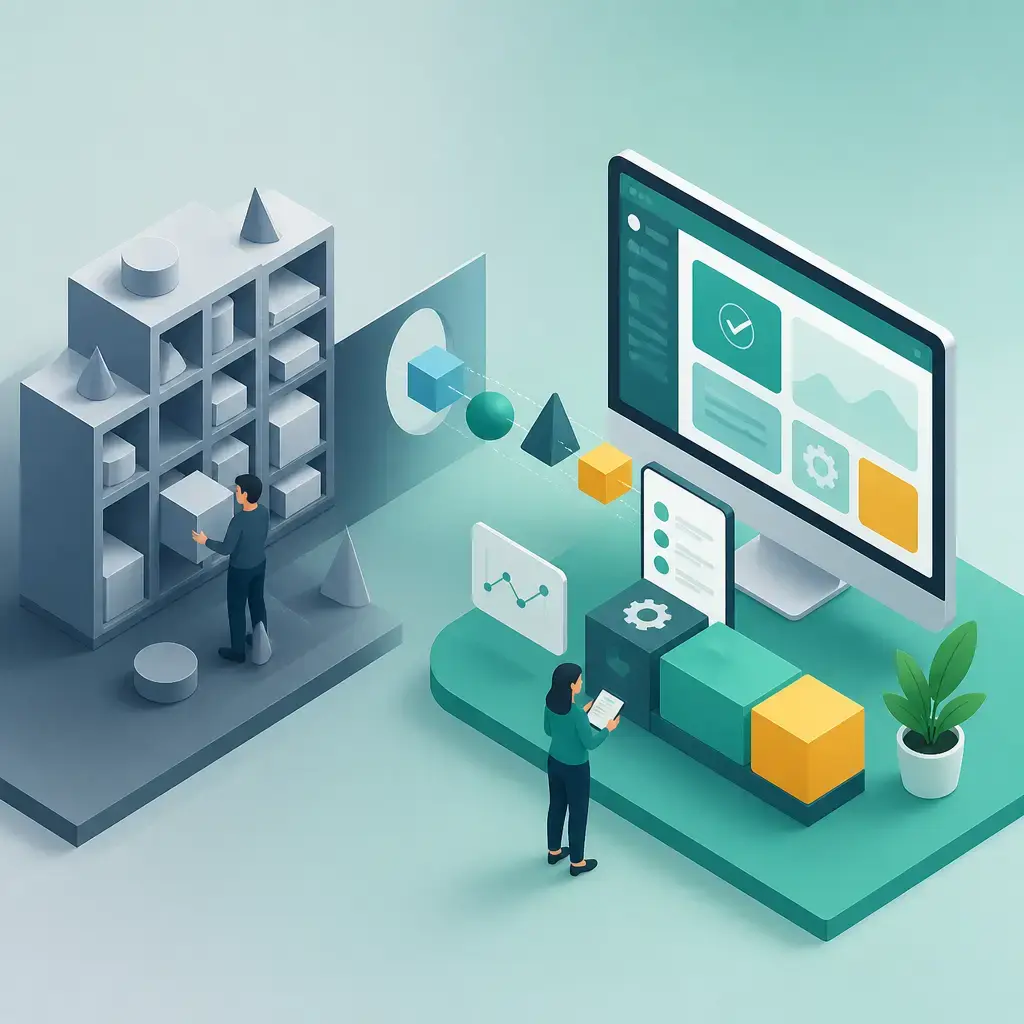
Off the shelf software promises a quick fix, but for most growing businesses it ends up as a compromise. You adapt your processes to fit the tool instead of the other way round, you pay for features you never use, and you hit a ceiling the moment your needs change. Custom software solutions flip that equation entirely.
Key Takeaways
- Off-the-shelf tools frequently fail to match the specific workflows, scale or security requirements of small and medium businesses.
- Custom software is built around your processes, so it grows with you rather than forcing you to change to fit it.
- Common business problems it solves include manual inefficiency, poor scalability, weak customer experience and data security gaps.
- The upfront investment tends to be higher, but operational savings and productivity gains offset that cost over time.
- A structured development process, from discovery through to post-launch support, keeps projects on time and on budget.
Why Generic Software Leaves Businesses Stuck
Every business runs differently. Your pricing logic, approval chains, customer journey and reporting needs are yours, not a template someone else designed. Off-the-shelf software is built for the average use case, which means it fits no one perfectly.
The result is usually one of two things: your team works around the tool's limitations, creating manual workarounds that eat time and introduce errors, or you end up paying for expensive add-ons and integrations that still don't quite join up. Neither is a good use of your budget.
Custom software is built from scratch around what your business actually does. That means every screen, workflow and data field is there because it needs to be, not because it came bundled in.
The Business Problems Custom Software Actually Fixes
Manual Processes and Outdated Systems
Repetitive, manual tasks are one of the most common drains on a team's time. Entering the same data in two systems, chasing approvals by email, generating reports by hand, these things slow everyone down and create room for mistakes.
Custom software can automate those repetitive tasks, wire your systems together so data flows between them without human intervention, and free your team up to focus on work that actually moves the business forward.
Lack of Scalability
This one catches businesses off guard. You buy a tool that works fine at your current size, then a year later you've doubled your customer base or added a new product line and the software starts creaking. Either it can't handle the volume, or scaling it up means a costly upgrade or, worse, starting again with a different system entirely.
Custom software is designed with your growth trajectory in mind. The architecture is built to handle increased demand, so you're not ripping things apart every time the business takes a step forward.
Poor Customer Experience
Customers now expect fast, joined-up, personalised experiences. If your customer-facing tools are clunky, slow or inconsistent, they'll notice, and they'll go somewhere else.
A bespoke platform lets you design the customer experience around what your customers actually need, rather than working within the constraints of a generic tool. Whether that's a custom client portal, a tailored e-commerce experience or a real-time support interface, you're in control of how it works and how it feels.
Data Security Concerns
Generic software is a broad target. Because it's widely used, attackers understand exactly how it works and where the weaknesses are. Security patches depend on the vendor's schedule, not yours.
Custom software can be built with security requirements specific to your industry and your data, whether that's how user access is controlled, how data is stored and transmitted, or how the system behaves under an attempted breach. You're not relying on a one-size-fits-all security model.
What the Business Case for Custom Software Actually Looks Like
The honest answer on cost is that custom software costs more upfront than buying an off-the-shelf licence. That's worth acknowledging plainly.
But the right comparison isn't custom software versus one SaaS subscription. It's custom software versus the full picture: the subscriptions you're currently paying for, the time your team loses to workarounds, the cost of data entry errors, the price of switching systems when your current tools don't scale, and the revenue you're leaving on the table because your processes can't keep up.
When you map it out that way, the investment in a bespoke solution often looks very different. Operational costs come down when repetitive tasks are automated. Errors reduce when data moves between systems without being re-keyed. Productivity goes up when your team isn't fighting tools that don't fit.
Two scenarios illustrate the point. A mid-sized manufacturing company integrated its disjointed systems into a single ERP platform and saw a 30% increase in productivity alongside a meaningful reduction in operational costs. An online retailer that moved to a custom e-commerce platform with personalised recommendations and a smoother checkout saw a 40% increase in sales and a 25% boost in customer retention within six months.
Those aren't guarantees, every project is different, but they show the kind of shift that becomes possible when software is built around a business's specific needs rather than against them.
The Four Business Problems Worth Thinking About Before You Build
Before committing to a custom build, it's worth being honest about where your current setup is actually failing. The most common pain points that justify a bespoke solution are:
- Process inefficiency, your team is spending significant time on tasks a system should handle automatically.
- Scalability ceiling, your current tools can't support the growth you're planning without expensive, disruptive changes.
- Customer experience gaps, your customer-facing tools are limiting what you can offer or how quickly you can respond.
- Security and compliance requirements, your industry or data obligations mean a generic tool's security posture isn't sufficient.
If you're only ticking one box, it may not justify a full custom build, a well-configured existing platform might do the job. But if two or more apply, a bespoke solution starts to look like the better long-term investment.
What a Good Development Process Looks Like
One reason businesses hesitate on custom software is the fear of projects running over time and budget. A structured process is what keeps that in check.
A solid approach starts with a proper discovery and consultation phase, where the developer spends time understanding your business, your goals and the specific problems you're trying to solve. Without that, you risk building something technically impressive that doesn't actually fix the right thing.
From there, the design and planning phase maps out exactly what the software will do, screen by screen and workflow by workflow, before a line of code is written. Changes are much cheaper at this stage than during development.
Development follows, with rigorous testing built in throughout rather than bolted on at the end. Then comes deployment and, crucially, ongoing support. Software isn't a one-off purchase, it needs to be maintained, updated and adapted as your business evolves.
If you're considering a custom build, our custom software development service covers the full lifecycle, from initial scoping through to long-term support.
Custom Software vs. Off the Shelf: A Practical Comparison
| Off-the-Shelf | Custom Software | |
|---|---|---|
| Upfront cost | Lower | Higher |
| Ongoing licence fees | Usually recurring | Typically none |
| Fit to your processes | Partial | Exact |
| Scalability | Limited by vendor | Built for your growth |
| Security model | Generic | Tailored to your needs |
| Integration with other systems | Varies, often limited | Designed in from the start |
| Long-term flexibility | Constrained by vendor roadmap | Yours to adapt |
The table isn't meant to say custom software always wins. For simple, well-defined needs, off-the-shelf is often the right call. But as complexity, scale and security requirements grow, the case for bespoke becomes stronger.
When to Involve a Development Partner Early
One of the most common mistakes businesses make is bringing in a developer too late, after they've already decided what they want to build, rather than working through the problem together first.
A good development partner will push back on assumptions, spot simpler approaches, flag technical risks early and help you prioritise features so you get value quickly rather than waiting for a monolithic launch. That kind of collaboration is harder to do if you arrive with a 50-page specification already written.
If your business is wrestling with processes that feel like they should be automatable, systems that don't talk to each other, or customer-facing tools that are limiting your growth, it's worth having that conversation early. Our team at IceBoxDesigns works through the problem with you before scoping a solution, so you're not paying to build something that solves the wrong thing.
Take a look at our custom software development work to get a sense of what we build and how we approach it. If you'd like to talk through a specific challenge, get in touch and we'll work out whether a bespoke build is actually the right answer for you.
Frequently asked questions
How do I know whether I need custom software or whether an off-the-shelf tool will do?
Start by mapping out where your current tools are actually failing you. If you're losing significant time to manual workarounds, hitting scalability limits, struggling with security requirements, or your customer experience is being constrained by the tools you're using, a custom build is worth considering. For simpler, well-defined needs, a well-configured existing platform is often the better call.
Isn't custom software too expensive for a small or medium-sized business?
The upfront cost is higher than buying an off-the-shelf licence, but that's not the full picture. Factor in recurring subscription fees, the cost of manual workarounds, errors from re-keying data, and the disruption of switching systems when your tools don't scale. For businesses with complex or growing needs, custom software often works out more cost-effective over the medium to long term.
How long does it take to build custom software?
It depends on the scope and complexity of what you're building. A well-structured project starts with a discovery phase to define requirements clearly, which helps avoid costly changes later. Simpler internal tools can be delivered in weeks; more complex platforms take longer. Getting a detailed scoping session done early is the best way to get a realistic timeline.
What happens after the software is built, who maintains it?
Custom software needs ongoing maintenance, security updates and occasional changes as your business evolves. A good development partner will offer post-launch support as part of the engagement. Make sure you understand what's included before you sign off on a project.
Related articles
- Software Development
eCoCs Explained: What the UK's Electronic Certificate of Conformity Means for Vehicle Manufacturers
10 September 2026 - Software Development
MVP to Scalable Product: How to Scope It Right and Know When to Scale
20 August 2026 - Software Development
Why ERP Integration, Not AI Tools, Is the Real Starting Point for Manufacturers
6 July 2026
Related services
Need a hand with this? Here's how IceBoxDesigns can help.