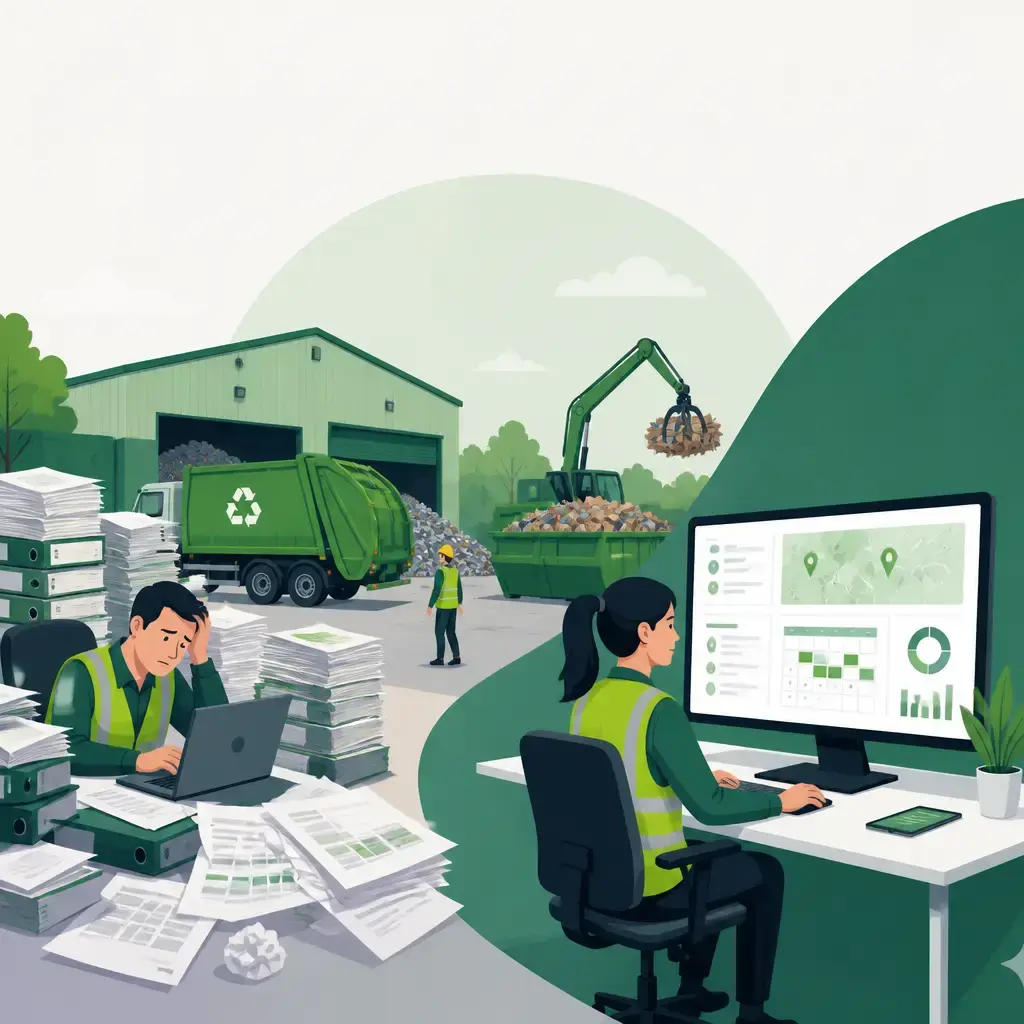
If your recycling or waste management business is still running on spreadsheets and off-the-shelf tools that don't quite fit, you're not alone. Most operations in this sector have grown faster than their systems, and the result is the same every time: manual data entry, scheduling headaches, missed bookings, and staff spending hours on tasks that should take minutes. Custom software for recycling centres is the practical way out of that loop.
Key Takeaways
- Recycling centres, cardboard processors, WEEE (electrical waste) handlers and general refuse operators all share the same core problem: generic software wasn't built for them.
- Custom software can automate intake, queue management, bay allocation and bookings in one joined-up system.
- Moving away from spreadsheets reduces human error, speeds up throughput and improves site safety.
- A bespoke system can integrate with weighbridges, existing management tools and booking platforms you already use.
- The investment is usually justified by time saved, fewer errors and the ability to scale without adding admin headcount.
The Spreadsheet Problem Is Bigger Than You Think
Spreadsheets aren't inherently bad. They're flexible, cheap and most people already know how to use them. The trouble is, a waste management or recycling operation has a lot of moving parts, and spreadsheets fall apart the moment things get complex or busy.
Think about a typical morning at a busy recycling centre. You've got commercial clients booking drop-offs, residential vehicles queuing at the gate, multiple bays handling different waste streams (cardboard, plastics, WEEE, general refuse), and a weighbridge that needs to record every load. A spreadsheet can't manage all of that in real time. Someone has to manually update it, and the moment two people are editing at once, or someone forgets to save, you've got conflicting records and confusion on the ground.
The safety angle is equally important. When operators are relying on manual records and verbal communication to manage vehicle flow and bay allocation, the risk of accidents goes up. A purpose-built system removes that ambiguity by automating the instructions and making the current state of the site visible to everyone who needs to see it.
What Purpose Built Software Actually Does Differently
The best custom systems for recycling and waste operations are built around the specific flow of your site, not a generic workflow someone designed for a warehouse or a logistics depot. Here's where the difference really shows up.
Automated Operations and Reduced Human Error
A well-designed system handles the repetitive, rule-based decisions automatically. Which bay should this vehicle go to? Is the cardboard compactor bay full? Has this commercial client pre-booked, and if so, what are they dropping off? These questions don't need a person to answer them in real time if the system has the right rules built in. That frees your staff to focus on what actually needs human judgement, and it removes a significant source of error from your operation.
Queue and Booking Management for Mixed Clientele
Recycling centres typically serve a mix of clients: private citizens turning up unannounced, businesses with regular contracts, and larger commercial clients from skyscrapers, shopping centres or industrial estates who need scheduled drop-offs. Managing those different priority levels manually is messy. A custom system can handle bookings, manage queues, assign priority slots and communicate wait times, all without someone standing at a gatehouse with a clipboard.
For WEEE recycling operations or computer recycling businesses specifically, the tracking requirements are even more detailed. You need records of what came in, from whom, in what condition, and often where it's going next. That's exactly the kind of structured, auditable data trail that a bespoke system handles well and a spreadsheet handles badly.
Multi Bay and Multi Stream Coordination
If your centre handles several different waste streams simultaneously, whether that's separated recycling (cardboard, glass, metals, plastics) or a combination of recycling and general refuse, coordinating traffic across multiple bays is a genuine logistical challenge. Custom software can monitor each bay in real time, regulate transit through the site, and prevent bottlenecks forming because two vehicles have been sent to the same place at the same time.
This kind of coordination is hard to retrofit onto generic software. It's the sort of thing that needs to be designed into the system from the start, with your specific site layout, your specific waste streams and your specific volumes in mind.
Integration With Existing Devices and Systems
One concern that comes up a lot when businesses consider going custom is the fear of ripping everything out and starting from scratch. A properly built system doesn't work like that. Good bespoke software is designed to integrate with the tools and devices you already have: weighbridges, CCTV systems, existing management platforms, invoicing software. You keep what works and replace what doesn't.
This modular approach also means the system can grow with your operation. If you add a new bay, take on a new waste stream or expand to a second site, the software can be updated to reflect that without needing to start over.
The Real World Case for Going Bespoke
Let's be honest about the alternatives. You could buy an off-the-shelf waste management package. Some of them are decent. But off-the-shelf means built for an average operation, not yours. You'll spend time and money customising it, training staff on features you don't need, and working around the limitations that the vendor hasn't prioritised fixing because most of their customers don't need what you need.
The businesses that tend to get the most from bespoke software are the ones that have outgrown generic tools but aren't yet big enough to justify enterprise platforms with six-figure price tags. That's a large chunk of the UK's independent recycling and waste sector: small-to-medium operators running one or two sites, handling a mix of commercial and residential waste, who need something solid and tailored without paying for a system designed for a national contractor.
The operational savings are where the case gets made. If a custom system saves each member of staff an hour a day on manual admin, and you have ten staff, that's ten hours a day you've recovered. Over a year, that's a substantial number. Add in the reduction in errors (wrong bay allocations, missed bookings, disputes over whether a commercial client's load was weighed correctly) and the improved safety record, and the return starts to look very clear.
What the Transition Looks Like in Practice
The biggest source of anxiety for most business owners considering this step is the transition itself. What happens to your existing data? How long will staff take to get up to speed? Will the site go quiet for a week while everything is switched over?
A well-managed bespoke development project addresses all of this up front. The build phase typically involves:
- Discovery and scoping -- mapping your current processes in detail, identifying where the bottlenecks and errors happen, and agreeing what the new system needs to do.
- Design and build -- building the system in stages, with regular check-ins so you can see progress and flag changes before they're locked in.
- Integration -- connecting the new system to your weighbridge, existing software and any other devices it needs to talk to.
- Testing -- running the system in parallel with your existing setup for a period, so you can catch any issues before going fully live.
- Training -- because a well-designed system should be straightforward to use, operator training is generally quick. You don't need your staff to become software experts.
- Go-live and ongoing support -- with a reliable development partner, you have someone to call when things need updating or something unexpected comes up.
The goal isn't just to digitise what you're already doing. It's to redesign the process so it works better, and then build software around that improved process.
Is This Only for Large Operations?
No. This is worth addressing directly because a lot of smaller recycling businesses assume bespoke software is only for large-scale operators. That's not true. A single-site cardboard recycling business or a community recycling centre handling several waste streams can benefit just as much from purpose-built software as a larger operator.
The key question isn't the size of the operation. It's whether your current tools are actually fit for what you're doing. If you're managing bookings in a shared spreadsheet, tracking loads on paper tickets, and manually updating records at the end of each day, then you have inefficiency in your operation regardless of how many vehicles come through the gate.
Smaller operations often see the proportional benefit more quickly, simply because there are fewer layers of bureaucracy involved in making changes and the savings show up faster against a smaller cost base.
Getting Started
The first step is usually the simplest: map out what your current system actually does and where it breaks down. Write down every manual task your team does on a daily basis that feels like it should be automated. Every time someone has to re-enter data from one place to another. Every time a booking gets missed or a bay allocation causes a queue. That list is your specification in rough form.
From there, a conversation with a development team who've built operational software before will quickly tell you what's realistic, how long it might take, and roughly what it'll cost. That's a much better starting point than trying to evaluate software packages you're not sure are right for you.
If you're running a recycling, waste or refuse operation and you're starting to feel like your tools are holding you back, get in touch with IceBoxDesigns about our custom software development service. We build practical, integrated systems for businesses that have outgrown generic solutions, and we're happy to start with a straightforward conversation about what you actually need.
Frequently asked questions
What types of recycling or waste businesses benefit most from custom software?
Any operation that handles a mix of commercial and residential clients, manages multiple waste streams or bays, or relies on manual processes like spreadsheets and paper tickets will benefit. This includes cardboard recyclers, WEEE and computer recycling businesses, general refuse centres and mixed-stream recycling facilities.
Will custom software integrate with our existing weighbridge and management tools?
Yes. A well-built bespoke system is designed to connect with the devices and software you already use, including weighbridges, CCTV and existing management platforms. The idea is to replace what isn't working, not rip out everything.
How long does it take staff to learn a new custom system?
Because the system is designed around your specific operation rather than a generic workflow, operator training is typically quicker than learning off-the-shelf software. The interface reflects tasks your staff already understand, just handled more efficiently.
Is bespoke software worth it for a smaller recycling operation?
Often, yes. The question isn't the size of the operation but whether your current tools are genuinely fit for purpose. Smaller sites frequently see proportional benefits more quickly because changes are easier to implement and savings show up faster against a smaller cost base.
Related articles
- Software Development
eCoCs Explained: What the UK's Electronic Certificate of Conformity Means for Vehicle Manufacturers
10 September 2026 - Software Development
MVP to Scalable Product: How to Scope It Right and Know When to Scale
20 August 2026 - Software Development
Why ERP Integration, Not AI Tools, Is the Real Starting Point for Manufacturers
6 July 2026
Related services
Need a hand with this? Here's how IceBoxDesigns can help.