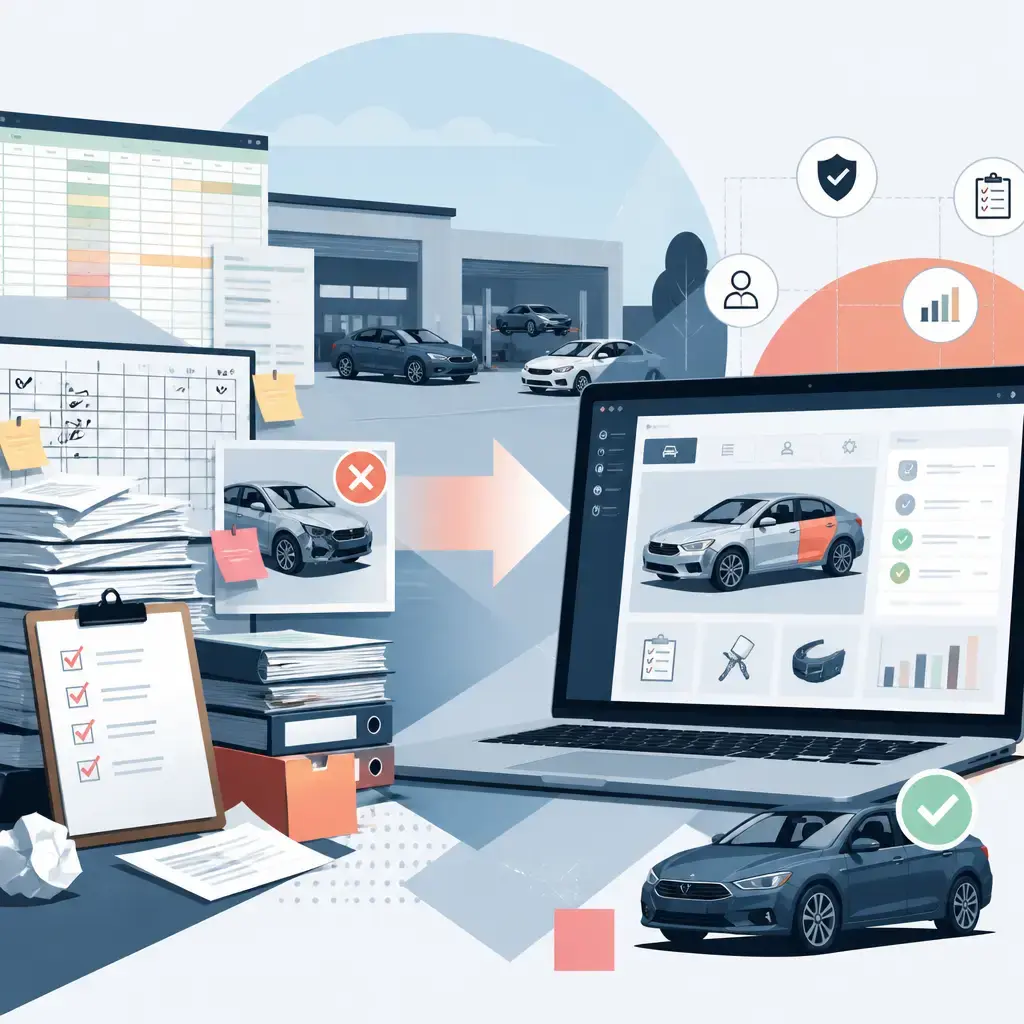
Spreadsheets work fine when you're small. But as a body shop scales, they start costing you money in rework, missed compliance, and time spent chasing paper. Most collision centres hit a point where the whiteboard, the Excel file, and the folder of PDF checklists simply can't keep up. That's the moment body shop management software stops being a nice-to-have and becomes a business necessity.
Key takeaways
- Spreadsheets and generic tools create quality gaps that only show up at the worst possible moment: during a failed inspection or a customer complaint.
- Purpose-built body shop management software links job management, quality audits, and compliance in one place.
- Free or off-the-shelf tools often lack the configurable checklists, multi-site visibility, and reporting that serious shops need.
- The jump from spreadsheets to a custom or specialist platform is usually triggered by scale: more vehicles, more technicians, more insurers to satisfy.
- A bespoke system can be shaped around how your shop actually works, rather than forcing your team to adapt to software built for someone else.
What Body Shop Software Actually Does (And What It Doesn't)
At its core, body shop management software handles the operational basics: creating and tracking repair orders, allocating jobs to technicians, managing parts and labour, and confirming delivery dates. For many shops, it replaces the whiteboard and the string of disconnected tools with a single view of what's in progress and what's waiting.
That's genuinely useful. Visibility alone reduces bottlenecks. When a service manager can see at a glance that three vehicles are sitting at the paint stage and one technician is double-booked, they can act before it becomes a problem.
But most systems stop there. They focus on workflow and billing. They don't handle structured quality audits. They don't track non-conformities. They don't enforce OEM repair standards or insurer requirements at each stage of the repair. That gap is where things get expensive.
The Real Cost of Running on Spreadsheets
If your shop is still using spreadsheets to manage jobs, checklists, and compliance records, you're probably aware of the friction. But it's worth being specific about where the cost actually lands.
Quality depends on the person, not the process. When checks live in someone's head or in a paper form that varies by shift, repair quality becomes inconsistent. One technician's final QC looks nothing like another's. You don't know that until a customer comes back, or until an insurer flags a problem.
Compliance evidence is hard to produce. OEM programmes and dealer networks want to see that specific standards were met on specific vehicles, with timestamps and sign-offs. A spreadsheet saved on someone's desktop doesn't cut it when an external assessment comes around.
Problems surface too late. Rework is expensive. Fixing an issue after a vehicle has been through painting and reassembly costs far more than catching it at disassembly. Without structured stage-by-stage audits, problems tend to show up at the worst possible point: customer delivery, or the insurer's inspection.
Multi-site operations become chaotic. If you're running more than one location, spreadsheets mean each site is effectively operating in isolation. There's no easy way to compare performance, spot the site that's consistently underperforming on a particular check, or roll out a process change across all locations at once.
These aren't hypothetical problems. They're the ones that body shop managers at scaling collision centres run into repeatedly.
What Proper Body Shop Management Software Looks Like
When shops move beyond the spreadsheet stage, they're typically looking for a few things that free or generic tools can't provide.
Configurable Digital Checklists
A paper checklist can't be updated for 10 locations at once. A digital one can. Good body shop software lets you build audit templates that reflect your actual OEM repair methods, dealer standards, or network programme requirements. When those requirements change (and they do), you update the template centrally and it rolls out everywhere.
Stage by Stage Audits, Not Just Final QC
The most effective quality control catches problems early: at disassembly, before painting, at reassembly, and at final inspection. Each stage is a checkpoint. Auditors or supervisors can record findings, add photos, and log non-conformities directly on a phone or tablet, standing next to the vehicle. That's a very different process from filling in a form at a desk at the end of the day.
Real Time Dashboards and Reporting
Managers need to see what's happening across the shop floor without having to ask. A good dashboard shows audit completion rates, common defect categories, and performance trends. Filtered by site, department, or time period, it tells you where your coaching effort needs to go and which process changes are actually working.
A Full Audit Trail
Every check, every photo, every corrective action, logged centrally with timestamps. That's what OEM programmes, insurers, and warranty conversations require. It's also what protects the business if a dispute arises six months after a repair.
Scoring and Escalation Workflows
Not every checklist item carries the same weight. A structural alignment check is not the same as a trim clip. A decent system lets you assign criticality, set pass/fail thresholds, and automatically trigger follow-up tasks or escalations when an audit score drops below an acceptable level.
Free Tools and Off the Shelf Software: Where They Run Out
It's completely reasonable to start with free or low-cost tools. For a very small shop early in its digital journey, a simple job tracker or shared calendar might be enough. But free tools tend to hit their ceiling fast when quality and compliance requirements get serious.
Configurable checklists that mirror OEM standards, role-based access controls, multi-site visibility, reliable audit history: these features typically sit above what free software offers. The moment a shop needs to manage quality, compliance, and performance in a joined-up way, basic tools become a constraint rather than a solution.
Off-the-shelf body shop software from a large vendor solves some of this, but it's built for the average shop. If your operation has specific network programme requirements, a particular insurer workflow, or a structure that doesn't match the software's assumptions, you end up working around the tool rather than with it.
When a Custom System Makes More Sense
This is the conversation we have regularly with business owners who've been told they have two options: keep hacking the spreadsheet, or buy a standard product that fits poorly.
A custom software solution built around your specific operation doesn't come with that trade-off. It can reflect your exact audit stages, your OEM programme criteria, your insurer requirements, and your internal escalation process. It can integrate with the job management tools you already use. It can be built to scale with you as you add sites or technicians, rather than creaking under the weight of growth.
The honest caveat is that bespoke development costs more upfront than buying a subscription. But for a shop that's processing significant volume and has real compliance obligations, the cost of repeated rework, failed audits, and poor CSI scores will often outpace a one-time build investment fairly quickly. It's worth doing the maths properly rather than defaulting to the cheaper-looking option.
The Practical Case for Audit Driven Workflows
The shift from spreadsheet-based quality control to structured, digital audit workflows changes the texture of daily operations in ways that are hard to fully appreciate until you're inside them.
When every vehicle passes through the same defined checkpoints, repair quality stops depending on who happens to be on shift. That's a meaningful change for a business that competes on reputation and repeat custom. Insurers notice consistent quality. Customers notice fewer comebacks. CSI scores reflect it.
The audit trail also changes how managers spend their time. Instead of finding out about problems when a customer calls, they're looking at a dashboard that shows a spike in a particular defect category at one location this week. They can act on that before it becomes a pattern. That's the difference between managing reactively and managing with actual information.
For dealer groups or multi-site operations, the ability to compare performance across locations, roll out checklist updates centrally, and enforce consistent standards without relying on individuals to remember what the standard is: that's an operational capability that simply doesn't exist in a spreadsheet world.
Choosing the Right Path for Your Shop
If you're currently running on spreadsheets or a basic off-the-shelf product and starting to feel the friction, here are the questions worth sitting with:
- Are quality issues being caught before the vehicle reaches the customer, or after?
- Can you produce a timestamped audit trail for an insurer or OEM programme without significant manual effort?
- If you have more than one site, can you see how they're performing against each other right now?
- When process requirements change, how long does it take to update the checks across your whole operation?
If the honest answers to those questions are uncomfortable, the spreadsheet has run its course.
The next step depends on your scale and your specific requirements. Some shops will find a specialist bodyshop management platform fits well enough. Others, particularly those with network programme obligations, bespoke workflows, or growth ambitions that go beyond a standard template, will get more value from something built specifically for them.
If you're at the point where spreadsheets and generic tools are holding your operation back, we can help you think through what a proper system would look like for your shop. Take a look at our custom software development service to see how we approach building tools that fit the way you actually work.
Frequently asked questions
What's the main difference between body shop management software and audit management software?
Body shop management software handles the operational side: repair orders, job allocation, parts, labour, and invoicing. Audit management software adds a structured quality control layer on top of that, with digital checklists, stage-by-stage inspections, non-conformity tracking, and a full evidence trail. The two can work together, but most basic management tools don't include the audit functionality.
Can free body shop management software handle compliance and audit requirements?
Generally not at any serious scale. Free tools can handle basic job tracking, but configurable checklists that mirror OEM or insurer standards, multi-site visibility, role-based access, and reliable audit history typically exceed what free products offer. Shops with real compliance obligations tend to outgrow free tools fairly quickly.
When does it make sense to build a custom body shop management system rather than buying off the shelf?
When your operation has specific network programme requirements, insurer workflows, or audit processes that don't map neatly onto a standard product's assumptions. Off-the-shelf software is built for the average shop. If you're spending significant time working around the tool rather than with it, a bespoke build often makes more practical and financial sense over the medium term.
How does digital audit management reduce rework in a collision centre?
By catching problems at each stage of the repair, not just at final QC. Structured audits at disassembly, painting, reassembly, and final inspection mean defects are found and corrected before the vehicle progresses to the next stage. Fixing an issue early in the process costs significantly less than correcting it after paint or reassembly.
Related articles
- Software Development

eCoCs Explained: What the UK's Electronic Certificate of Conformity Means for Vehicle Manufacturers
10 September 2026 - Software Development

MVP to Scalable Product: How to Scope It Right and Know When to Scale
20 August 2026 - Software Development

Why ERP Integration, Not AI Tools, Is the Real Starting Point for Manufacturers
6 July 2026
Related services
Need a hand with this? Here's how IceBoxDesigns can help.