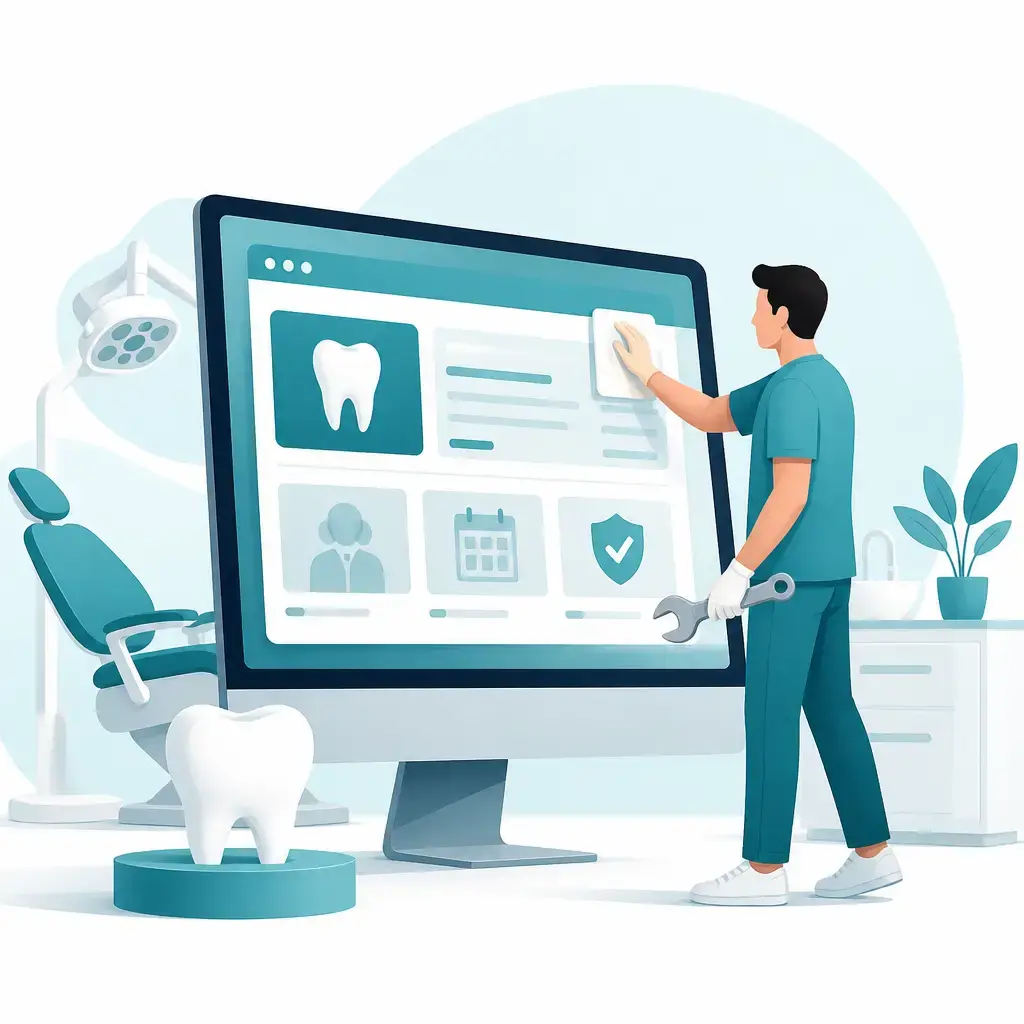
77% of patients search online before booking with a new dentist. If your website lists insurance you no longer accept, shows a dentist who left last year, or has a booking form that quietly stopped working, those patients don't ring to check. They book with the practice down the road. And with a new dental patient worth £1,200 to £3,000 in lifetime value, every one of those lost first impressions is real money walking out the door. Website maintenance for dental practices isn't a nice-to-have admin task. It's patient acquisition, trust and compliance rolled into one.
Key takeaways
- Incorrect insurance information is the number one reason new dental patients abandon a website before booking. Verify your accepted plans at least quarterly against what your billing team actually processes.
- Online booking is the highest-value and highest risk part of a dental website. A broken integration loses appointments around the clock, including the evenings and weekends when nobody's answering your phone.
- Staff changes should hit the website within 48 hours. Patients who chose a specific dentist from a profile page feel misled if that person is no longer there.
- Typical maintenance costs run from £100 to £200 per month for smaller practices, up to £1,000+ per month for large groups with advanced booking systems and patient portals.
Your website is part of the patient experience, not separate from it
Dental practices put enormous effort into the in-person experience. The waiting room is comfortable, the team is friendly, the clinical work is excellent. Then a prospective patient lands on a website with last year's opening hours and a treatment page that hasn't been touched since the site launched, and the whole impression falls apart before they've ever met you.
Here's the uncomfortable truth: most patients decide whether to contact a practice long before they pick up the phone. Your website is usually their first interaction with you. If it looks dated, loads slowly on their phone, or makes them hunt for basic information like whether you offer the treatment they need, they don't conclude "this practice is probably better in person". They conclude the practice doesn't pay attention to detail, and they wonder whether that extends to the clinical work too.
The flip side is just as true. A current, fast, accurate website does quiet work for you every day. It answers the questions patients actually have (do you take their insurance, can they book online, who will they see), it shows off the work you're proud of, and it makes booking feel low-effort. Patients who get what they need online arrive at their first appointment already confident in you. The website sets the tone; the practice confirms it.
That's why maintenance matters so much here. A dental website isn't a brochure you print once. It's a live representation of a practice that changes constantly, and it needs to keep pace.
What makes website maintenance for dental practices different?
Every business website needs updates, backups and security patches. Dental websites carry an extra layer of responsibility because patients make booking decisions based directly on what the site says.
Think about what's actually on a dental practice website: which insurance plans you accept, whether you offer sedation or specific procedures, which dentist or hygienist a patient will see, what payment and financing options exist. None of that is decorative. Patients read it, weigh it and act on it. When any of it is wrong, the practice pays twice. First in patient disappointment when they discover the error, and again in the time your front desk spends managing the fallout.
There's also a regulatory dimension that general business sites don't have. In the US, any web-based intake or communication tool that handles patient information has HIPAA implications. A standard contact form that drops submissions into an ordinary email inbox is fine for "what are your opening hours?" enquiries, but using it to collect medical history or insurance details is a compliance gap. Dental websites should use HIPAA-compliant intake tools, or clearly separate general contact forms from anything clinical. UK and Canadian practices aren't bound by HIPAA, but the principle holds: patient data submitted through your website needs to be handled properly under your local data protection rules (UK GDPR in Britain, for instance), and a maintenance provider who doesn't think about where form submissions end up is a liability.
Finally, dental practices simply change more often than most small businesses. Associates join and leave, hygienists move on, new equipment arrives, treatments get added, insurance participation shifts. Each of those changes has a website consequence, and most practices have nobody whose job it is to make the update.
The four things your dental website must always get right
Accuracy requirements for a dental site fall into four categories, and each one has a direct line to bookings.
1. Clinical services and capabilities
Your website should list exactly the procedures you actually perform, no more and no less. Added Invisalign, implants or sedation dentistry since the site launched? Those need their own presence on the site, because patients are searching for them by name. Stopped offering a procedure? The page or any reference to it needs to come down, otherwise you're generating enquiries you can't serve and starting relationships with a "sorry, we don't actually do that".
2. Insurance and payment information
This is the highest-urgency accuracy requirement on the entire site. Insurance plans listed on the website should be verified at least quarterly against what your billing team is genuinely processing, because participation changes and websites lag. Payment options matter too: the financing, credit card and payment plan options on the site should match exactly what's offered at the front desk. If the website promises a payment plan that quietly ended, you've created an awkward conversation at the worst possible moment.
3. Dentist and staff profiles
New patients choose providers partly on biography, specialty and credentials. They read the profile, they pick a person, they book. When a dentist joins, changes their specialty focus, or leaves the practice, the website should reflect it within 48 hours. A patient who booked because of a specific provider's profile, then discovers that provider left months ago, doesn't just feel inconvenienced. They feel misled, and that's hard to recover from.
4. Appointment booking accuracy
If you offer online booking, the available appointment types, availability settings and confirmation workflows need regular testing, not just a one-off check when the system was set up. A booking system that shows availability but never confirms, or confirms to the patient but never reaches your scheduling system, creates the worst kind of failure: the patient believes they have an appointment, your team has no idea they're coming, and somebody turns up to a practice that isn't expecting them.
The five most common dental website maintenance mistakes
These are the failures that come up again and again, and every one of them is preventable with a routine.
Outdated insurance lists. The most common and the most costly mistake. Insurance participation changes when you add or drop plans, and the website often lags months behind. A patient who picks your practice because the site lists their insurance, then discovers at the desk that you don't accept it, is unlikely to book again. They may well leave a negative review on the way out.
Broken or untested booking integrations. Online booking tools like Zocdoc, Healthgrades direct booking, Acuity and Jane App connect to your scheduling system via API. These integrations can fail after software updates, credential changes, or plan changes at the booking tool provider, and nothing on the surface looks broken when they do. A weekly booking test (submit an appointment request, then verify it actually appears in your scheduling system) catches failures before they cost you patients.
Staff pages that don't reflect the current team. Dental practices see more staff turnover than most small businesses. If a hygienist leaves, the page should be updated within 48 hours. If a new associate dentist joins, new patients are already searching for them by name, so the profile should go up within one business day of the change.
No mobile check after template or platform updates. Dental website platforms (Dental Intelligence, Neon, Sesame Communications, or general platforms like WordPress) push updates that can shift mobile layouts without warning. A booking button that disappears on mobile costs you every patient searching on their phone in the evening, which is exactly when a lot of dental browsing happens. If your site runs on WordPress, a team that handles proper WordPress development and updates will check mobile rendering after every change rather than assuming the desktop view tells the whole story.
Before/after gallery images without model releases. Treatment photos are a powerful conversion element, especially for cosmetic and restorative work. But every image needs a signed patient release on file. Using patient images without documented consent is both an ethical violation and, in the US, a HIPAA risk. Part of good maintenance is auditing the gallery against your consent records, not just adding new photos.
A practical maintenance schedule for a dental practice
Good dental website maintenance isn't complicated. It's a routine, run consistently, with clear triggers for the urgent stuff. Here's the schedule that works.
Monthly:
- Test the online booking flow end-to-end. Submit a booking request and confirm it routes correctly into your scheduling system.
- Submit each contact form on the site and verify the email actually arrives.
- Check office hours and holiday closures are current.
- Confirm the insurance list reflects your current participation.
Quarterly:
- Full staff page review: photos, bios and credentials current for every provider.
- Services page review: everything listed is still offered, and new capabilities have been added.
- Review patient review counts and response status on Google and Healthgrades.
- Run a broken link check across all pages.
On-event (these don't wait for the next scheduled review):
| Event | Website action | Deadline |
|---|---|---|
| Provider joins or leaves | Update or remove the profile | Within 48 hours |
| Insurance plan added or dropped | Update the insurance list | Within 24 hours |
| New service launched | New page or updated services page | Within 1 week |
| Office hours change | Update website, local search listing and voicemail together | Simultaneously |
That last row deserves a word. When your hours change, the website, your Google listing and your voicemail need to change at the same time, because patients check all three and any mismatch erodes trust. A patient who turns up to a closed practice because one of those three was wrong remembers it.
None of this is technically difficult. The hard part is that nobody in a busy practice owns it, so it doesn't happen. That's the actual case for a website maintenance plan: not the technical complexity, but the consistency.
What does dental website maintenance cost?
Costs scale with the size of the practice and how much the website actually does. Industry figures put it roughly like this:
| Practice type | Typical monthly cost | What it covers |
|---|---|---|
| Smaller dental practices | £100 to £200 | Content updates, security checks, plugin and CMS updates, speed monitoring, fixes to appointment forms and contact pages |
| Multi-location or growing practices | £250 to £800 | Frequent content edits, location page updates, stronger security layers, performance optimisation, closer SEO monitoring for local search |
| Large dental groups or specialist clinics | £1,000+ | Advanced booking systems, CRM integrations, patient portals, ongoing technical SEO support |
A few costs sit outside the monthly figure and are worth budgeting separately:
- Domain renewal. Your domain is your digital address, and losing it can knock out your online visibility overnight. Most dental domains cost £10 to £20 per year.
- SSL certificate. This protects patient data in transit and shows the padlock patients expect before they fill in an enquiry or appointment form. Some hosting providers include it free; paid options range from £10 to £1,000+ per year depending on the security level.
- Hosting. Hosting affects speed, uptime and reliability, and dental sites often use managed WordPress or VPS hosting for better performance. Annual hosting typically runs £150 to £2,000 depending on traffic and features.
Set those numbers against the value of a single new patient (£1,200 to £3,000 over their lifetime with the practice) and the maths is straightforward. If proper maintenance saves you a handful of lost patients a year, it has paid for itself several times over. The mistake practices make is treating maintenance as a cost to minimise rather than a leak to plug.
What happens when maintenance gets neglected
The damage from skipping maintenance is rarely dramatic. It's quiet, which is exactly why it's dangerous. Outdated plugins and unpatched software open up security vulnerabilities. Load times creep up until mobile visitors give up. A form breaks after an update and nobody notices for weeks, because the practice only finds out when someone mentions in person that they tried to book online and nothing happened. Each neglected element chips away at search visibility, site performance and patient trust, and the enquiries that should have come in simply don't.
Search visibility deserves particular attention for dentists, because dental is a local search game. Patients search "dentist near me" or "Invisalign [town]", and Google rewards sites that are fast, technically sound and current. A neglected site slides down the local results slowly enough that you don't notice a cliff edge, just a gradual thinning of new patient enquiries that's easy to blame on something else. If you're also spending on Google Ads to bring in new patients, a poorly maintained site is doubly expensive: you're paying for clicks that land on broken forms and slow pages.
There's a compounding effect too. Small content errors accumulate. An outdated treatment detail here, an unclear price there, an old location reference on a page nobody's reviewed in two years. Individually each one is trivial. Together they make the site confusing to navigate and quietly damage trust, and patients who can't quickly find what they need don't email to ask. They leave. We've written more broadly about why ongoing website maintenance matters for any business, but for dental practices the stakes are sharper because the website carries decision-critical information.
A note for cosmetic dentists: your gallery is your shop window
If you offer cosmetic work (veneers, whitening, smile makeovers, composite bonding), your website carries even more of the sales load than a general practice site. Cosmetic patients are discretionary. Nobody needs veneers the way they need a root canal, so the decision is driven by confidence, and confidence is built almost entirely online before they ever sit in your chair.
That means your before/after gallery, your treatment pages and your provider profiles aren't supporting content. They're the pitch. A gallery with dated photos, a smile makeover page that doesn't mention the techniques you've invested in since launch, or a profile that undersells your cosmetic credentials is leaving high-value work on the table.
It also means the consent discipline matters more. Cosmetic galleries grow over time as new cases get added, often informally, and it's easy for an image to slip in without the paperwork behind it. Make the gallery audit part of your quarterly review: every image matched to a signed release on file, every image still representative of the work you do now. Showcasing great results properly is one of the strongest conversion assets a cosmetic practice has, and it deserves the same care as the clinical work it shows off.
How to choose a maintenance provider for your practice
Not every web agency understands what's at stake on a dental website. Four questions sort the ones who do from the ones who don't:
Have they worked with healthcare or dental clients? A provider who has maintained dental websites understands the urgency of insurance accuracy, the need to test booking integrations, and the cadence of staff page updates. One who hasn't will treat your site like any other small business site, and the gaps will show.
What's their turnaround for urgent staff updates? Staff changes need same-day or next-day turnaround, not "we'll get to it in the next sprint". Confirm whether urgent requests are included in the plan or priced separately, before you need one.
Do they test booking integrations after changes? Any change near the booking system or form area should be followed by a test submission before the change is considered done. If a provider doesn't do this as standard, broken bookings are a matter of when, not if.
Are they HIPAA-aware (or aware of your local equivalent)? They don't need to be compliance experts, but they should understand not to introduce non-compliant form handling, and they should flag it if you ask them to use a standard contact form for clinical intake. A provider who says yes to everything without questioning where patient data ends up is a red flag.
Beyond those four, look for evidence of process: a documented monthly checklist, proof of testing after updates, and clear reporting so you can see the work actually happened. Maintenance done well is invisible, which makes it easy for a lazy provider to charge for work they're not doing.
Keep the online experience as good as the in chair one
Your patients judge the whole practice, online and off. The same attention you give to the waiting room and the clinical work needs to extend to the website, because for most new patients the website comes first. Accurate insurance information, working booking forms, current staff profiles and a fast mobile experience aren't technical niceties. They're the difference between a patient booking with you and booking with someone else. And small improvements compound: practices that keep their sites current convert noticeably more of their visitors, which is why we've covered quick conversion wins for clinics and dental practices separately.
At IceBoxDesigns we look after websites for dental practices throughout the UK, the United States and Canada, handling the updates, security, performance checks and content changes so your team can focus on patients. If your practice website hasn't had a proper review in a while, or you suspect your booking form isn't doing its job, get in touch and we'll take a look.
Frequently asked questions
How often should a dental practice website be updated?
Run monthly checks on booking flows, contact forms, opening hours and your insurance list, plus a quarterly review of staff pages, services pages and broken links. Urgent changes shouldn't wait: staff changes within 48 hours, insurance changes within 24 hours, and new services within a week.
How much does website maintenance cost for a dental practice?
Smaller practices typically pay £100 to £200 per month, multi-location or growing practices £250 to £800, and large dental groups with booking systems and patient portals upwards of £1,000 per month. Domain renewal (£10 to £20 a year), SSL and hosting are usually budgeted separately.
What is the most common dental website maintenance mistake?
An outdated insurance list. Incorrect insurance information is the number one reason new dental patients abandon a website before booking, and a patient who discovers at the desk that you don't actually take their plan rarely books again.
Do dental website contact forms need to be HIPAA compliant?
In the US, any form collecting patient information such as medical history or insurance details needs HIPAA-compliant handling. A standard contact form that stores submissions in an ordinary email inbox is a compliance gap for clinical intake, though it's fine for general enquiries. UK and Canadian practices should apply the same principle under their local data protection rules.
Related articles


Related services
Need a hand with this? Here's how IceBoxDesigns can help.