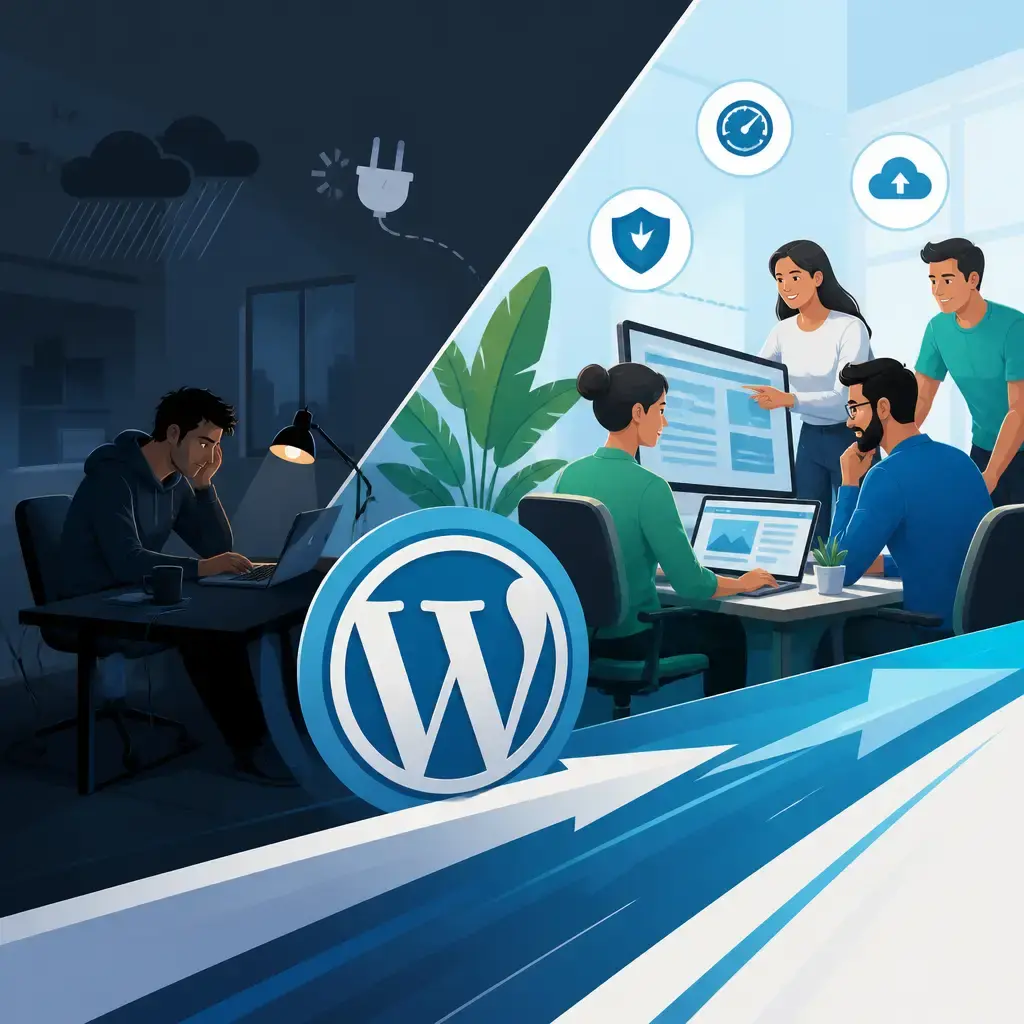
If the person running your website clocks out at 5pm, your growth clocks out with them. That's the uncomfortable truth behind hiring a side-hustle developer or a single freelance "web guy" to build and look after the most important sales tool your business owns. A proper WordPress agency isn't just more hands. It's redundancy, process and someone who's still there when something breaks at 9am on a Monday. This article unpacks why that difference matters, where the one-man-band model quietly fails, and how to spot the risk before it costs you months of momentum.
None of this is about talent. Plenty of solo developers are genuinely skilled. The problem is structural: a single person building your site in spare time runs into hard limits on time, attention and cover, no matter how good they are. And when your revenue depends on the thing they're building, those limits become your problem.
Key takeaways
- A part-time developer means part-time results: limited availability, divided attention and no cover when things go wrong.
- The biggest risk isn't bad code, it's dependency. If your developer controls your domain, hosting and admin logins, you rent your business, you don't own it.
- Delays aren't just annoying. Every month your site stalls is lost search authority, lost leads and lost ground to competitors who kept compounding.
- An agency gives you redundancy, documented process and pattern recognition built from doing the same work many times over.
- Whoever you hire, insist on owning your domain, hosting and admin access in your own name from day one.
The "web guy" trap most owners fall into
Most business owners don't set out to gamble with their website. They just want it done, and a freelancer or a mate who "does websites" is cheaper and feels more personal than an agency. So they either try to DIY it, or they hand the lot to one person doing it between other commitments.
The mistake is treating access to tools as the same thing as mastery of execution. WordPress is free. Page builders are everywhere. Anyone can spin up a site that looks fine in a screenshot. Looking the part and running a website that actually generates demand, stays secure and keeps growing are two very different jobs.
That gap doesn't show up on day one. It shows up three months in, when revisions are looping, the developer's gone quiet, and you realise you can't even log in to your own hosting. By then the cost isn't theoretical.
Visibility isn't the same as competence
There's a quiet distortion in the digital market. It isn't illegal or malicious, it's structural. Inexperienced operators get presented as authorities because they have the trappings of one: marketplace badges, tier ratings, a clean portfolio, confident sales patter and a visible profile.
The bar for "expert" has dropped a long way. When someone hits "elite" status after building a few dozen sites, the word stops meaning anything. Participation gets marketed as mastery. Exposure gets mistaken for experience. None of that hurts the platforms handing out the badges. It hurts the business owner who trusts them.
So when you're weighing up who builds your site, treat badges and portfolio gloss as a starting point, not proof. Ask what happens when something goes wrong, who covers the work if your contact is ill, and who owns the assets at the end. The answers tell you far more than a five-star rating.
Why part time effort produces part-time results
Call it execution fragility: what happens when your revenue engine depends on a single, under-resourced person. It's not about personality, it's about capacity. A side-hustle developer is working inside hard constraints, whether they admit it or not:
- Limited availability
- Divided attention
- No redundancy if they're unavailable
- No institutional systems or documented process
- No pressure-tested workflow for when deadlines bite
Under those constraints, deadlines stretch. Momentum stalls. Revisions go round in circles. Excuses start to multiply. When pressure rises, the fragility surfaces, and it surfaces at the worst possible moment, usually when you've got a launch or a campaign riding on it.
There's also a motivation problem baked into the side-hustle model, and again it isn't about character. It's incentive alignment. Sales gives quick gratification. Execution needs sustained, unglamorous discipline. When someone's time is squeezed, sales wins. New projects get started, the complex finishing work lags, and completion becomes conditional on them not having anything better to do. Forced to choose between closing new revenue and finishing your infrastructure, the part-timer chases the sale. Your project becomes the drag. That's not an insult, it's just the maths of how the model works.
An agency runs on a different model. Work is scheduled, handed between people and tracked, so finishing a job isn't competing for attention with the next sales call. If you want the longer case for ongoing, structured support over ad-hoc fixes, we've made it in why a WordPress support retainer is worth it for growing businesses.
Operator dependency: the risk nobody prices in
Here's the risk that almost no one calculates when they hire cheap. Operator dependency risk is the exposure you create when your whole digital setup relies on someone whose main income and attention are elsewhere.
Think about what happens if that one person gets overwhelmed, gets a promotion at their day job, hits a personal crisis, burns out or simply stops replying. Your business absorbs the entire shock. When your vendor disappears, so does your asset. Search equity you've built up resets. Authority signals dissolve. The time you invested evaporates. You restart, not because the strategy was wrong, but because the foundation was fragile.
With a team, one person being unavailable is an inconvenience, not a catastrophe. Someone else picks up the work, the documentation is there, and your site keeps running. That redundancy is precisely what you're paying for, even on the months when nothing goes wrong.
Infrastructure ownership: rent or own?
The single highest-risk setup is vendor-controlled ownership. When the developer holds:
- The domain
- The hosting account
- The CMS (WordPress) access
- The administrative credentials
you don't own your infrastructure. You rent it. And if the relationship breaks down, your growth breaks down with it. We've seen owners locked out of their own sites because the only admin account belonged to a freelancer who'd vanished, and recovering from that is slow, stressful and sometimes expensive. If you've ever needed to claw access back the hard way, our guide on adding an admin user via SQL when you're locked out of WordPress shows just how messy it gets.
The rule is simple. Your digital assets must be transferable, durable and independent of whoever builds or maintains them. Anything less is dependency dressed up as convenience.
So whoever you hire, agency or freelancer, insist on this from the start:
- Register the domain in your own business name, on your own account, and keep the login.
- Own the hosting account, or at minimum have full administrative access to it.
- Hold your own WordPress administrator account, separate from the developer's.
- Make sure backups exist and that you (or someone you trust) can reach them.
- Get a clear, written handover plan for the day the relationship ends.
A good agency will set this up as standard and won't blink when you ask. If anyone resists giving you ownership of your own assets, that's your answer.
Repetition is the proof that actually counts
Expertise isn't something you declare, it's something you demonstrate through repetition. Low volume produces theory. High volume produces pattern recognition, and pattern recognition is what kills the guesswork that wrecks conversions.
A developer who's built 30 or 50 sites across a career is working from limited exposure. Every awkward problem is, in some sense, new to them. A team that's delivered 30,000+ projects across all the relevant platforms is working from institutional memory: they've seen this plugin conflict before, this migration headache before, this performance issue before, and they already know the fix.
10com, the source for this piece, reports over 10,000 builds on a single ecosystem alone. They note that at multiple points platform leadership confirmed their execution throughput exceeded other top partners by more than 10 times, that their completion rates held steady under record demand, and that internal communications named them the top of the top three partners globally and referred to them as their "star." Whatever the exact numbers behind any one agency, the principle stands: volume isn't ego, it's insurance. The more times a team has done the work, the less likely your project is the one that catches them out.
If you're weighing up the WordPress platform itself rather than the team behind it, we've covered the honest pros and cons in WordPress advantages and disadvantages for UK business owners.
Platforms don't create market leaders, operators do
Tools don't create dominance. Operators do. In inexperienced hands, even a powerful platform produces amateur results. In experienced hands, the exact same platform produces market leaders. The platform isn't the differentiator. The execution model is.
There's a tell here too. Hobbyists tend to specialise in one platform because they have to, it's all they've had time to learn. A capable team works across the relevant platforms and languages because it can, which means platform choice becomes a strategic decision made to suit your business rather than a limitation imposed by what your developer happens to know. If WordPress is genuinely the best fit for you, great. If it isn't, you want someone who can tell you that honestly instead of defaulting to the one tool in their kit.
This is the core of what we do at IceBoxDesigns: bespoke WordPress development built by a team, with the process and cover behind it, not a single person fitting it around other work.
The "free website in minutes" illusion
There's a second distortion warping the market, and it's all about speed over substance. "Create a free website in minutes" sounds empowering. It isn't. It quietly conditions owners to treat their website like a commodity: simple, quick, disposable, interchangeable.
A real website is none of those things. It isn't decoration, a placeholder or a digital business card. It's an appreciable asset. It's your salesperson, your lead engine, your conversion funnel, your authority anchor and your search entity all at once. Assets like that don't get built in minutes, and treating them as if they do is how owners end up with something that looks live but does no actual work.
Activity is not progress
AI builders and DIY platforms are very good at creating motion. You click. You drag. You prompt. You generate copy. You rearrange sections. You tweak colours. You feel busy and productive. But none of it is necessarily strategic progress.
Every week, agencies speak to owners who've spent months inside "free" builders, used AI to generate content, rearranged templates over and over, and tried to fix deeper perception problems with surface-level edits. They were active. They weren't advancing. They built something. It just didn't work.
Using AI well is a real skill, not a substitute for strategy, and getting that balance right is its own discipline. If that's where you're tempted to start, read how small businesses can use AI without losing their strategy or voice before you let a builder run the show.
The hidden cost no one calculates: time equity
Time isn't free, and this is the bill that never appears on an invoice. When you spend three months "figuring it out," that's three months of lost search authority, lost compounding signals, lost engagement data, lost backlinks, lost market positioning and lost inbound demand. That's your time equity, and once it's gone you don't get it back.
The maths is brutal when you actually run it. While you were spinning your wheels inside a builder, your competitor was compounding. While you were rewriting AI-generated paragraphs, someone else was ranking. While you were tweaking colours, someone else was closing deals.
Now put a number on it. If your average client is worth £5,000, how many clients did invisibility cost you over those months? If your average client is worth £25,000, what did six months of delay really cost? (The source uses dollar figures; the point holds in any currency: do the sum for your own business.) The most expensive website isn't the one with the biggest invoice. It's the one that stalls your momentum. "Free" is rarely free. It's deferred revenue loss dressed up as convenience.
Agency vs one-man band, side by side
| Factor | Side-hustle / one-man band | WordPress agency |
|---|---|---|
| Availability | Limited, fits around a day job | Scheduled, with cover for absences |
| Redundancy | None, single point of failure | Multiple people, work handed over |
| Process | Ad-hoc, often undocumented | Documented, pressure-tested |
| Incentive | Sales wins when time is tight | Delivery is the job, not a side bet |
| Experience base | Limited builds, more guesswork | High volume, pattern recognition |
| When something breaks | You wait for one busy person | A team responds |
| Asset ownership | Often held by the developer | Set up in your name as standard |
None of this means a freelancer can never do good work. For a small, simple, low-stakes site they may be perfectly fine. The calculation changes the moment your website is doing real commercial work, carrying leads, sales and your reputation. At that point, fragility stops being acceptable.
How to choose without getting burned
Whether you go agency or freelance, a few questions cut through the sales gloss fast:
- Who covers the work if you're unavailable for two weeks?
- Will the domain, hosting and admin logins be in my name from day one?
- What does your handover process look like if we part ways?
- How many sites like mine have you actually built and maintained?
- What happens when my site gets hacked or goes down, and how quickly?
If the answers are vague, you've found your risk. If they're clear and the ownership terms are in writing, you're on safer ground. For a fuller checklist on vetting a partner, we wrote how to choose a Manchester web design agency, and the same principles apply wherever you are.
The bottom line
Digital infrastructure can't be built reliably between shifts and meetings. A part-time operator gives you part-time results, no cover, and a dependency that can collapse the moment their attention moves elsewhere. An agency gives you redundancy, process and the experience that comes from doing the work over and over. That's the difference between renting your growth and owning it.
If your site is starting to carry real commercial weight and you want it built and looked after by a team rather than one person squeezing it in, our WordPress development service is built exactly for that. Get in touch and we'll talk through what your business actually needs.
Frequently asked questions
Is a freelancer ever the right choice over an agency?
For a small, simple, low-stakes website a good freelancer can be perfectly fine. The calculation changes once your site is carrying real commercial work, leads, sales and reputation. At that point the lack of cover, redundancy and documented process becomes a genuine risk, and a team is the safer bet.
How do I make sure I actually own my website?
Register the domain in your own business name on your own account, own or have full admin access to the hosting, hold your own WordPress administrator account separate from the developer's, make sure backups exist and you can reach them, and get a written handover plan. A good agency sets this up as standard. Anyone who resists giving you ownership of your own assets is a warning sign.
Why are deadlines a bigger problem with a part-time developer?
When someone is fitting your build around a day job, their time is squeezed. Sales and quick wins tend to win out over the unglamorous finishing work, so projects start fast and then stall. There's also no one to cover if they get overwhelmed, ill or distracted, which is why deadlines stretch and revisions loop.
What is 'time equity' and why does it matter?
Time equity is the cumulative value you build while your site is live and working: search authority, backlinks, engagement data, market positioning and inbound demand. Every month a project stalls is a month of that compounding lost to competitors who kept going, and you don't get it back. That's the real, uninvoiced cost of a slow or fragile build.
Related articles


Related services
Need a hand with this? Here's how IceBoxDesigns can help.