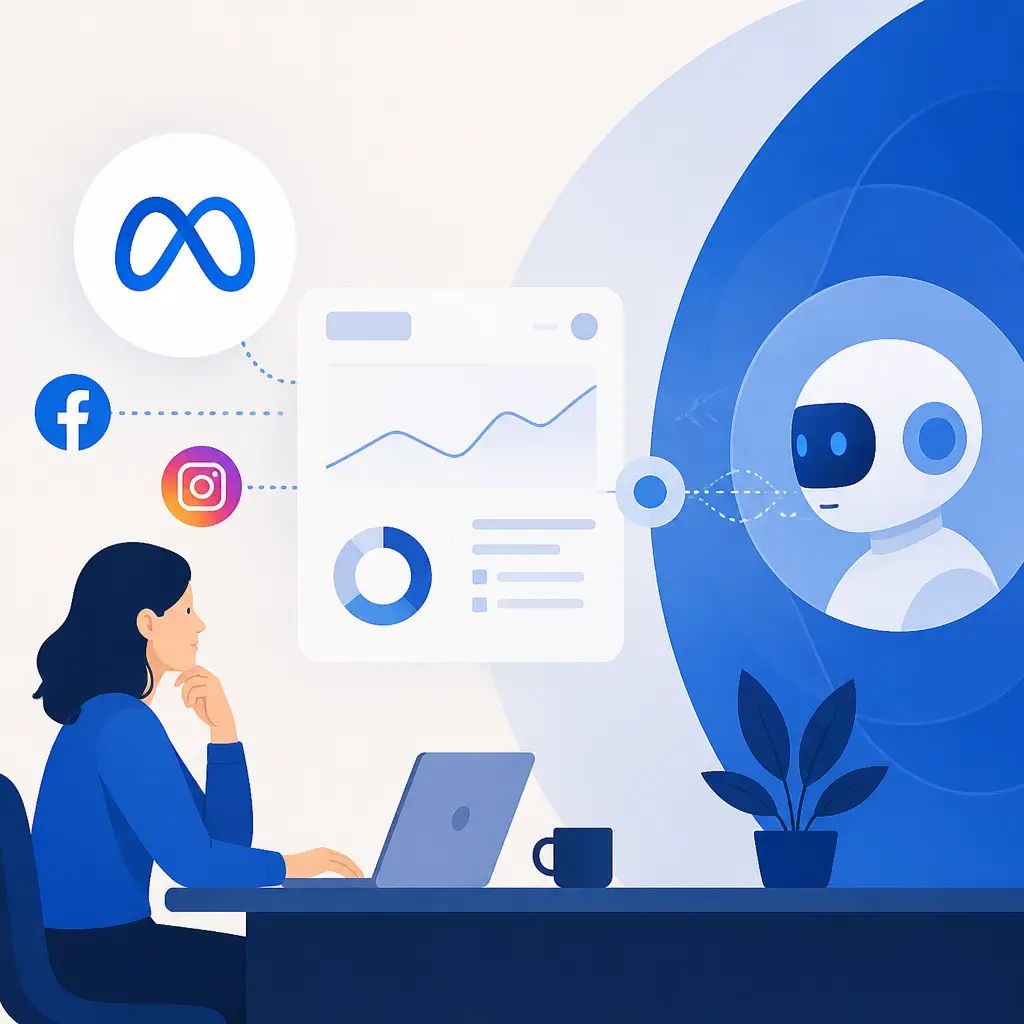
Meta has just made it possible for AI assistants like ChatGPT and Claude to connect directly to your Meta advertising account. The Meta Ads AI connector is one of the most significant changes to paid social management in years, and if you run ads on Facebook or Instagram, it's worth understanding what it actually does.
Key Takeaways
- The Meta Ads AI connector uses something called Model Context Protocol (MCP) to let AI tools like Claude and ChatGPT plug into your Meta Ads Manager account.
- You can use plain, conversational language to pull reports, spot underperforming campaigns, and get creative suggestions, without touching a dashboard.
- AI handles the data-heavy, repetitive work faster than any human can, but it doesn't understand your brand, your customers' emotions, or your wider business goals.
- Agencies and marketers who combine AI tools with genuine strategic thinking will outperform those who rely on automation alone.
- This technology is already reshaping how paid social is managed, and the shift will only accelerate.
What Is Meta Ads MCP and How Does the Connector Work?
MCP stands for Model Context Protocol. In plain terms, it's the underlying system that lets AI assistants connect securely to external platforms, in this case, your Meta advertising account.
Think of it as a bridge. On one side you have Meta Ads Manager and all the campaign data sitting inside it. On the other side you have an AI assistant like Claude or ChatGPT. The Meta Ads AI connector is what joins the two together.
Once connected, you can ask the AI questions in plain English rather than digging through dashboards yourself. For example:
- "Find my worst-performing campaigns."
- "Show me audiences with rising CPMs."
- "Generate new ad copy ideas."
- "Break down performance by creative type."
- "Summarise this month's Meta ads performance."
The AI pulls the relevant data, analyses it, and gives you a clear answer. For anyone managing multiple campaigns or large ad accounts, that alone is a significant time saving.
What These AI Advertising Tools Can Actually Do
The practical benefits are real and worth taking seriously. Using ChatGPT or Claude integrations with Meta Ads Manager, marketers can:
- Analyse campaign performance without manually exporting data
- Generate reporting summaries in seconds
- Build audience insights from live account data
- Spot creative fatigue before it tanks your results
- Get suggestions for new campaign angles and ad copy
- Speed up testing workflows
- Cut down the time spent on routine account admin
For agencies running campaigns at scale, this could genuinely reduce hours of weekly work. Reports that used to take a morning to compile can be produced in a few minutes with the right prompts.
The technology is also driving a surge in interest around AI for Meta advertising more broadly. Searches for terms like "ChatGPT Meta Ads" and "Claude Meta Ads" have been climbing sharply as marketers try to understand what's now possible.
Where AI Falls Short
Here's the bit that gets glossed over in most of the excitement around these tools: AI is very good at processing data and spotting patterns. It is not good at understanding people.
Successful paid social campaigns depend on things that sit outside a dataset. That includes strong creative concepts that actually stop someone mid-scroll, an understanding of buyer psychology and emotional triggers, full-funnel thinking that connects an ad to a business outcome, and a clear sense of brand voice and positioning.
AI can suggest ad copy ideas. It can flag that a campaign is underperforming. It can tell you which audience segment has a rising CPM. What it cannot do is interpret all of that within the context of your specific business, your competitive landscape, or the cultural nuance that makes a message land with your particular customers.
Faster insights don't automatically lead to better decisions. Someone still has to make the call.
Why Human Strategy Still Drives Results
There's a question circulating among business owners right now: can AI tools just replace an agency altogether? The short answer is no, at least not yet, and arguably not ever for the things that matter most.
The value an experienced team brings isn't in pulling reports or summarising data. It's in:
Creative direction. High-performing ads need ideas that cut through. AI can generate options, but knowing which concept will resonate with a specific audience at a specific moment requires human judgement.
Strategic decision-making. AI can surface a trend. Working out what to do about it, given your budget, your goals, and your competitors, is a different skill entirely.
Audience psychology. Understanding why someone buys, what fears or desires drive the decision, is critical for conversion-focused advertising. That's not something you can automate.
Testing frameworks. Winning paid social strategies are built through structured, iterative testing. Automation can speed that up, but it doesn't design the framework.
Brand positioning. Tone of voice, long-term messaging consistency, and competitive differentiation all require a level of nuance that AI tools currently can't replicate.
The marketers who will perform best in this new landscape are the ones who treat AI as a powerful assistant rather than a replacement for thinking. If you're exploring how AI automation could support your broader marketing operations, the same principle applies across the board.
What This Means for the Future of Paid Social
Paid social marketing is moving towards a more connected, AI-assisted model. Campaign analysis is becoming more real-time. Reporting is getting faster. Creative production is speeding up. Data that used to require an analyst to interpret is increasingly accessible to anyone who knows the right questions to ask.
That's genuinely good news for brands and marketers. But it does shift what the job actually is. The role is moving away from manual campaign operation and towards strategic decision-making. Knowing how to use these tools well, and knowing when to override them, is becoming as important as knowing the platform itself.
The brands that get the strongest long-term results from Meta advertising will be the ones combining the speed and data-processing power of AI with the creative strategy, psychological insight, and business context that only experienced people can provide. The competitive advantage won't come from having access to the AI connector. Everyone will have that. It will come from knowing how to use it properly.
If you're also thinking about how AI tools might support other parts of your business, it's worth exploring what's possible with AI business automation beyond just advertising.
Is Your Business Ready to Make the Most of These Changes?
The Meta Ads AI connector is a meaningful development, not hype. It will save time, surface better insights, and make campaign management more efficient for anyone who uses it well. But the brands that pull ahead will still be the ones with a clear strategy, strong creative, and a proper understanding of their customers.
If you want to make sure your paid social campaigns are set up to take advantage of what AI tools can now offer, without losing the strategic edge that actually drives growth, get in touch with IceBoxDesigns. We'd be happy to talk through what's possible.
Frequently asked questions
What is Meta Ads MCP?
Meta Ads MCP stands for Model Context Protocol. It's the system that allows AI assistants like Claude and ChatGPT to connect securely to your Meta advertising account so they can analyse data, generate reports, and support campaign management.
What can the Meta Ads AI connector actually do?
It lets AI tools interact directly with your Meta Ads Manager data. You can ask plain-English questions to pull performance reports, identify underperforming campaigns, spot audiences with rising CPMs, get ad copy suggestions, and summarise campaign results, all without manually digging through dashboards.
Can ChatGPT or Claude fully manage my Meta ad campaigns?
They can assist significantly with analysis, reporting, and creative ideation, but they can't replace the strategic thinking, audience psychology, and creative direction required to run high-performing campaigns. Human oversight and strategy remain essential.
Will AI advertising tools replace agencies?
Not for the things that drive real results. AI improves efficiency and automates repetitive tasks, but experienced teams still provide the creative direction, strategic decision-making, and brand understanding that AI currently can't replicate.
Related articles



Related services
Need a hand with this? Here's how IceBoxDesigns can help.