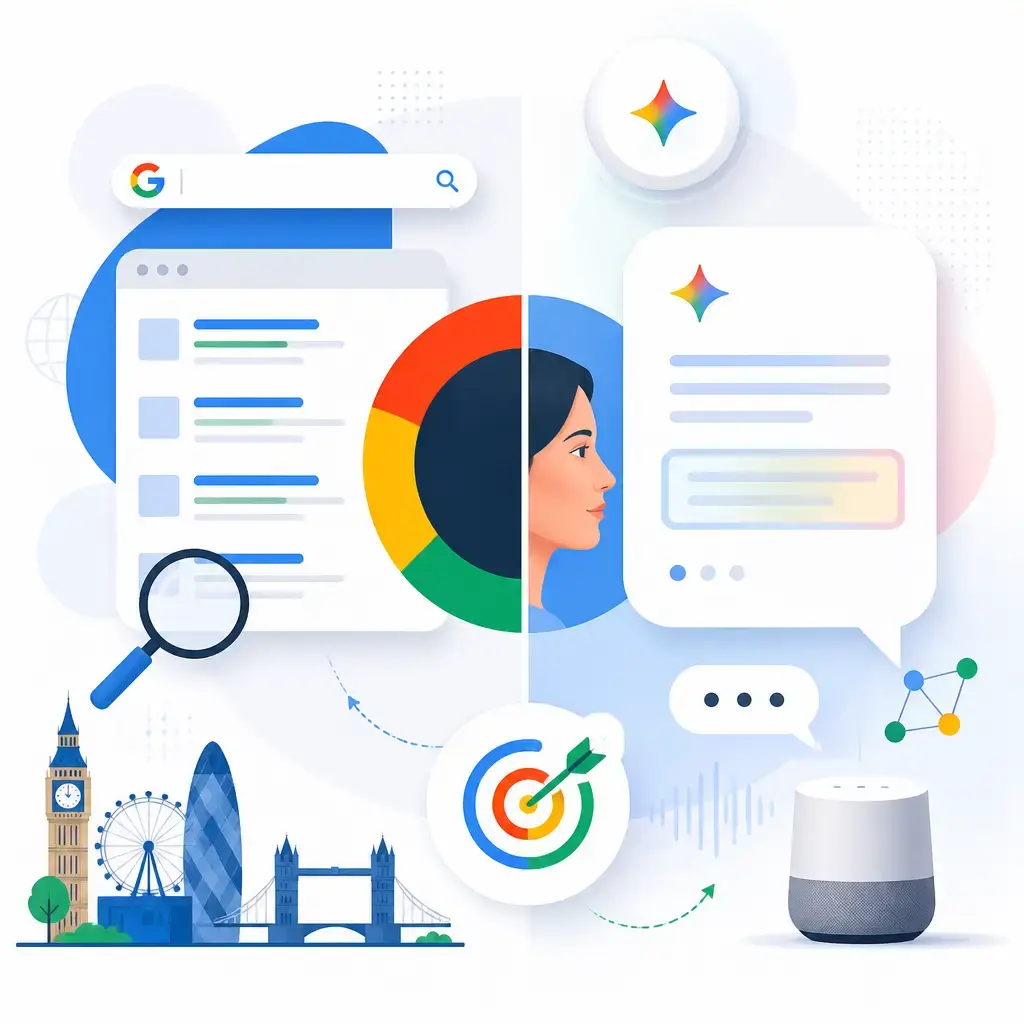
Your customers aren't all scrolling through ten blue links any more. A growing number ask ChatGPT, Google's AI results or a voice assistant a question and take the answer that comes back. That changes how you get found. SEO (Search Engine Optimization) is still about ranking your pages in Google and Bing. GEO (Generative Engine Optimization) is about getting your content into the AI-generated answer itself. This piece walks through SEO vs GEO in plain terms, what each one rewards, and why the smart move for most businesses is to do both rather than pick a side.
Key takeaways
- SEO gets your pages ranking in traditional search results; GEO gets your content cited inside AI-generated answers from tools like ChatGPT and Google's AI Overview.
- GEO is a young field. The term was coined in 2023 by researchers at Princeton University, and Wired reports the GEO industry is expected to be worth nearly USD 850M.
- AI search behaves differently from Google. Keyword stuffing won't help, and some studies say it can actually reduce your visibility in AI answers.
- Half of website traffic still comes from organic search, so you don't abandon SEO. GEO sits alongside it.
- Both reward clear, accurate, well-structured content. The biggest practical difference is the metric: clicks for SEO, references for GEO.
Why this shift is happening now
Search is changing because of generative AI. For years, SEO was the obvious way to get a product or service discovered. You optimised your pages, you climbed the rankings, and the traffic followed. That still works. But people have started using conversational chatbots to form opinions and choose what to buy, and that forced brands to rethink how they grow online.
The numbers behind the shift are worth pausing on. A recent Adobe study found that generative AI drove a 690% increase in traffic to retail sites during the 2025 holiday season. That's not a rounding error. It's a sign that AI tools are sending real, buying customers to websites, and the businesses that show up in those AI answers get the benefit.
The money is following too. Wired reports that the GEO industry is expected to be worth nearly USD 850M. A category that didn't have a name before 2023 now has an industry forming around it.
So the question for most business owners isn't "SEO or GEO". It's "how do I cover both without doubling my workload". Let's break down what each one actually is first.
What SEO actually is
Traditional search engines crawl sites, index the content they find, and run algorithms to decide which pages best answer a given query. It feels like a modern concept, but search engines started tweaking their algorithms to stop people gaming the rankings as far back as 1997, which you can still see in archived pages on the Wayback Machine.
SEO is the set of strategies for tailoring your content so it ranks higher in engines like Google and Bing. In practice that covers:
- Keyword optimisation, so your pages target the terms people actually search for.
- Backlink management, because links from other reputable sites still carry weight.
- Technical site improvements, the under-the-bonnet work that helps engines crawl and understand your site.
- User experience factors like page speed and mobile friendliness.
Get it right and you rank for relevant keywords, which brings qualified traffic, leads and conversions. And here's the stat that keeps SEO firmly on the table: half of website traffic still comes from organic search. That's why SEO remains a cornerstone of digital marketing rather than something you can quietly drop.
What GEO actually is
GEO grew up alongside AI search and chatbot assistants. The term was introduced in 2023 by researchers at Princeton University, who used it to describe ways of influencing how large language models retrieve and present information when someone asks a question.
In plain terms, GEO is the practice of adapting your content and online presence so a specific piece of it shows up in answers produced by generative AI, rather than in a list of blue links. Think Google's Search Generative Experiences (the AI Overview), OpenAI's ChatGPT, and Amazon's Alexa.
Here's the difference in action. Say someone asks Google, "What project management apps integrate better with Slack?" Old-school SEO results would hand them ten website links, each with its own list of apps. The AI might instead generate a single answer: "Management apps X, Y and Z integrate with Slack and offer these features..." GEO is the work of making sure your content or product is part of that answer.
What does GEO reward? A few things in particular:
- Content formatting. Concise answers, bullet points and a clear question-and-answer structure.
- Factual accuracy. AI leans on current, authoritative data, so out-of-date or vague content gets passed over.
- Trustworthy signals. Citing your sources and using schema markup helps the AI understand and trust what you've published.
The goal is simple to state and harder to achieve: be one of the sources the AI pulls from, draws on and cites when it builds its answer.
One thing worth flagging early. AI search works differently enough that the old SEO tricks don't carry over. Keyword stuffing, cramming a phrase in over and over, won't help here. Some studies even claim that keyword stuffing can decrease your visibility in AI-generated results, because the AI is reading for value and outcome to understand what a piece of content is really about. Stuff it with repeated phrases and you can do yourself harm.
SEO vs GEO: the key differences
Both approaches want the same thing, to connect people with content that's genuinely useful. But they play in different arenas and reward different tactics. Here's how they compare across the things that matter.
| Factor | SEO | GEO |
|---|---|---|
| Query style and length | Shorter queries like "restaurants near me" | Conversational queries like "What is the best restaurant to eat sushi in New York?" AI search prompts are almost six times longer than traditional searches |
| Results format | A list of around ten links; the user picks and clicks | A single comprehensive answer with references; the AI aggregates the sources, not the user |
| Content requirements | Favours comprehensive pages that cover a topic thoroughly | Favours structured, information-dense content with facts, definitions and labelled sections |
| Structure | Long-form pages work well | Bullet points and FAQs help the AI extract what it needs |
| Ranking factors | Backlinks, keywords, metadata, engagement metrics | Content quality, structure and source credibility |
| Success metric | Did the user click your link? | Did the AI reference and cite your content? |
A couple of these deserve a closer look.
Queries are getting longer and more conversational
People type "restaurants near me" into Google. They ask an AI, "What is the best restaurant to eat sushi in New York?" As users settle into longer dialogues with these tools, their questions carry more context. AI-based search prompts run almost six times longer than traditional searches. That changes the kind of content that wins, because the AI is matching your content against a rich, specific question, not a two-word phrase.
Structure beats stuffing
For GEO, bullet points and FAQs are often more digestible to an AI than a long flowing essay. Keywords still matter for context, but semantic relevance and clarity matter more. The AI wants facts and clearly labelled sections it can lift cleanly into an answer. If your best information is buried three paragraphs deep in a wall of prose, the AI may never surface it.
The metric changes from clicks to references
This is the one that catches businesses off guard. SEO lives or dies on whether someone clicks your link. With GEO, the user might never click anything, because the AI has already given them the answer with your name attached. Andreessen Horowitz describes this as the shift from "click-through rates to reference rates", where relevance matters more than your position in a ranking.
So you can get value without a click. If an AI says "according to YourWebsite's blog, onboarding best practices include tutorials and messages...", your brand has been named as the authority even though nobody landed on your page. That's a different kind of win, and you measure it differently.
A quick worked example
Say you run a blog about UX and someone searches for "user onboarding best practices".
The SEO play is to get them to click your post, "10 Best Practices for User Onboarding". You want that top-ten slot, the click, and the visit.
The GEO play is to get your content folded into the AI's summary: "According to YourWebsite's blog, onboarding best practices include tutorials and messages..." No click required. Both are valuable. They just need different preparation. SEO is about earning one of those top ten spots on the page. GEO is about earning a spot in the answer itself.
Where AEO fits in
There's a third term you'll hear: AEO, or Answer Engine Optimization. It's often described as the bridge between SEO and GEO. AEO optimises content for "answer-first" interfaces, the search experiences that put an instant response ahead of a list of links. That includes featured snippets, the People Also Ask boxes, knowledge panels and voice assistants.
If you've ever spotted your content pulled into a featured snippet at the top of Google, that's AEO territory. It sits naturally between classic ranking and full AI-generated answers, and the same habits that help, clear answers, good structure, trustworthy sources, serve all three.
Why most businesses should do both
Here's the honest take. The headline "SEO vs GEO" makes it sound like a fight where one wins. It isn't. Half of web traffic still comes from organic search, so dropping SEO would be daft. At the same time, AI tools are driving measurable traffic and forming a market worth nearly USD 850M. Ignoring GEO leaves money on the table.
The good news is the two overlap more than they compete. Both reward content that's accurate, current, well-structured and genuinely useful. Get those fundamentals right and you're helping your search rankings and your chances of being cited by an AI at the same time. The work isn't doubled. It's mostly the same work, framed for two audiences: the search algorithm and the language model.
The practical changes that pull double duty:
- Write clear, concise answers near the top of a page, then expand below. Both Google's snippets and AI tools grab those clean answers.
- Use FAQs and bullet points so key facts are easy to extract.
- Keep your facts current and cite where they come from. Authority helps you rank and helps an AI trust you.
- Use schema markup so machines understand the structure of your content.
- Stop stuffing keywords. It was already weak for SEO, and it can actively hurt you in AI answers.
If you're a small or medium business, the trap to avoid is chasing the shiny new thing while letting your existing search foundations rot. A site that's slow, broken on mobile or full of outdated content won't do well in either world. Getting the basics solid, fast pages, sensible structure, accurate content, is the groundwork that makes both SEO and GEO possible. That's the kind of ongoing care a proper website maintenance plan is built to handle, so your content stays current and your site stays in shape for whatever's reading it.
If this all feels like a lot to juggle, you're not alone. We've written more on using AI search optimisation tools to grow your organic traffic, and on keeping track of how your brand shows up in AI responses, both of which dig into the practical side of getting found in AI answers.
What this means for you, in practical terms
Start by accepting that visibility now has two front doors. One is the traditional results page, where ranking and clicks still matter. The other is the AI answer, where being referenced matters more than being clicked. You want to be present at both.
Then audit what you already publish. Is your best information easy for a machine to find and lift? Are your facts current? Do you cite sources and use structured formatting? Most businesses already have decent content, it's just buried or badly formatted for the way people search now. Fixing that is usually faster than starting from scratch.
Finally, measure both. Keep watching your organic search traffic, but also start paying attention to whether your brand turns up in AI answers when people ask questions in your space. That's the reference rate Andreessen Horowitz pointed to, and it's becoming as important as the rankings you've always tracked.
The shift from search to AI answers is real, but it isn't a cliff edge. SEO isn't going anywhere while half of web traffic still comes from organic search. GEO is the new layer on top. Treat them as two parts of one strategy and you'll show up wherever your customers are asking.
If you'd like help getting your content found in both Google and AI answers, our team can audit your site and build a combined SEO and GEO approach that fits your business. Take a look at how we handle SEO-led growth and paid advertising and let's talk.
Frequently asked questions
What's the difference between SEO and GEO?
SEO (Search Engine Optimization) tailors your content to rank higher in traditional search engines like Google and Bing, so your pages appear in the list of results. GEO (Generative Engine Optimization) adapts your content so it gets pulled into and cited within AI-generated answers from tools like ChatGPT and Google's AI Overview. SEO is about earning a top spot on the page; GEO is about earning a spot in the answer itself.
Should I stop doing SEO and focus on GEO instead?
No. Half of website traffic still comes from organic search, so SEO remains essential. GEO works alongside it rather than replacing it. The two overlap heavily, since both reward accurate, current, well-structured content, so you can usually serve both with mostly the same work.
Does keyword stuffing help with GEO?
No, and it can hurt. AI search works differently from traditional engines, so keyword stuffing won't help, and some studies claim it can actually decrease your visibility in AI-generated results. AI reads for value and outcome to understand a page's context, so clarity and structure matter far more than repeating a phrase.
What is AEO and how does it relate to SEO and GEO?
AEO (Answer Engine Optimization) is often described as the bridge between SEO and GEO. It optimises content for answer-first experiences that prioritise instant responses over link lists, including featured snippets, People Also Ask boxes, knowledge panels and voice assistants.
Related articles



Related services
Need a hand with this? Here's how IceBoxDesigns can help.