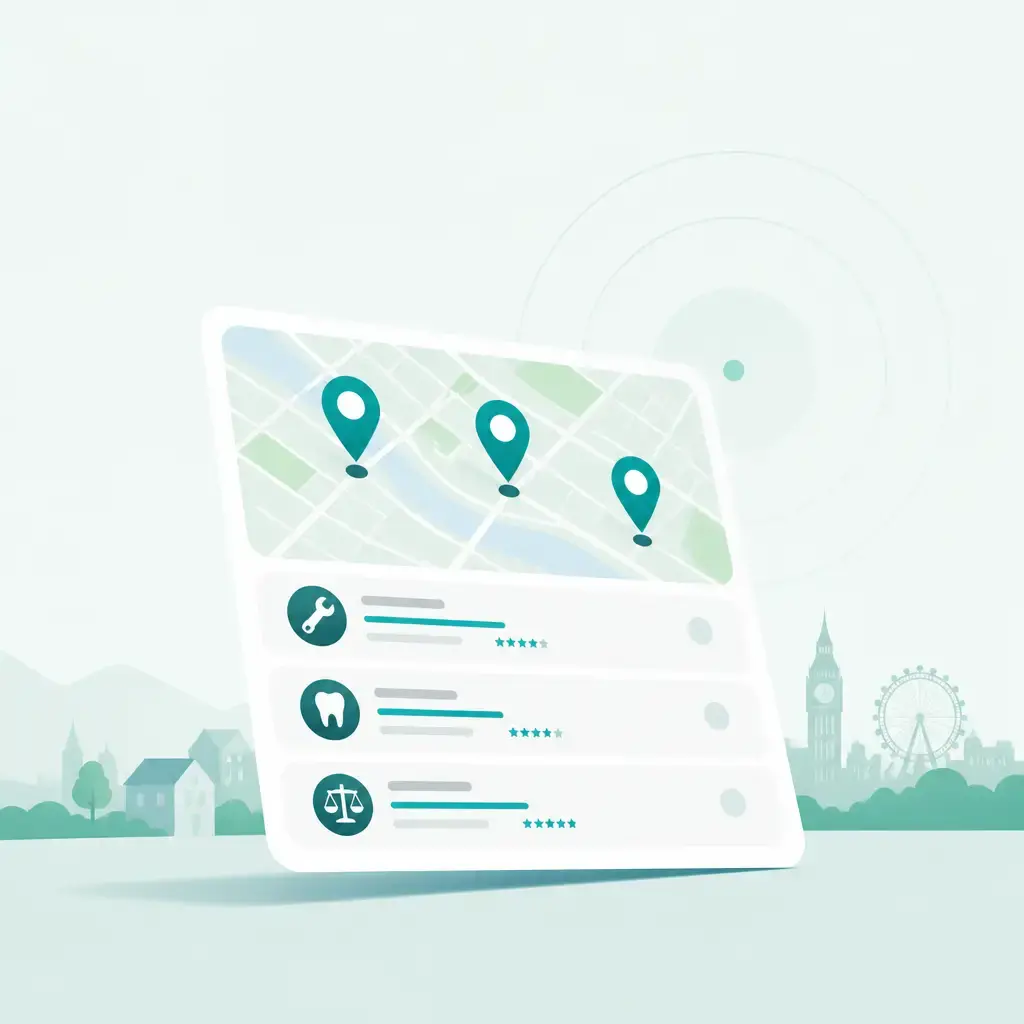
When someone searches "plumber near me" or "best restaurant in Manchester", three listings show up above every normal result. That block is Google's Map Pack, and it's the most fought-over space in local search. The businesses that hold those three spots tend to win most of the clicks, calls and bookings in their area. Everyone else is more or less invisible at the exact moment a customer is ready to act.
This is the heart of local SEO for service businesses: getting into that pack, and now showing up in the AI-generated answers that are starting to sit alongside it. Below is how the Map Pack actually works, the signals Google weighs, why reviews are climbing in importance, and the practical steps you can take to become the obvious choice in your city.
Key takeaways
- The Google Map Pack shows three local listings and runs on its own algorithm, so you can rank well in normal search and still be missing from it.
- Google judges local results on three things: proximity, relevance and prominence. Strengthen all three or you'll get outranked.
- Your Google Business Profile is the single biggest lever, accounting for roughly 32% of Map Pack ranking weight according to Whitespark, and your primary category is the most important individual factor.
- Review signals now make up 20% of local pack ranking weight (up from 16% in 2023), and 97% of consumers rely on reviews when choosing a local business.
- Consistent name, address and phone details across the web, plus citations, build the trust signals that feed both the Map Pack and AI search.
What local SEO actually means for a service business
Local SEO is about getting your business to show up prominently when people search within a specific area. Broad organic SEO chases audiences across the whole web. Local SEO narrows in on people who are physically nearby or deliberately searching within a set geography.
For service businesses, that's gold. Law firms, contractors, healthcare providers, dental practices, consultants: when someone searches for what you do near them, they're usually ready to call, book or buy. There's very little tyre-kicking. That's why local intent searches are the highest-quality demand most service businesses can get.
According to BrightLocal's guide to Google's local algorithm, Google weighs three core factors on every local query:
- Proximity: how close your business is to the person searching.
- Relevance: how well your business matches what they're actually looking for.
- Prominence: how well-known and trusted you appear, based on reviews, citations and your wider online presence.
Proximity is the one you can't change much. You are where you are. But relevance and prominence are very much in your control, and that's where the work pays off. Businesses that strengthen all three consistently outrank competitors in both the Map Pack and the newer AI answer panels.
If you're running a UK service business, the principles map across cleanly. Swap "plumber near me" for the same search a customer in Manchester, Leeds or Bristol would type, and Google is making the same calculation about who to show.
How the Google Map Pack works in 2025 and 2026
The Map Pack, also called the Local Pack, shows three business listings at the top of results for searches with local intent. Each one displays the business name, star rating, address, phone number, opening hours and a link to the Google Business Profile.
Here's the part most people miss. According to Search Engine Land's guide to the Google Local Pack, the Map Pack runs on a separate local algorithm that weighs signals differently from the standard organic index. You can rank brilliantly in normal organic search and still never appear in the Map Pack. The reverse is true too. So the Map Pack needs its own dedicated strategy, not the leftovers from your general SEO.
The Whitespark Local Search Ranking Factors report, the most thorough annual survey of local SEO experts in the industry, names Google Business Profile signals as the biggest single driver of Map Pack visibility, accounting for roughly 32% of local pack ranking weight. After that come review signals, on-page signals, link signals, behavioural signals and citation signals. The lesson is blunt: if your strategy doesn't start with your Google Business Profile, you're building on half a foundation.
Why a separate strategy matters
Think of it as two different competitions running at once. Your website competes in the organic listings below the pack. Your Google Business Profile competes inside it. They feed each other, but they're scored differently. A common mistake is pouring everything into the website and treating the profile as a tick-box exercise. For a service business chasing local calls and bookings, that's backwards. The pack sits higher on the page, gets more eyeballs, and converts the people who are ready to act.
Optimising your Google Business Profile for Map Pack rankings
Your Google Business Profile is the most direct lever you have. A fully sorted profile tells Google your business is active, credible and relevant to the searches you want to win. According to BrightLocal's local algorithm and ranking factors guide, your primary business category is the single most important individual local SEO ranking factor for the Map Pack. Get that right first, then work through the rest.
Primary business category
The primary category tells Google exactly what you do and decides which searches you're even eligible to show up for. Pick the most precise option available, not the broadest.
A personal injury law firm should choose "Personal Injury Attorney", not the wider "Lawyer". A children's dental practice should choose "Pediatric Dentist" rather than just "Dentist". The more specific you are, the better Google matches you to the searches that produce your highest-value leads. A vague category dilutes you across queries you don't really want and waters down the ones you do.
Name, address and phone (NAP)
Consistent name, address and phone details across your profile, your website and every directory listing is a foundational requirement. Inconsistencies create conflicting signals and chip away at Google's confidence in your listing.
Check that your business name appears exactly as it does in the real world, your address matches the format on your website, and your phone number is a local number rather than a toll-free or non-geographic line. Even tiny differences matter. "St" versus "Street" can introduce citation inconsistencies that drag on your rankings. It sounds pedantic because it is, but Google rewards the consistency.
Description, services and ongoing activity
Write a proper business description that explains what you do, which city or region you serve, and what sets your service apart. Then use the Services section to list your individual offerings, each with its own description. Every service entry is a relevance signal for a specific local search.
Don't set it and forget it. Regularly uploading photos and publishing Google Posts signals active management, and the Whitespark report flags that as a growing behavioural engagement signal in 2026. A neglected profile with no new photos in two years tells Google something. So does one that's clearly being looked after.
If you want a fuller walkthrough of the profile itself, our piece on what a Google Business Profile is and why your local business needs it covers the setup side in detail.
Review signals: the fastest-growing local SEO ranking factor
Reviews aren't just social proof any more. They're a measurable ranking signal, and their weight is climbing. According to BrightLocal's guide to Google's local algorithm, review signals now account for 20% of local pack ranking weight, up from 16% in 2023. That jump reflects Google leaning harder on authentic user-generated signals to judge how good a business really is.
The human side backs it up. The BrightLocal Local Consumer Review Survey reports that 97% of consumers rely on reviews when evaluating local businesses, and 88% would choose a business that responds to all its reviews over one that doesn't respond at all. Those behaviours shape the click-through and engagement signals Google measures as part of prominence scoring. In other words, replying to reviews isn't just good manners. It nudges the metrics that decide your ranking.
A disciplined review approach covers four things:
- Volume and velocity. Keep generating new reviews through systematic requests after each job, by email or SMS. Recency matters. A steady trickle of fresh reviews beats a big pile of old ones.
- Keyword context. Encourage customers to mention the specific service and location in their review. A review that says "emergency pipe repair in Austin" carries far more local relevance than a generic "great service".
- Response cadence. Reply to every review, good or bad. Responses signal active management and reinforce the prominence signals that govern the pack.
- Platform diversification. Prioritise Google reviews, but build presence on Yelp, industry-specific directories and wherever your customers actually hang out.
A practical review system, not a one-off push
The businesses that win here treat reviews as a process, not a campaign. The moment a job is done and the customer is happy is the moment to ask. Wait a week and the goodwill cools. The simplest version is an automated message that goes out after every completed job, with a direct link to your Google review page so there's no friction. This is exactly the sort of repetitive admin worth handing to AI-driven business automation so it happens every single time without anyone remembering to do it.
One caution. Don't game it. Don't buy reviews, don't gate negative ones, and don't fire off a hundred requests in a single afternoon. A sudden spike looks unnatural and can do more harm than the reviews do good. Steady and genuine wins.
Citations and NAP consistency across the web
Citations are mentions of your business name, address and phone number across directories, data aggregators and third-party platforms. They remain an important trust signal, and they're becoming more significant for AI search visibility specifically.
The Whitespark report notes that citation signals now rank as the third most important category for AI-based local discovery, even though their relative weight in the traditional Map Pack has fallen compared with Google Business Profile and review signals. So there's a split worth understanding: for the classic Map Pack, citations matter less than they used to, but for the AI answers Google and others are increasingly serving, they're climbing back up the list.
The practical job is consistency. Your name, address and phone need to match everywhere they appear. Conflicting versions across directories confuse the systems trying to verify you exist and are who you say you are. Prioritise the core directories first, get them accurate and identical, then work outward into industry-specific ones.
How AI answers are changing local discovery
The search results page isn't just ten blue links and a map any more. AI-generated answers are increasingly pulling together responses to local queries, and they draw on the same underlying signals: your profile, your reviews, your citations and the consistency of your information across the web.
What's notable from the Whitespark data is that citations punch above their weight for AI discovery while sitting lower for the traditional pack. That tells you something about how these systems work. They're cross-referencing mentions of your business across many sources to build confidence in what you are, where you are and whether you're trustworthy. The more consistent and widespread your footprint, the easier you are to surface in a generated answer.
If you want a broader view of how AI search is reshaping organic visibility, our take on how AI search optimisation tools can grow your organic traffic sits alongside this nicely.
The good news for service businesses is that you don't need a separate AI strategy bolted on top. The foundations that win the Map Pack, an accurate and active Google Business Profile, a steady flow of genuine reviews, and consistent details across the web, are largely the same foundations that get you cited in AI answers. Do the unglamorous groundwork well and you're covering both at once.
Putting it together: a sequence that works
Here's the order most service businesses should tackle this in.
- Nail your primary category. It's the most important individual factor for the Map Pack, so get it as specific and accurate as possible before anything else.
- Fix your NAP everywhere. Make your name, address and phone identical across your profile, website and directories. Hunt down the "St" versus "Street" inconsistencies.
- Fill out the profile properly. Detailed description, full services list with descriptions, real photos, and a habit of posting updates.
- Build a review engine. Systematic post-service requests, replies to every review, encouragement to mention the service and location, and presence beyond Google.
- Sort your citations. Get the core directories accurate and consistent, then expand into industry-specific ones, with an eye on AI visibility.
None of this is a single push. It's ongoing. The businesses that hold those three pack spots month after month are the ones treating local SEO as a continuous practice rather than a project they finished once. If your website also needs to keep pace, with content, structure and the technical health that supports all of this, ongoing website maintenance keeps the foundations solid while you focus on the local signals.
A realistic word on competition
Three spots. That's all there is in the pack. In a busy category in a busy city, the competition is fierce, and proximity means a searcher across town may see a different pack to one round the corner. You won't win every search. What you can do is make sure that for the searches that matter most, in the area you actually serve, your relevance and prominence signals are stronger than the businesses next to you.
That comes down to discipline. The right category, clean and consistent details, a genuine review habit, an active profile and a tidy citation footprint. None of it is flashy. All of it compounds. And because the same signals now feed AI answers as well as the classic pack, the work is more durable than ever.
If you'd like help getting your local search and wider SEO working harder, our SEO and paid advertising team can audit where you stand and build the plan to get you into the pack and the AI answers in your market.
Frequently asked questions
What's the difference between the Map Pack and normal Google results?
The Map Pack is a block of three local business listings at the top of the page for searches with local intent, showing name, rating, address, phone, hours and a link to the Google Business Profile. It runs on a separate local algorithm, so you can rank well in standard organic search and still not appear in the pack, and vice versa. It needs its own strategy.
How important are Google reviews for local SEO?
Very. Review signals now account for 20% of local pack ranking weight, up from 16% in 2023. On top of that, 97% of consumers rely on reviews when choosing a local business, and 88% prefer a business that replies to all its reviews. Reviews drive both your ranking and your conversion rate.
Which is the single most important factor for the Map Pack?
Your Google Business Profile is the biggest single driver overall, at roughly 32% of local pack ranking weight. Within that, the primary business category is the most important individual factor, so choose the most specific category that describes what you do.
Do citations still matter for local SEO?
Yes, though their role is shifting. Their weight in the traditional Map Pack has fallen compared with profile and review signals, but they now rank as the third most important category for AI-based local discovery. Consistent name, address and phone details across directories remain a key trust signal.
Related articles


Related services
Need a hand with this? Here's how IceBoxDesigns can help.